

Fully recovering Australia’s threatened species would cost 25% of GDP. We can’t do it all at once – so let’s start here
- Written by: April Reside, Lecturer in Conservation, The University of Queensland
Australia has already lost at least 100 species since European colonisation. Across land and freshwater habitats, 1,657 species are currently threatened with the same fate. Their populations have fallen 2-3% every year over the last quarter century.
The accelerating loss of species is one of the greatest environmental challenges of our time. Losing biodiversity threatens cultural values, economic stability and society’s wellbeing.
Like many nations, Australia has pledged to stem these losses. We have signed international commitments to restore nature and halt species extinctions.
These are noble and necessary goals. But at present, we lack an understanding of the sheer size, range of options – and expense of the challenge.
In our new research, we estimate the costs of bringing Australia’s threatened species back to their potential ranges. Rather than being limited by current spend on conservation, we calculated what it would cost to fully recover Australia’s threatened species across their viable range.
Our cost models are designed to also be used at different resolutions and scales, from small urban parks up to landscape scale. We found the costs vary greatly, from very low to more than A$12,600 per hectare for areas where intensive efforts such as habitat restoration through tree planting and weed removal would benefit species.
To undo all the human-induced damage and bring nature roaring back across their viable continental range would come with a staggering cost – A$583 billion per year, every year, for at least 30 years. That’s 25% of our GDP.

This, obviously, is infeasible. But it shows the extent of 200 years of human impacts on nature in Australia.
Importantly, it is a cautionary tale for what further damage will cost to repair. And – more positively – it gives us a way to cost and plan for species recovery at local or regional levels.
 The endangered Condamine earless dragon (Tympanocryptis condaminensis) is threatened by habitat loss.
Oscar Dash, Author provided (no reuse)
The endangered Condamine earless dragon (Tympanocryptis condaminensis) is threatened by habitat loss.
Oscar Dash, Author provided (no reuse)
Australian biodiversity – globally significant, widely threatened
Of the world’s 195 nations, just 17 are mega-biodiverse – nations with very high numbers of species found nowhere else. Australia is one of them.
Unfortunately, feral predators, clearing for agriculture, widespread change to Indigenous fire regimes and other human impacts have caused among the greatest biodiversity losses on the planet in recent history.
Unsurprisingly, the need for species recovery are greatest – and most expensive – in the east and south-west of Australia, where impacts on biodiversity have been most significant. Tackling threats in these regions is particularly challenging and costly.
 This shows the cost of implementing these repair strategies compared with the number of threatened species in a region. Paler areas denote lower cost and fewer species, dark purple denotes high cost and a greater number of species.
Author provided
This shows the cost of implementing these repair strategies compared with the number of threatened species in a region. Paler areas denote lower cost and fewer species, dark purple denotes high cost and a greater number of species.
Author provided
Previous estimates of the cost of recovering these species are orders of magnitude smaller. That’s because these estimates tended to focus on preventing extinction, rather than achieving full species recovery. Many previous estimates also excluded key expenses such as planning, labour and contingencies.
Why is full recovery so expensive?
Full species recovery would require widespread action across most of the continent, especially to manage fire, weed species and invasive predators (cats and foxes) and herbivores (rabbits, deer and more).
We were surprised to learn that the single most expensive measure across the continent wasn’t replanting native habitat or controlling cats and foxes. It’s tackling invasive weeds, such as blackberry and lantana.
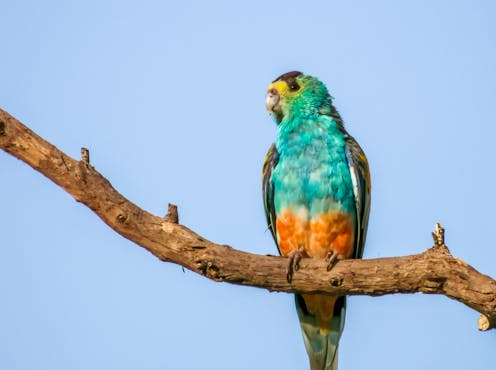
At least 470 plant species are threatened by invasive weeds. The worst are “transformer” weeds – vigorous species such as invasive buffel and gamba grasses able to smother entire habitats, out-competing native plants and stopping seed-eating birds, such as the golden-shouldered parrot, squatter pigeon and black-throated finch, from finding food.
Controlling weeds accounts for 81% of our total costs. This is because weeds cover such large areas of Australia.
 The endangered waddywood (Acacia peuce) is a rare acacia endemic to central Australia. Adverse fire regimes and livestock grazing are key threats.
Eric Vanderduys, Author provided (no reuse)
The endangered waddywood (Acacia peuce) is a rare acacia endemic to central Australia. Adverse fire regimes and livestock grazing are key threats.
Eric Vanderduys, Author provided (no reuse)
We acknowledge that full recovery of all of Australia’s threatened species at a continental scale is financially, technically and socially unfeasible. Policymakers need to balance nature restoration with other priorities.
Importantly, recovery actions must take place in a collaborative manner, with First Nations custodians and other land managers and stakeholders.
Bite-sized efforts for nature
Reversing Australia’s trajectory of biodiversity decline will require a range of different efforts across all regions and sectors. It’s important to clearly see the scale of the challenge we face – not to make it insurmountable, but so we can take steps in the right direction.
Our research offers bite-sized ways for organisations, environment groups and governments at all levels to take steps towards the repair of our species and native ecosystems. It provides digestible, local-scale options useful for planners, as well as important (and doable) actions that provide the most benefit threatened species for the resources available.
For example, some recovery efforts are relatively inexpensive per hectare and crucial for native species survival, such as reintroducing ecological burning regimes, and controlling cats and foxes. These type of efforts are often higher priority.
This is exactly what’s being done at Pullen Pullen Station in southwest Queensland, where feral cat control and better fire management are safeguarding the tiny populations of the night parrot – long thought extinct.
 Feral cat control and better fire regimes have helped the night parrot (Pezoporus occidentalis) survive.
Bruce Greatwich/Broome Bird Observatory
Feral cat control and better fire regimes have helped the night parrot (Pezoporus occidentalis) survive.
Bruce Greatwich/Broome Bird Observatory
How recovering threatened species helps us too
Funding the restoration of nature is good not just for threatened species, but for us as well.
Restoring nature takes a huge effort, which means it would, for instance, involve up to one million people working full time for 30 years. Many of these jobs would be in rural and regional communities.
If implemented collaboratively, farmers could benefit greatly. For farmers, weeds and introduced animals such as mice and rabbits are a constant thorn in their side.
Introduced animals and plants cost billions each year. In the past, many weed-control programs have been done to benefit agriculture, as weeds can also sicken or kill livestock.
Restoration of habitat would, we estimate, store an extra 11 million tonnes of carbon each year, helping Australia towards net zero.
If successful, these efforts could reverse the long-term damage done to our native species and help create new, more sustainable and biodiverse pathways for Australia’s future.
 Invasive weeds such as Paterson’s curse can be dangerous to native animals as well as livestock.
cbpix/Shutterstock
Invasive weeds such as Paterson’s curse can be dangerous to native animals as well as livestock.
cbpix/Shutterstock
We hope our work helps governments and other organisations see what’s possible and necessary when setting goals for nature and to guide nature related decision making.
The worsening plight of Australia’s biodiversity poses a direct and costly threat to meeting conservation targets. And the most cost-effective action is to avoid further damage.
We depend on nature and nature depends on us. We need to find new solutions for enabling social and economic progress without further harm to our natural world.
Authors: April Reside, Lecturer in Conservation, The University of Queensland


















