

Five ways to make aviation more sustainable right now
- Written by: Mark Maslin, Professor of Natural Sciences, UCL
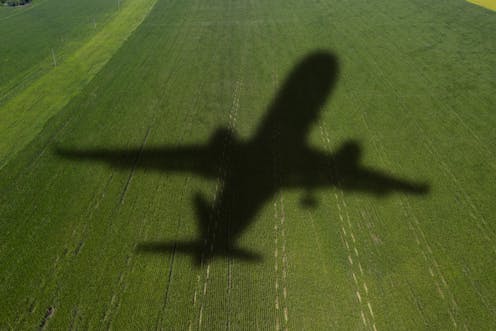
Many of us feel guilt when we fly because it is a very obvious source of carbon emissions. Aviation causes around 2.5% of global greenhouse gas emissions. But we do not perhaps feel the same guilt when we walk into a new building, even though global concrete manufacture emits closer to 8%. Or when we jump in a petrol car or turn on our gas central heating.
This is because aviation is a very visible symbol of our high-carbon consumption and, until now, the aviation industry has been slow to engage with the climate change agenda. According to the UN, we are looking at global warming of up to just over 3˚C which would be disastrous for the planet and our societies.
Human-caused global warming has just nudged passed 1.5˚C. But science suggests that we could keep close to this temperature increase if we reduced global emissions by 45% by 2030 and reached net zero by 2050.
Post-COVID, aviation continues to regroup and grow and is set to be a trillion dollar industry by 2030, but it is incredibly vulnerable to the effects of climate change. Clear air turbulence events in the North Atlantic have increased by 55% since 1979, and prominent incidents have resulted in deaths, serious injury and damage to aircraft.
Extreme weather events are not just confined to there, with extreme rains and flooding affecting Middle Eastern airports and snowfall crippling UK airports causing considerable disruption.
While aviation is a relatively small contributor to global emissions, the industry is predicted to grow at 4% per year for the foreseeable future. Without meaningful action, net zero by 2050 will never be achieved. New generations of technology coming on-stream are not yet proven nor implementable, and aviation needs to reduce its carbon footprint now.
These five key steps focus on not only decarbonisation but make aviation more sustainable while also improving operational efficiency and safety.
1. Optimise flight planning and airspace
Airlines already try to select the most fuel-efficient routes and altitudes using advanced flight planning systems, AI, and optimisation software. However, future route optimisation could reduce turbulence events and the production of contrails with associated radiative forcing, increasing comfort and safety for passengers as well as contributing positively to the environment.
Optimising aircraft separation and air traffic control flow management can prevent aircraft bunching up and arrival delays because planes are forced into holding patterns, waiting their turn to land at the airport, carrying and burning large amounts of fuel.

2. Make operations more sustainable
The latest generation of commercial aircraft utilises advanced aerodynamics and engine technology, which saves a significant amount of fuel and emissions from previous types.
Airlines must invest in modern fuel-efficient aircraft as their expansion plans evolve. In the meantime, they can retrofit existing aircraft to improve efficiency by adding winglets to reduce induced drag and introducing new aircraft cabins, which save weight to improve efficiency.
Airlines and airports can also optimise weight and centre of gravity by reviewing the distribution of cargo and passengers to maximise efficiency, as well as using renewable energy to replace auxiliary power units on the ground and improving noise and air quality.
3. Switch to sustainable fuels
The biggest source of emissions within the aviation industry remains the burning of kerosene. Airlines need to transition from conventional to sustainable aviation fuels (SAF) over an agreed timescale with equitable access. SAFs cover a whole range of technology from biofuels derived from plants, animals or waste to synthetic fuels such as artificial kerosene.
Depending on which type of SAF is used, they could lower CO₂ emissions by 20–98% compared to conventional fuel. The quality, reliability and the supply of SAFs needs to be ensured and secured.
4. Make airports more eco-friendly
Airports can become much more sustainable by using renewable energy, such as solar or wind energy, for airport operations, including powering the terminals and equipment. Renewable energy can be used for ground equipment and airplane support, by having electric airplane tugs, baggage loaders and catering trucks, for example.
It is possible to improve ground operations to reduce emissions such as minimising aircraft engine idling time during taxiing and using reduced engines for taxiing around the airport.
The industry has an exciting opportunity to design and develop the next generation of sustainable airports. There are 575 existing or new airport projects around the world at a total value of US$488 billion, (£395 billion) with many more planned over the next two decades.
5. Smart travel
The aviation industry can make passengers more sustainable by redefining the passenger experience from door to door, not just the time spent at the airport or on a plane. This could include luggage pickup from your home and incentives to use public transport to the airport.
Support to reduce luggage weight can be implemented by basic essentials (such as toiletries) or heavier equipment such as skis, ski helmets and golf clubs being provided at the end destination instead of everyone having to pack them.
Read more https://theconversation.com/five-ways-to-make-aviation-more-sustainable-right-now-245441


















