

Enough 'gotcha' campaign coverage. Here are five ways the media can better cover elections
- Written by Rodney Tiffen, Emeritus Professor, Department of Government and International Relations, University of Sydney
The key to understanding media coverage of election campaigns is that the political parties are far more professional than the news organisations.
The reason is simple: for political parties, elections are make or break, determining their fate for the next three years; for the media, an election is just another story, admittedly a long-running and important story, but not an organisation-transforming event.
Because the parties have a clear aim and measure of success, each campaign is a learning experience. Although there are electoral ups and downs, their overall trajectory is towards constant improvement. The resultant professionalism is, of course, not often conducive to a healthier democracy, but it is dynamic.
In contrast, there seems to be little learning among the news media about how they might cover elections better.
I’ve identified five weaknesses in the approach of most mainstream media. I am highlighting here tendencies in the approach to news coverage, rather than, for example, the blatant and unrelenting partisan bias of News Corp publications. And obviously, both news organisations and individuals vary in the quality of their reporting.
1. Follow the leader
Media coverage of elections – especially television coverage – has always been leader-focused. This is logistically convenient and feeds into the narrative of a gladiatorial contest. But if this is the main news effort, it will always result in fairly circumscribed coverage.
At times, media outlets devote time to covering certain high-profile electorates, such as Warringah in this year’s election. Occasionally, some back-bencher or candidate will make the news, normally in an embarrassing way, as a result of digging by the other side’s “dirt unit” rather than any media initiative. But even then, the focus is on the leader’s response.
Read more: Outrage, polls and bias: 2019 federal election showed Australian media need better regulation
We live in a parliamentary rather than presidential democracy, in which the good functioning of the cabinet is central to a government’s effectiveness. Instead of focusing so obsessively on the leaders, the media should give more attention to the whole front bench.
While there was much outcry about whether there would be a third leaders’ debate in this campaign, a much higher media priority should have been to demand ten minister-vs-shadow-minister debates about issues in each portfolio. These would not only have more substance than the leaders’ debates, they’d provide a much stronger guide to each party’s policy directions, and the competence of each team to govern.
In this campaign – but not always – this would have arguably favoured Labor, with Scott Morrison receiving support from so few Coalition ministers (Josh Frydenberg, Simon Birmingham and almost no others). It is amazing, for instance, that the environment could be such a central issue, but the environment minister, Melissa Price, was simply unavailable for any interviews.
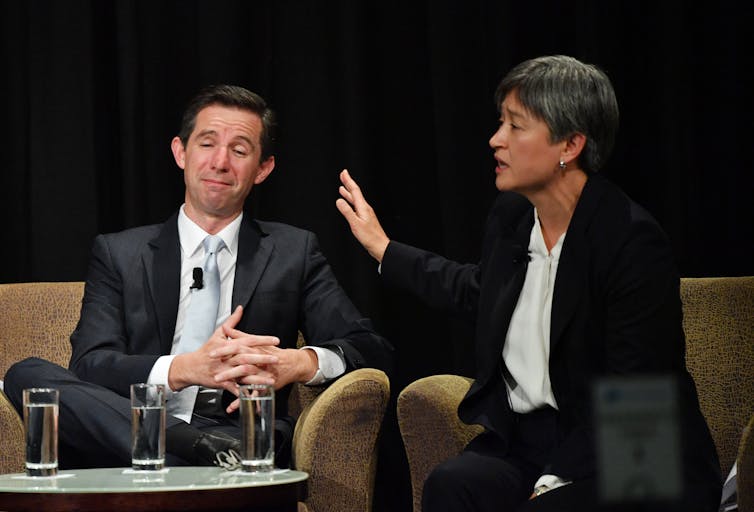 There should be more election debates between ministers, such as this year’s spirited panel in South Australia featuring Penny Wong and Simon Birmingham.
David Mariuz/AAP
There should be more election debates between ministers, such as this year’s spirited panel in South Australia featuring Penny Wong and Simon Birmingham.
David Mariuz/AAP
2. Conniving in meaningless figures
The political parties use statistics to impress, to alarm, and nearly always to bamboozle. With the honourable exception of the fact-checking teams, most media tend to either pass numbers on uncritically or have an indiscriminate suspicion of them – lies, damned lies and statistics.
The numbers cited in campaigns are usually so great and so remote from most peoples’ experience that they have little meaning. People generally do not know the size of the country’s labour force, the amount of government spending in any particular area, or the size of the economy.
A first step in making statistics meaningful for the public would be to contextualise them as proportions, and to perhaps offer some comparisons.
The situation has reached peak stupidity in recent campaigns. To go beyond the limits of annual sums, the idea of the forward estimates - the budget projections for revenue and expenses over a four-year period – was introduced. Conveniently for the parties, this was a year beyond the next election.
Then, former prime ministers Kevin Rudd and Julia Gillard escalated the tendency to project, for example, promising big increases in education spending, but with the largest amounts kicking in just beyond the forward estimates. The Morrison government has escalated the trend even further with ten-year estimates of its tax cut plan – a forecast that must involve so many assumptions, it is fanciful.
The proper use of statistics is an indispensable tool in evaluating policy performance. As such, and the media need to develop protocols for keeping the parties accountable in their use of figures.
Read more: A matter of (mis)trust: why this election is posing problems for the media
The media should report primarily what the promise will mean for the next budget year and the next period of government, and should either ignore or downplay estimates beyond this, or at least give warnings about the unreliability of more distant projections.
Raw sums should also be supplemented by percentage amounts. And when funding pledges are made, the media should always ask how much of this money is new and whether it comes at the expense of an existing program.
3. The polls were so unanimous, so consistent and so wrong
The 2019 election was disastrous for the pollsters. Not only were the polls tightly clustered, not a single poll in the past two years had found the Coalition scoring 50% or better of the two-party preferred vote.
Some commentators found the degree of clustering so unusual, they suspected there was some herding by pollsters, aligning their published results with the apparent consensus.
The spectacular failure of the pollsters is not the fault of the media who commission them. But as the pollsters’ major clients, they must demand a thorough review of methods. Are the sampling frames still adequate? Are they relying too much on weighting the results?
Read more: Here's how to make opinion polls more representative and honest
The media themselves can also aid in one important way. Having paid for the poll, they want a strong story to result. As a result, they are tempted to impose a misleading certainty on the flux of public opinion.
There needs to be both in the presentation and interpretation of polls more attention to lack of opinion, to those respondents who say they haven’t decided. The softness of opinion and how it is resolved may be crucial in affecting an election result.
4. History starts today
A common, but somewhat misplaced criticism, of the media is that they cover elections like horse races. But in addition to this, the media need to develop strategies for making election campaigns meaningful policy debates.
Political leaders everywhere have become increasingly adept at evading questions, at mastering and surviving the televised moment, with any problems in their claims only catching up to them later and to a much smaller audience.
The most convenient way for the media to cover policy pronouncements by the parties is as duels over alternative futures. If the parties are allowed to frame the debate, the benefits of their policies are often overstated and the costs and difficulties understated.
This is abetted by the media’s tendency to cover such promises in a vacuum. When politicians talk about future policy, the media rarely take the initiative to explore the extent and effectiveness of existing policy. Too often these debates are conducted as if no history has preceded them.
Good governance is about deciding priorities, weighing costs and benefits. But the media often want to play “gotcha” in their election coverage, as if policies are cost-free and have no losers. As long as this continues, there will be a disconnect between politicking and governing – and politicians will be rewarded for avoiding realistic debate.
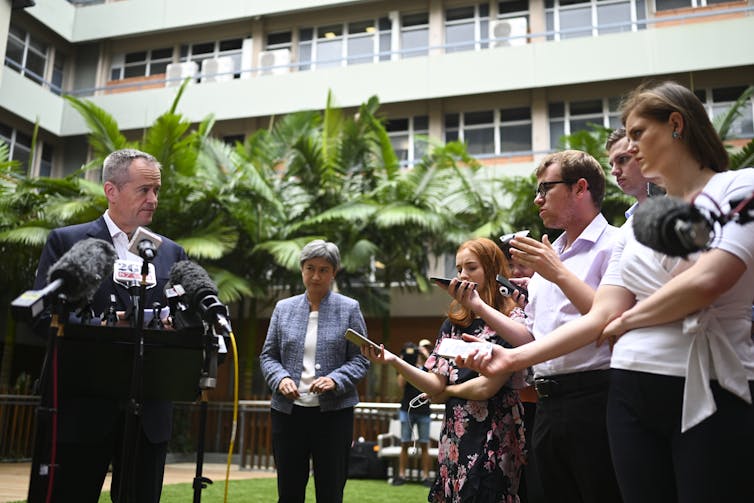 Opposition Leader Bill Shorten fronting the media during a press conference at Cairns hospital this month.
Lukas Coch/AAP
Opposition Leader Bill Shorten fronting the media during a press conference at Cairns hospital this month.
Lukas Coch/AAP
5. Superiority signaling
Virtue signalling, a recently coined phrase much in favour among right-wing commentators, means the conspicuous expression of moral values, intended more to show someone’s righteousness than to have any substantial effect.
We need a similar phrase – superiority signaling - to describe how the media position themselves as above the fray in their election coverage, substituting posturing for performing their role. Many times, they are overly concerned with signaling their impartiality, but in ways that do not further inform the public.
One way journalists do this is by opting for balance rather than truth. Reporting stories in a “he said, she said” fashion appears to be impartial, but leaves the audience little wiser. Another manifestation is “bothsides-ism.” Here, journalists highlight their neutrality by criticising both sides as if they are equivalent (which they sometimes are). But if they stop here and fail to probe further, the public learns little.
Another common way journalists signal their superiority is through their disdain for a boring campaign, as if this is the fault of the politicians, and not their own failure to make a campaign interesting. Politicians, after all, are not meant to be reviewed like Vaudeville entertainers.
After this election, the major parties will review their strategies. The process will certainly be less than objective – especially in the blame game among the losers – but they will be thinking about what they can do differently next time. It would be nice to think the media will undertake a similar exercise, with a focus on how they can improve in ways that enhance democratic choice and accountability.
Authors: Rodney Tiffen, Emeritus Professor, Department of Government and International Relations, University of Sydney

















