

World-first study reveals the mysteries of the desert-dwelling marsupial mole
- Written by: Charles Feigin, Lecturer in Genetics & Evolutionary Biology, La Trobe University
Hidden beneath the dunes, a mysterious creature glides through the sand.
This is not one of the giant worms of Arrakis in Frank Herbert’s sci-fi epic, Dune. Rather, it’s an enigmatic and tiny mammal found only in the deserts of Australia – the marsupial mole.
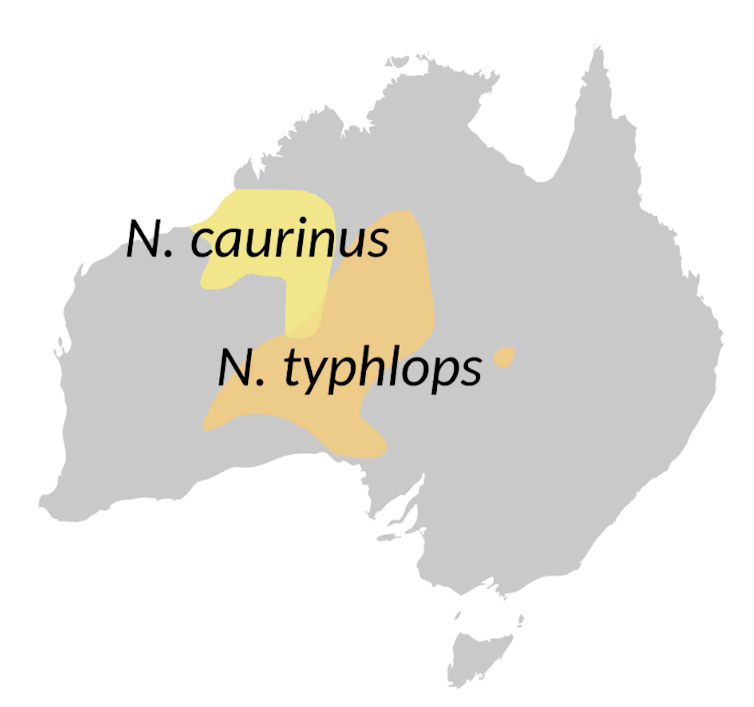
There are two related species of the marsupial mole.
Notoryctes typhlops, or southern marsupial mole, is found across the deserts of central and southern Australia. It is also also called itjaritjari by the local Indigenous Aṉangu peoples. Notoryctes caurinus, or the northern marsupial mole, is found in the deserts of northwestern Australia. It is also called kakarratul by the local Indigenous Martu people.
Until recently, these elusive animals have been nearly impossible to study. But our recent study in Science Advances has finally started to unravel the basis of their incredible “desert power”.
Rarely observed
Marsupial moles are small, about the length of a pencil, and weigh between 40 to 70 grams. They have a tubular body, yellow hair and limbs that barely protrude from their sides.
Rather than building permanent tunnels like their namesakes in the northern hemisphere, they “swim” through the loose sands of Australia’s deserts.
The subterranean lifestyle of marsupial moles, along with the vastness of the deserts they inhabit, means they are rarely observed. In fact, there are only a handful of sightings each decade.

New technologies, new insights
New DNA technologies can provide a window into the lives of cryptic species such as the marsupial mole that can’t be studied effectively in the wild.
To this end, our team worked with the Australian Biological Tissue Collection at the South Australian Museum to acquire two tiny tissue samples frozen more than a decade ago from a southern marsupial mole.
From these, we extracted extremely long fragments of DNA needed to produce a genome assembly. This is a digital representation of every base or “letter” that makes up the marsupial mole’s genetic code.
Because DNA contains both the instructions for how to make an organism’s traits and a record of its evolutionary history, we were able to glean remarkable insights into this cryptic species.
 Distribution of the southern and northern marsupial moles.
Jolly Janner, CC BY-SA
Distribution of the southern and northern marsupial moles.
Jolly Janner, CC BY-SA
Unique adaptations
Marsupial moles have a variety of unique adaptations that help them survive in their harsh environment. For example, their eyes are tiny and located beneath their skin, making them functionally blind.
By comparing the sequences of eye genes to those of related marsupials, we were able to show that marsupial moles first lost genes critical for the eye’s lens. This probably happened because a clear image isn’t very important underground.
This was followed by genes for colour-sensing cone cells in the retina. After the eye had lost considerable function, the last genes to degrade were the ones active in rod cells, important for low-light conditions.
In mammals living on the surface, these changes would likely be harmful. Yet, by occurring in the right order, the stepwise degradation of eye genes allowed the marsupial mole’s ancestors to change gradually without harming their fitness.
This is a beautiful illustration of how both adaptations and disorders can share a similar genetic basis, with the line between them being shaped by their context.
Other traits
Sequencing the genome allowed us to study other traits in marsupial moles.
For example, we showed that a key gene involved in testicles dropping during puberty is likely to have also degraded in this species. This may help to explain why male marsupial moles lack a scrotum and have their testes perched in their abdominal wall.
We also found that marsupial moles have two copies of a gene encoding haemoglobin – the molecule that carries oxygen in red blood cells. This is important because sand has low oxygen levels and poor air movement.
Moreover, this duplicated haemoglobin gene is typically used in newborn mammals.
The pouch of a marsupial is already a low-oxygen environment, so marsupial moles needed to evolve ways to avoid their young suffocating. Having more haemoglobin may help.
 Marsupial moles have a variety of unique adaptations that help them survive in their harsh environment.
Mike Gillam
Marsupial moles have a variety of unique adaptations that help them survive in their harsh environment.
Mike Gillam
Tracing the mole’s evolutionary heritage
For years the marsupial mole’s strange, specialised traits have frustrated attempts to determine precisely who its closest relatives actually are. But sequencing its genome has allowed us to trace its evolutionary heritage.
To do this, we examined a special type of DNA sequence called retrotransposons.
These are short stretches of DNA that can make copies of themselves that get randomly inserted across an animal’s genome and passed down through generations.
Our examination revealed marsupial moles are a sister group to bandicoots and bilbies, with carnivorous marsupials like the Tasmanian devil being distant cousins.
Long-term decline
Almost nothing is currently known about the population health of marsupial moles. However, deserts are among the ecosystems most threatened by climate change.
Given this, we also sought to glean the first insights into how marsupial mole populations have changed over time.
Using patterns of genetic diversity across the marsupial mole genome, we were able to show they have likely experienced a long-term decline in effective population size that began around 70,000 years ago. This corresponds with historical changes during the last glacial period, suggesting the decline was because of climate change rather than human actions.
It’s unclear precisely how genetic diversity lost over tens of thousands of years will affect the marsupial mole’s ability to continue its record of adaptation to extreme environments.
However, these findings highlight that new, more expansive efforts to study marsupial moles through genetic methods may be needed to ensure they aren’t lost to the sands of time like too many other Australian mammals.
Authors: Charles Feigin, Lecturer in Genetics & Evolutionary Biology, La Trobe University



















