

5 expert tips on how not to be branded a twit when using a beach tent
- Written by: Samuel Cornell, PhD Candidate, UNSW Beach Safety Research Group + School of Population Health, UNSW Sydney
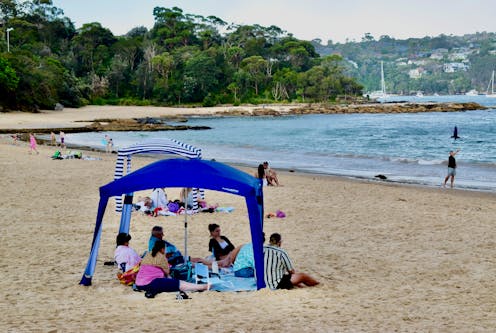
Debate erupted this week over the growing number of beach tents, or “cabanas”, proliferating on Australian beaches. The controversy, which began on social media, was fuelled by Prime Minister Anthony Albanese who declared it was “not on” for beachgoers to reserve a spot on the sand by erecting a cabana then leaving it vacant for hours.
Albanese told Nine’s Today show “everyone owns the beach” and staking a claim on the sand was “a breach of that principle, really”.
Other critics deem beach cabanas an eyesore. And lifeguards say the structures can obscure their view of the water, which poses a safety risk.
Beach cabanas do, however, serve a valid purpose. They provide some protection against the sun’s harmful ultraviolet rays and, from a recreational perspective, can enable people to spend longer at the beach on hot days than they might have otherwise.
I’m a member of the University of NSW Beach Safety Research Group, and I’ve worked with local councils and national parks to address health and safety issues on beaches. So let’s look at how to strike the right balance between personal convenience and public safety when using a cabana.
A fair go for all?
In years past, Aussies came to the beach with a towel and maybe a book, stayed a little while then left.
But more recently, the use of beach tents and cabanas has grown. It’s likely the result of Australia’s growing coastal population, and a rising awareness of the dangers posed by sun exposure.
These days, it’s not uncommon to visit a popular beach in summer and find a village of cabanas stretching as far as the eye can see.
It’s great to see so many people using the beach. Beaches and oceans are health-giving places, though they come with inherent dangers.
And of course, in Australia the beach is free for all who wish to use it. It’s an approach in line with our supposedly egalitarian culture, in which everyone gets a “fair go”. Here, beaches are a place to be shared, no matter what your income or social status.
The approach contrasts to many destinations in Europe, the United States and elsewhere, where large sections of beaches are reserved for private use. At Waikiki beach in Honolulu, for example, people pay US$100 or more to hire an umbrella and chairs, and a place on the sand for the day.
To some naysayers, cabana use in Australia challenges the notion that the beach is for everyone. They question whether people should be allowed to mark out beach territory no-one else can use. That’s why in 2020, a bid by a private company to introduce paid cabanas on Sydney’s Bondi Beach prompted a public outcry.
Cabanas bring practical challenges, too. They represent an unplanned influx of temporary infrastructure into busy public spaces. Left unchecked, they could cause pedestrian congestion and become a flashpoint for disagreement between beachgoers.
The current debate may prompt Australian beach authorities to consider bringing in cabana regulation, similar to what’s in place for some beaches in the US.
In the meantime, here are five tips for safe and fair use of beach cabanas:
1. Placement: Erect your cabana at the back of the beach and away from lifeguard towers or lifesaver tents to avoid obstructing lifeguards’ views. Clear sightlines to the water are essential for ensuring timely emergency responses. This positioning also leaves space closer to the water for other beachgoers, including children playing at the water’s edge.
2. Tying down: Secure your cabana firmly in the sand to prevent it from being blown away by strong winds. Flying cabanas are a danger to other beach users, potentially causing injuries and damage to property.
3. Spacing: Avoid overcrowding by maintaining two to three meters between structures. This ensures free movement and accessibility for all beachgoers, and ensures families and groups can enjoy the beach without feeling cramped. Also, stay within the boundaries of your cabana and don’t claim territory outside its boundaries.
4. Emergency access: Keep pathways and access points clear at all times. This is crucial for lifeguard vehicles, ambulances and surf rescue teams. Unobstructed access can make the difference between life and death in an emergency.
5. Common sense: As with using any shared space, consider the needs of others and apply common sense. How would you feel if someone set up a structure right in front of you, blocking your view of the waves or ruining your vibe? Or if you or a loved one needed medical attention on a beach, would you want an ambulance crew obstructed by an unbroken line of tents?
Looking ahead
In the past, some have called for a ban on beach cabanas. But the structures appear here to stay – and that’s not a bad thing. Skin cancer affects more young Australians than any other cancer, and the Cancer Council applauds the use of cabanas.
It’s important to note, however, that cabanas do not provide complete protection from UV rays. If you’re at the beach all day, you might still get too much sun even under a tent.
When it comes to your next visit to the coast, by all means pack your cabana. But make sure you use it carefully and responsibly, so everyone’s day at the beach is safe and enjoyable.
Authors: Samuel Cornell, PhD Candidate, UNSW Beach Safety Research Group + School of Population Health, UNSW Sydney


















