

New research reveals why sabre-toothed predators evolved their deadly teeth
- Written by: Tahlia Pollock, Postdoctoral Research Fellow, Evans EvoMorph Laboratory, Monash University
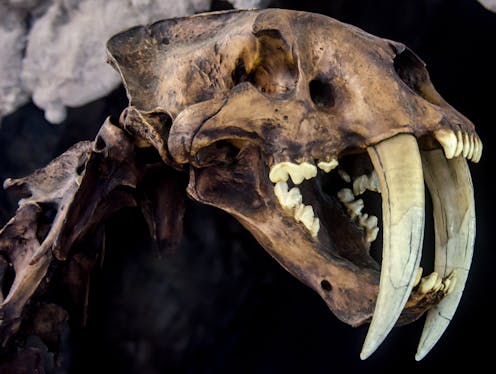
Sabre teeth – the long, sharp, blade-like canines found in extinct predators such as Smilodon – represent one of the most extreme dental adaptations in nature. They evolved at least five times throughout mammalian history and are a classic example of convergence, which is when similar structures evolve independently in unrelated animal groups.
With no living representatives, scientists have long debated how these predators used their fearsome teeth, and why this extreme tooth shape evolved so often.
Our new study, published today in Current Biology, provides an answer. We found extreme sabre teeth are functionally optimal, meaning their shape provided a real advantage as specialised weapons. Their slender and sharp forms were perfect for puncturing prey. However, this came at a cost: sabre teeth were also weaker and more prone to breaking.
These findings are important because they help us better understand how extreme adaptations evolve across nature. They also offer insights into optimal design principles that extend beyond biology into engineering and technology.
Sabre-toothed predators through time
Sabre-toothed predators once roamed ecosystems around the globe. Their fossils have been found in North America, Europe, Africa and Asia.
The feature that defines them are their sabres, a distinct type of canine tooth. These teeth are long, sharp, laterally compressed (flattened from the sides) and curved.
This is different to the short, robust, conical canines of modern big cats such as lions and tigers.

This iconic tooth is older than the dinosaurs. It first appeared around 265 million years ago in a group of mammal-like reptiles called the gorgonopsids.
Over millions of years, sabre teeth evolved repeatedly in different groups of carnivorous mammals, marsupial relatives like Thylacosmilus and “false” sabre-tooth cats such as Barborofelis.
The most well known sabre-toothed predator is Smilodon. It persisted until just 10,000 years ago.
You can look at a 3D model of one of these predators – Smilodon fatalis – below. This model has been digitised from a cast specimen from the Natural History Museum of Los Angeles County.
Based on extensive research into sabre-tooth ecology there is a general consensus that these predators primarily targeted large prey, delivering slashing bites to the soft tissue of the throat powered by strong neck muscles. It is thought that their teeth offered an advantage doing this, helping them to deliver the killing bite.
This idea is what we set out to investigate.
Testing the puncture-strength trade-off
Specifically, we tested whether their shape was an optimal balance between two competing needs related to tooth function. First, being sharp and slender enough to puncture prey effectively. Second, being strong and robust enough to resist breaking.
To investigate this, we conducted a large-scale analysis of more than 200 different carnivore teeth, including both extinct sabre-toothed species and modern animals.
First, we measured their 3D shape to show how sabre teeth compared to other carnivores. Then we tested how a subset of these teeth performed during biting via two experiments.
We 3D printed tooth models in stainless steel and drove them into a gelatine block (simulating prey flesh) to measure how much force was needed to puncture. We used metal replicas to prevent tooth bending during the experiment, ensuring accurate puncture force measurements.
We also ran engineering simulations to test how much stress different tooth shapes experienced under biting forces. This revealed their likelihood of breaking.
Finally, we conducted an “optimality” test to determine which tooth shapes struck the best balance between puncture efficiency and strength .
A 3D-printed sabre tooth being driven into a gelatine block to measure the force needed to puncture.Extreme sabre-tooth forms are optimal
It terms of sabre-tooth shape, our results challenge the traditional idea that these predators fell into just two categories: dirk-toothed, which are long and slender, and scimitar-toothed, which are short and laterally compressed.
Instead, we uncovered a continuum of sabre-tooth shapes. This ranged from extreme forms, such as the long, curved canines of Barbourofelis, Smilodon and Hopolophoneus, to less extreme forms, such as the straighter, more robust teeth of Dinofelis and Nimravus.
Our results reveal that the extreme sabre-toothed forms, like Smilodon, were optimised for puncturing prey with minimal force. However, they were more prone to breakage under high stress.
Less extreme sabre-toothed forms, such as Dinofelis, were also optimal but in a different way. They struck a more balanced trade-off between puncture efficiency and strength.
The fact that different sabre-toothed species evolved varying balances between puncture efficiency and strength suggests a broader range of hunting strategies than previously thought. This supports a growing body of research on their ecological diversity.
 Morphospace’ (visualisation of shape diversity) of sabre and non-sabre-tooth canines showing areas of optimal performance.
Miranta Kouvari & Melisa Morales/Science Graphic Design
Morphospace’ (visualisation of shape diversity) of sabre and non-sabre-tooth canines showing areas of optimal performance.
Miranta Kouvari & Melisa Morales/Science Graphic Design
A striking solution
These results help explain why extreme sabre teeth evolved so many times, likely driven by natural selection for an optimal design. They also provide a possible explanation for their eventual demise.
Their increasing specialisation may have acted as an “evolutionary ratchet”, making them highly effective hunters, but also more vulnerable to extinction when ecosystems changed, and their prey became scarce.
Our study also provides broader insights into how extreme adaptations evolve in other species. By integrating biomechanics with evolutionary theory, we can better understand how natural selection shapes organisms to perform specialised tasks.
The sabre tooth form represents a striking solution to a fundamental mechanical challenge, balancing efficiency with strength — one that is also reflected in human-made tools.
This trade-off between sharpness and durability is a key consideration in engineering, influencing the design of everything from surgical scalpels to industrial cutting blades.
Engineers developing precision tools, such as hypodermic needles or high-performance cutting instruments, can look to nature’s evolutionary solutions for inspiration, applying the same principles that shaped these prehistoric predators.
The author is currently working at the University of Bristol and acknowledges the generous support she received from them over the course of the research.
Authors: Tahlia Pollock, Postdoctoral Research Fellow, Evans EvoMorph Laboratory, Monash University


















