

Study shows hot leaves can’t catch carbon from the air. It’s bad news for rainforests – and Earth
- Written by: Kristine Crous, Senior Lecturer, School of Science and Hawkesbury Institute for the Environment, Western Sydney University
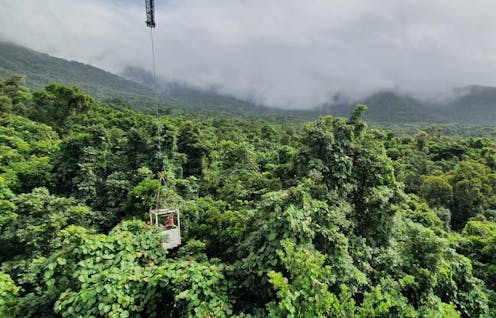
On the east coast of Australia, in tropical North Queensland, lies the Daintree rainforest – a place where the density of trees forms an almost impenetrable mass of green.
Stepping into the forest can feel like stepping back in time. It contains many ancient plant families dating back to the ancient supercontinent of Gondwana. The air is warm and thick with humidity, carrying the earthy scent of wet leaves and soil. Sunlight filters through the dense canopy in scattered beams, while ferns and seedlings carpet the forest floor.
The Daintree and other tropical rainforests, including those in the Amazon, the Congo Basin and Southeast Asia, have been called the “lungs” of our Earth. They absorb carbon dioxide from the air while releasing water vapour and oxygen via photosynthesis – the process by which plants take in carbon dioxide and fix energy.
Because of this, their leafy canopies play a crucial role in regulating the global climate – and mitigating global warming.
But our recent research shows that rising temperatures will severely affect the ability of tropical forests to photosynthesise. This will hinder their capacity to absorb carbon dioxide from the atmosphere, reducing their role in mitigating global warming and exacerbating climate change.
Coping with a rapidly changing climate
The ability of plants to adjust to different environments (also known as acclimating) is an important strategy for them to cope with a changing world.
Plants can dynamically acclimate to their environment. When warmed, they can adjust their photosynthesis to perform more efficiently at moderately higher temperatures. This allows them to maintain or even increase their carbon uptake under these new conditions.
However, tropical trees may have a limited capacity to acclimate to warming, because they have evolved under relatively stable climatic conditions. As a result, they are already near the upper limit of temperatures they can tolerate without suffering damage.

Warming the leaves of tropical rainforest trees
To test this theory, we set up an experiment in the Daintree rainforest focusing on tropical trees between 15 and 30 metres tall.
Using a canopy crane to access the treetops, we installed custom-made leaf-heater boxes to warm leaves from four mature tree species by 4°C – a temperature rise predicted for tropical systems by 2100.
Boxes were made from plastic takeaway containers with fishing wire to hold the leaf in place and a heating wire to heat the leaves. Leaf temperatures were measured throughout the experiment and a feedback control algorithm was used to maintain consistent heating.
The experiment lasted eight months, making it one of the longest running in-situ leaf warming experiments in a mature tropical forest.
By comparing the physiological responses of warmed leaves to the responses of non-warmed leaves, we were able to capture a realistic picture of how tropical tree leaves might respond to future climate warming.
 Scientists used custom-made leaf-heater boxes to warm leaves from four mature tree species.
Kristine Crous
Scientists used custom-made leaf-heater boxes to warm leaves from four mature tree species.
Kristine Crous
Warming reduces photosynthesis across all species
Our study found warming reduced photosynthesis across all species.
Photosynthetic rates dropped by an average of 35% in warmed leaves compared to non-warmed controls. This decline was driven by two key factors.
First, the leaf pores, called stomata, which allow carbon dioxide to enter and water to escape, became less open in response to the drier air around the warmed leaves.
Second, the warmer temperatures interfered with the enzymes essential for photosynthesis, reducing their ability to fix carbon.
Even after eight months of warming, the trees showed little ability to adjust to the higher temperatures. They did not improve their capacity to photosynthesise effectively at the elevated temperatures, nor did they shift the maximum temperature at which photosynthesis could be maintained.
This supports the idea that these trees may already be operating close to their thermal limits.
 At 4°C of warming, the leaves of slow-growing rainforest trees had a significantly reduced ability to photosynthesise.
Kali Middleby
At 4°C of warming, the leaves of slow-growing rainforest trees had a significantly reduced ability to photosynthesise.
Kali Middleby
Significant implications for the global water cycle
Our findings of reduced carbon uptake and decreased water loss due to stomatal closure under warmer temperatures align with the concept of a “weakened pulse” of water exchange in tropical systems.
This has significant implications for the global water cycle.
While stomatal closure can limit water released to the atmosphere, a drier atmosphere simultaneously extracts more moisture from trees, creating a complex dynamic.
The response of tropical forests to warming will undoubtedly affect the water cycle, but the overall impact remains uncertain.
Little room to adapt
Other studies have also pointed to detrimental effects of climate change on tropical ecosystems, including a warmer and drier atmosphere.
Lowland tropical environments are already near the physiological limits for photosynthesis. This leaves little room for trees to adapt to rising temperatures and drier conditions.
Combined with predictions of warming and drying from climate models, these studies point to less resilient tropical forests under climate change, weakening their role as the lungs of the Earth.
 There is little room for tropical rainforests to adapt to rising temperatures and drier conditions caused by climate change.
Michel Arnault/Shutterstock
There is little room for tropical rainforests to adapt to rising temperatures and drier conditions caused by climate change.
Michel Arnault/Shutterstock
Protecting rainforest biodiversity offers hope
However, the biodiversity of tropical rainforests offers some hope, as not all species are equally vulnerable.
Recent research shows fast-growing species are less affected by warming compared to slow-growing ones. While this is promising, it’s important to remember that species that live longer play the most significant role in long-term carbon storage.
These findings highlight the urgency of protecting tropical forests and limiting the magnitude of global warming by carbon dioxide emissions.
Conservation strategies should focus on maintaining biodiversity to enhance resilience, and identifying species that have a greater potential to acclimate in a warming world.
Authors: Kristine Crous, Senior Lecturer, School of Science and Hawkesbury Institute for the Environment, Western Sydney University


















