

Is my child being too clingy and how can I help?
- Written by Elizabeth Westrupp, Senior Lecturer in Psychology, Deakin University
Many parents complain of difficulties in managing clingy children – whether it’s a baby who cries every time the parent is out of sight, a toddler who clings to their parent’s legs at social events, or a primary school kid who doesn’t want their parents to go out for dinner without them.
“Clinginess” refers to a child who has a strong emotional or behavioural reaction to being separated from their parent.
Children can show clingy behaviour at any stage up to late primary school. Infants may cry to let their parents know they don’t like being separated. Toddlers or older children may cry, cling or even have a full-blown meltdown if their parent is leaving them.
In most cases, these reactions are perfectly normal. Parents can help their children through periods of clinginess by acknowledging and accepting the feelings that come with this behaviour.
Why do children get clingy?
A child can show clinginess due to a fear of being away from their parents (separation anxiety) or because of stranger anxiety, where the fear is more about being around people the child doesn’t know.
Children also develop their own sense of self from an early age, as well as a will – the healthy desire to express themselves and impact their world. So, sometimes clingy behaviour isn’t due to children being truly afraid at being left by a parent but is instead about expressing a strong desire for their parent to stay.
 Children need their parents to be a safe base from which they can explore the world and gain independence.
Photo by Monica Gozalo on Unsplash
Children need their parents to be a safe base from which they can explore the world and gain independence.
Photo by Monica Gozalo on Unsplash
And children are socially and biologically programmed to form strong attachments with their parents. Parents usually represent a safe, loving base from which children can explore the world and develop independence.
Clingy behaviour may intensify at certain times of development as children test out new-found independence, such as when they learn to walk, or during transitions such as starting preschool, kindergarten or primary school.
Clingy behaviour becomes less common as children get older but can still be present for primary-school-aged children.
Read more: Infancy and early childhood matter so much because of attachment
A child’s level of clinginess, and the way it is expressed, may be affected by:
child temperament: some children are more socially shy or introverted; others are reactive and experience emotions intensely
major events or changes in the child’s family, such as the birth of a new sibling, starting a new school or moving house – it’s normal for children to become more clingy with their parents while they’re getting used to change
other family factors such as parent separation or divorce, parent stress or mental-health problems. Children can be very sensitive to changes in their parents, so if a parent is going through a hard time, their child may become clingy or show other challenging behaviours.
How can you help your child?
Be a safe base
Many children are clingy in a new situation or with new people. This is developmentally appropriate and has an evolutionary advantage, because children are less likely to run off by themselves in potentially dangerous situations.
But it’s also important for children to learn to separate from their parents and gain confidence in their own abilities.
Parents can help children get used to a new situation by supporting them through it. For example, if a child is starting at a new childcare centre, it may help for the parent to spend some time there with their child, so the child can become accustomed to the new environment with their trusted parent close by.
 Acknowledging your child’s feelings can help them let go.
from shutterstock.com
Acknowledging your child’s feelings can help them let go.
from shutterstock.com
Acknowledge your child’s feelings
When children are being clingy, they’re communicating their feelings. Resisting the clinginess won’t usually help, because children’s feelings will not disappear if they’re ignored or downplayed.
Instead, research shows it’s important to acknowledge, label and normalise children’s feelings.
Parents may be afraid talking about their child’s feelings will make the situation worse, but this is rarely the case. Talking about feelings usually helps children let them go, by helping children to regulate their emotions.
This will happen in the child’s own time, which may mean accepting a tantrum at separation, or clingy behaviour at a social event, until the child adjusts.
Read more: Let them play! Kids need freedom from play restrictions to develop
Model calm confidence
Parents are important role models for children, which means they become their child’s working example of how to react to particular situations. The way parents respond to their child’s clingy behaviour can shape how children feel about a particular situation.
For example, if a child is clingy when they start primary school and their parent reacts with a high level of concern and anxiety, the child may be unsure of whether the new environment is safe. But if the parent demonstrates calm confidence in their child, that he or she will cope with separation and/or the new situation, the child is more likely to feel comfortable too.
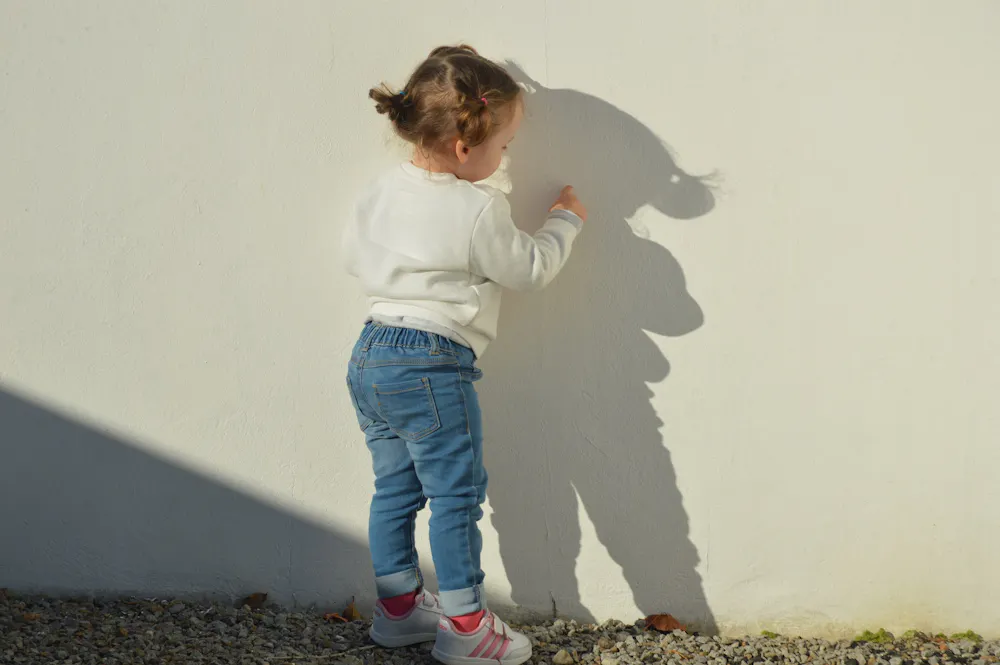 Children start to gain a sense of self from a young age.
Photo by Susana Coutinho on Unsplash
Children start to gain a sense of self from a young age.
Photo by Susana Coutinho on Unsplash
Discuss the plan in advance
Humans are afraid of the unknown, so talking to children about an upcoming change or feared situation will help them cope with it.
For instance, before going to the doctor, it would help to talk about how you’ll prepare (what to take, how you’ll get there, where the doctor’s office is), what might happen when you arrive (report to reception, sit in waiting room with other patients), and what might happen on the visit (what you’ll talk about with the doctor, whether the doctor might need to touch the child).
Even when talking about future events, it’s important to acknowledge feelings and model calm confidence.
Read more: 'It's real to them, so adults should listen': what children want you to know to help them feel safe
But what if my child is just too clingy?
There are a few factors to consider when making a judgment about whether a child’s clingy behaviour is of concern.
First, consider the context. Is the child coping with a significant change in their life, a new environment or new people? Some children are particularly sensitive to change and may need a number of weeks (or months) to adapt. So you may need to provide the child with a little extra support to get them through the transition.
Second, consider the intensity of the behaviour. Is the clingy behaviour interfering with the child’s regular life? For instance, is it interfering with their ability to go to kindergarten or school, or causing your child (and the parents) considerable upset and stress?
Third, consider the time frame. If the behaviour is occurring daily and lasting more than four weeks, and is interfering with the child’s life, it may be helpful to consult with a professional such as a GP, paediatrician, psychologist, or school counsellor.
Authors: Elizabeth Westrupp, Senior Lecturer in Psychology, Deakin University
Read more http://theconversation.com/is-my-child-being-too-clingy-and-how-can-i-help-115372

















