

Making aluminium uses 10% of Australia’s electricity. Will tax incentives help smelters go green?
- Written by: Tessa Leach, Research Manager, Industry, at Climateworks Centre, Monash University
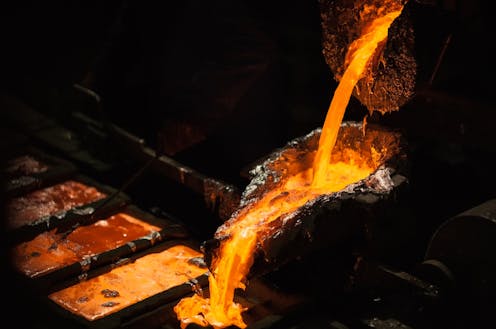
Aluminium is an exceptionally useful metal. Lightweight, resistant to rust and able to be turned into alloys with other metals. Small wonder it’s the second most used metal in the world after iron and demand is set to soar.
But aluminium comes at a cost – energy. The four aluminium smelters in Australia consume 10% of the nation’s electricity and produce close to 5% of total emissions. Smelting is so energy intensive that in many countries, it has driven the construction of new fossil fuel power plants. That’s why it’s nicknamed “congealed electricity”.
This week, the federal government proposed a new policy aimed at making aluminium smelting green.
Under the scheme – due to run between 2028 and 2036, aluminium producers would receive a certain amount of funding for every tonne of aluminium produced using renewable energy. If smelters pursue this incentive, we can expect to see more funding flowing to renewables to meet demand.
But will this scheme work? Our research shows Australia could cut aluminium emissions 98% by 2050, from mining all the way to smelting – if renewable energy expands to support it, as well as domestic consumption.

Why focus on aluminium?
By 2050, global demand for aluminium is projected to rise by 50%, due largely to demand from electric vehicles manufacturing, clean energy equipment and construction.
Australia is one of few countries with an end-to-end aluminium industry, running from mining bauxite ore, refining it into alumina and smelting it to produce aluminium. We produce around 1.6 million tonnes annually and export almost all of it. Our exports account for 10% of the world’s total.
While emissions are produced at every step, this week’s announcement is aimed at the single largest emissions-producing process: smelting.
In 2020 Australia’s smelters produced about 4.6% of the nation’s emissions – 22.8 million tonnes of carbon dioxide equivalent.
The nation’s four smelters are in Tomago in New South Wales, Boyne in Queensland, Portland in Victoria and Bell Bay in Tasmania. The industry is important to local economies and employs roughly 14,000 workers.

How hard is it to go green?
At present, the electricity to smelt aluminium comes largely from burning coal.
Switching doesn’t require major changes in industrial processes – only that there’s enough renewable power to meet demand.
Technical limitations at existing facilities and limited financial incentives to update them mean Australia’s smelters can’t easily ramp up or down. Electricity demand is almost constant.
Renewables such as solar and wind can do the job once “firmed”, meaning the power is stored to be available as needed. Smelters could also use technology to be more flexible with the timing of energy consumption.
To their credit, some aluminium companies are already working to cut emissions. In 2024, Rio Tinto announced a deal to power its Gladstone aluminium operations with renewables.
The real challenge is ensuring enough renewable energy in the grid for smelters to tap into, alongside new solar and wind to electrify homes and businesses.
Globally, more than a third (34%) of the total electricity used to make aluminium now comes from zero-emissions sources – almost entirely from hydroelectric plants. Hydropower is well suited to powering smelters because it allows for continuous and cheap electricity once built. Tasmania’s Bell Bay smelter is powered by hydroelectricity, for instance.
Expanding aluminium production through hydropower is limited, however, due to a lack of suitable sites of the right scale and location.
Do we need a policy to make green aluminium a reality?
Aluminium production in Asia is steadily increasing, powered by fossil fuel plants. Vietnam is investing A$11.7 billion in boosting output, for instance.
Australian aluminium smelters risk being outcompeted. The industry’s best chance is to meet growing demand for green products. But to do this affordably, the smelters require reliable, near-zero emissions electricity supply at low cost.
Energy infrastructure must be planned at sufficient speed and scale to both achieve Australia’s export ambitions and meet increasing domestic demand.
To do this, as our research shows, Australia needs to double the capacity of renewable projects currently in progress.
Over the past decade, Australia’s electricity prices have increased substantially, particularly due to rising gas prices.
In response, governments have moved to shield aluminium smelters from price rises. In 2021, the previous government announced a A$150 million subsidy for Victoria’s Portland smelter. By contrast, this new federal government incentive is aimed at reducing emissions and accelerating the energy transition.
Over time, smelter operators may see opportunity in changing when they use the most electricity, to soak up cheap solar during the day and scale back during evening peaks. This would be good for smelters and would reduce electricity prices for all consumers.
 Almost all Australian aluminium is exported. Going green could open up new markets in a carbon-constrained world.
Travelstock by Powerhouse/Shutterstock
Almost all Australian aluminium is exported. Going green could open up new markets in a carbon-constrained world.
Travelstock by Powerhouse/Shutterstock
Government and industry will have to work together
Sun, wind, bauxite and water resources mean Australia has natural advantages in green aluminium. But it’s not a given.
If done well, tax credits or subsidies can kick-start a market for green products and give companies the certainty to take the plunge. Once running, the government can then remove the incentives.
As we tackle harder sectors such as chemical manufacturing, mineral refining, steelmaking and mining, we will need yet more firmed renewables. Shifting alumina refineries to clean energy will take yet more power.
Green aluminium offers a chance to slash Australia’s emissions while capitalising on growing demand for low-carbon products.
While these government incentives will start the process, it will take steady work from industry and government to make it a reality. Coordinated, strategic action will be necessary to future-proof our industrial heartlands.
Authors: Tessa Leach, Research Manager, Industry, at Climateworks Centre, Monash University


















