Why too many fearless people on a team make collaboration less likely
- Written by: Hedwig Eisenbarth, Senior Lecturer in Psychology, Victoria University of Wellington
Team work is common across society. From schools to multinational businesses, people usually collaborate in groups towards a shared goal.
It can work well, but sometimes, it can be a disaster. One team might create a proposal for a new policy because all members manage to agree on details, while another fails because they can’t find common ground.
Why is it that groups can vary so much in their outcomes? We know that some people are better team players than others. In fact, job interviews and personality assessments often include questions about team skills.
But this assumes that only individual personality is relevant, not the interaction between people with various personality characteristics.
Investigating group behaviour
We don’t yet fully understand how different personality types within a group interact and how that affects group outcomes. To address this, we investigated which mixes of personalities create more or less cooperative group working styles.
We wanted to know whether it matters how many group members show personality traits that have been found to be less cooperative. People high on so-called psychopathic personality traits are characterised by goal-oriented, fearless, impulsive, manipulative behaviours, and also by less cooperative behaviours such as refusing to find common ground when interacting with another person.
Read more: Not all psychopaths are criminals – some psychopathic traits are actually linked to success
But does the proportion of individuals high on these traits within a group matter for the overall group behaviour?
We asked participants to decide whether to cooperate with the people sitting next to them in mixed groups, composed of different numbers of participants with high or low scores on a questionnaire for psychopathic personality traits.
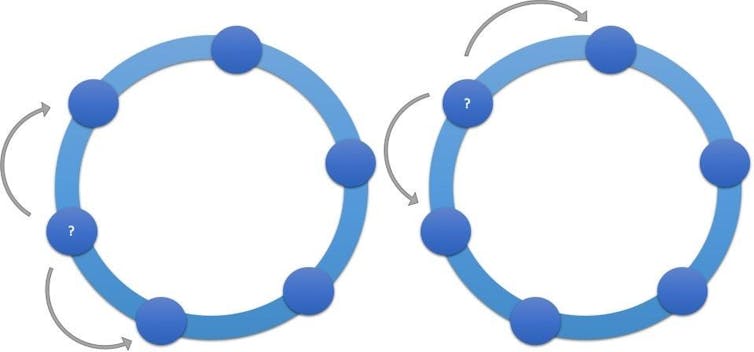 Participants who did not know each other were asked if they would like to cooperate with the people next to them, over a series of rounds.
Supplied
Participants who did not know each other were asked if they would like to cooperate with the people next to them, over a series of rounds.
Supplied
Usually, this setup leads to a maintenance of cooperative behaviour across a series of rounds of sharing. In our research we investigated how this tendency toward mutual cooperation is influenced by personality traits of the members of the group.
We found groups that were composed entirely of people with low psychopathic traits and groups with a low proportion (20%) of individuals with high psychopathic traits showed the expected cooperative behaviour. But in groups with a larger proportion (50%) of individuals with high psychopathic traits, the overall rate of cooperative behaviour was significantly lower. We measured this by the number of cooperative decisions participants in a group made.
Read more: How design thinking can help teachers collaborate
What does that mean for teams?
The overall group behaviour seems to be more than the sum of its parts. Group composition had an effect on cooperation over and above the effect of the individuals’ own level of psychopathic traits. Group members with low levels of psychopathic traits behaved less cooperatively and more “psychopathically” when in groups with more people who had high levels of psychopathic traits.
This suggests that interacting with people with high psychopathic traits increases uncooperative behaviour across all members of a group. The personality characteristics of group members matter for cooperative behaviour, and can change individuals’ behaviour. But the effect is only seen when a substantial proportion of individuals in a group have non-cooperative personality traits.
These findings indicate that group composition matters. Teams working on a collaborative task are more likely to cooperate successfully if most of the group members have more cooperative personality types. But our findings also trigger new questions about what role the type of task plays in collaborations and whether group behaviour stabilises over longer time periods.
Authors: Hedwig Eisenbarth, Senior Lecturer in Psychology, Victoria University of Wellington