With climate change likely to sharpen conflict, NZ balances pacifist traditions with defence spending
- Written by: David Belgrave, Lecturer in Politics and Citizenship, Massey University
In most countries, the question of whether to produce guns or butter is a metaphor for whether a country should put its efforts into defence or well-being. In New Zealand, this debate is much more literal and has been won easily by butter.
Dairy exports made up around 5.6% of New Zealand’s GDP in 2018 while defence spending only accounted for around 1.1%, with the tiny local defence industry adding little to that total.
Relative geostrategic isolation means New Zealand’s security has been more about ensuring global trade routes stay open for exports, like butter. But climate change is now challenging that notion as environmental change is expected to generate instability in the South Pacific.
While the government doesn’t expect core day-to-day defence spending to increase over the next few years, as much as NZ$20 billion will need to be spent on new equipment.
Replacing ageing equipment
Big ticket items such as warships and military aircraft last for decades and purchases are often years in the planning. Platforms purchased for the New Zealand military, including some acquired during the Vietnam War, are now reaching the end of their life.
New Zealand is facing significant bills as major aircraft, ships and army vehicles will need to be purchased in the next few years. The timing is particularly awkward for the government as it is shifting its spending towards well-being.
Read more: New Zealand's 'well-being budget': how it hopes to improve people's lives
To manage this problem the government has released its Defence Capability Plan 2019, which outlines its NZ$20 billion shopping list to resource the military into the 2030s.
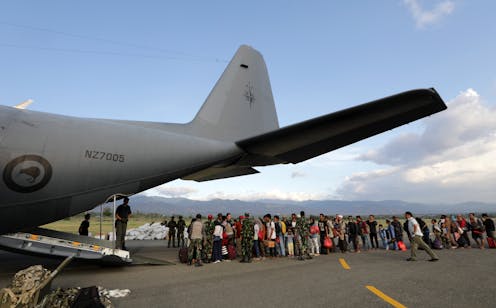
The first purchase to come consists of new C-130J-30 Super Hercules transport planes. They will replace the Royal New Zealand Air Force’s existing C-130s which are now more than 50 years old. At the time of writing, all five of these planes have been grounded due to maintenance problems. A major justification for the upgrades is greater need for a variety of relief, monitoring and peacekeeping missions caused by the effects of climate change.
A recent New Zealand Defence Force report warned that extreme weather patterns will threaten water, food and energy security in the region and shortages could spark violence. New Zealand’s military provides humanitarian aid and disaster relief in the Pacific and the climate crisis is shifting the rationale for defence spending and the politics of defence in general.
Criticism from the opposition National Party has been less about the plan and more about whether it fits with the government’s overall well-being approach. But the real flak has come from the coalition government’s Green Party support partner.
This shows the complexity of defence politics in New Zealand, as different political parties represent distinct strands of public opinion on the role of the military.
Balancing pacifist and martial traditions
The last 50 years have seen significant disagreement over how the country should engage with the rest of the world and what it should do with its military in particular. Decisions over big purchases and overseas deployments can open up major divisions over New Zealand’s strategic identity.
New Zealand’s strong martial and pacifist traditions are both represented in the current government and major defence decisions have to be made with care. Jacinda Ardern’s coalition is managing this complex balancing act. The coalition is made up of the centre-left Labour Party and the moderately populist New Zealand First Party, with the Green Party providing confidence and supply.
NZ First is the strongest supporter of the country’s martial traditions. It has always had a hawkish attitude towards China, which has become more relevant in recent years.
Read more: New Zealand's Pacific reset: strategic anxieties about rising China
While Labour is generally seen as more dovish than the National Party, the differences have been largely over tone rather than substance. Attitudes towards anti-nuclear policies, the scrapping of the RNZAF fighter wing, and the 2003 invasion of Iraq have been major points of difference in the past.
Labour has generally differentiated itself by being slightly more willing to criticise allies and placing more faith in collective security, the United Nations and disarmament.
To limit criticism that it is spending on “tanks not teachers”, Ardern’s coalition has skilfully outsourced the job of replacing ageing defence equipment to NZ First’s minister of defence Ron Mark. It was probably no coincidence that last year’s announcement that NZ$2.3 billion would be spent on new maritime patrol aircraft was made by NZ First leader Winston Peters while Ardern was on maternity leave.
Ardern has let NZ First claim the political credit and take the political risk with expensive defence replacements, lest they take the shine off Labour’s focus on social policies. That balancing was on show again last week when Ardern announced that New Zealand was ending its military training deployment to Iraq.
Pacifism in the age of climate change
By sitting outside cabinet, the Greens are able to represent the pacifist end of the political spectrum. The party has its roots in the Values Party of the 1970s, which helped make anti-nuclear attitudes mainstream in New Zealand and, by 1984, Labour Party policy.
The party’s defence spokesperson Golriz Ghahraman described the transport plane purchase as “war making capability” when New Zealand is good at humanitarian aid delivery, monitoring and supporting Antarctic research. She reconfirmed the Green Party’s commitment to peacekeeping through the UN.
This attitude is problematic as it forgets that the tools for war fighting are the same as those for peacekeeping and disaster relief. As the focus of Green movements worldwide has shifted to climate change, the commitment to disarmament is becoming more at odds with the realities of climate change. Rising sea levels, crop failures and mass migration will be massively destabilising to the international system.
It is not tenable to criticise the purchase of aircraft that will be largely used to send relief missions to the Pacific, scientists to Antarctica and peacekeepers to UN missions, simply because they could be used to send soldiers into combat. The challenge for the Greens will be to find a coherent message on the military that tackles the climate crisis and represents the views of its pacifist base.
The challenge for New Zealand’s allies will be to understand and respect how these contradictory threads of New Zealand’s strategic culture direct and constrain its defence spending.
Authors: David Belgrave, Lecturer in Politics and Citizenship, Massey University