

Competition for the kerb is rising, and cities are going to have to manage it
- Written by: Neil Sipe, Professor of Urban and Regional Planning, The University of Queensland
In case you missed it, 2018 was designated the Year of the Kerb by Sabrina Sussman, Zipcar’s public partnerships manager. This is because competition for limited kerb space has been increasing over the past few years, particularly in cities.
The kerb is the place that provides “access” between the street and the footpath. The definition tends to include the lane beyond the kerb that is used for car parking, bus stops, taxi pickups and dropoffs, and loading and unloading goods.
Read more: The battle to be the Amazon (or Netflix) of transport
But kerb competition is increasing from a range of new users including: car sharing, ride sharing, e-scooter share, bike share and e-bike share, food delivery, online order deliveries and, in coming years, autonomous vehicles.
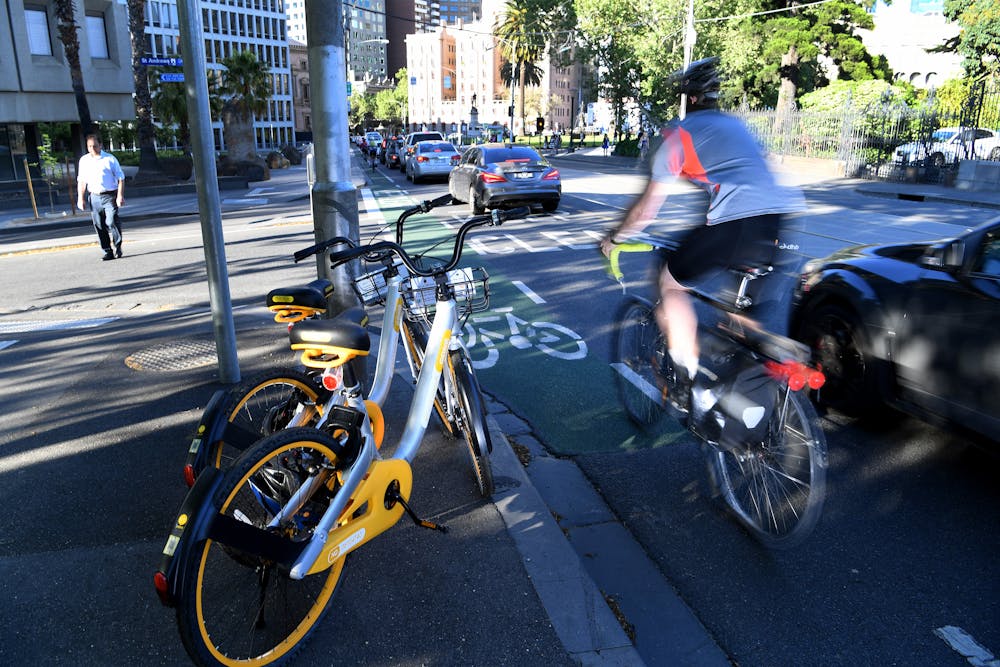 Share bikes are just the start of the many competing claims on kerb space.
Joe Castro/AAP
Share bikes are just the start of the many competing claims on kerb space.
Joe Castro/AAP
And this increasing focus on the kerb is highlighted in recent reports by the Institute of Traffic Engineers, the International Transport Forum and North America’s National Association of City Transportation Officials (NACTO).
With this range of new users, cities need to rethink how they manage this contested real estate. Without better kerb management, cities will face increased congestion on local streets from vehicles circulating to access the kerb and on footpaths from a range of shared mobility devices.
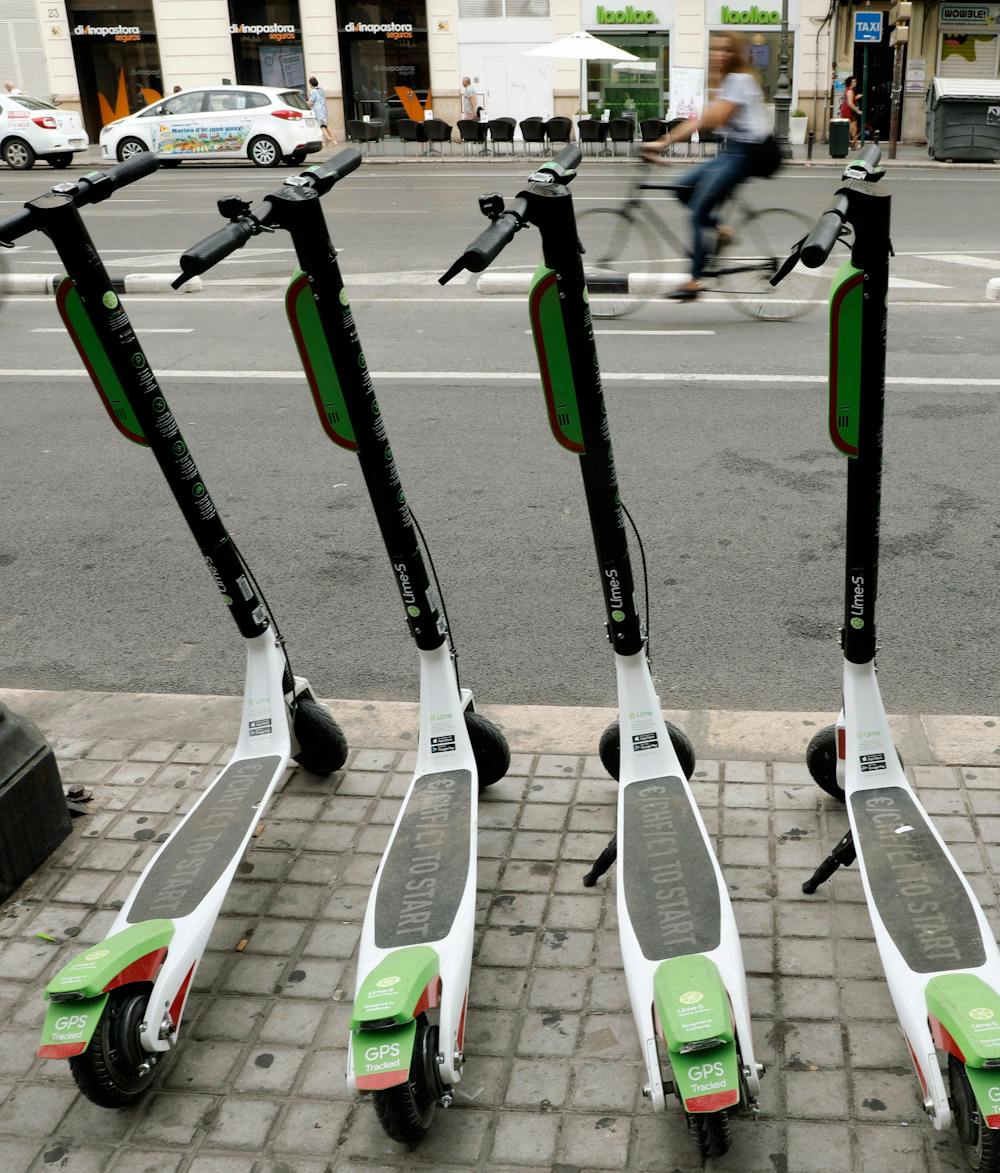 E-scooter share schemes also need kerb space for parking.
EPA/AAP
E-scooter share schemes also need kerb space for parking.
EPA/AAP
One change cities will need to make to accommodate these new users is to repurpose kerb space, which has traditionally been used for parking, to other uses. This change will most likely have a significant financial impact.
One survey of the 25 largest US cities found parking-related revenues totalled US$5 billion in 2016, or about US$129 per person. While repurposing kerb space will not affect all of this revenue, it will have an impact on city budgets. To minimise this impact, cities will need to think about if, and how, to charge new users of kerb space.
Read more: Of all the problems our cities need to fix, lack of car parking isn't one of them
To manage kerbs, first identify the uses
The City of Seattle is one of the leaders in kerb management. The city categorised kerb use into six key functions:
- mobility for travel lanes, bike lanes and bus lanes
- access for people using bus stops, bike parking and loading zones
- access for commerce to deliver goods
- activation for small parks, food trucks and public art
- greening for plantings, rain gardens and bio-swales
- storage for parking, bus layovers and construction.
One of the first in-depth analyses of the kerb was in San Francisco. As part of this 2018 study, commissioned in 2018 by Uber Technologies, the consultants (Fehr and Peers) developed a Curb Productivity Index (CPI). The index considered three things to compare productivity of kerb use.
- number of passengers using kerb space by mode
- time period the activity was observed
- total space dedicated to that use.
How to calculate kerb productivity
The CPI is a useful way of quantifying the various competing uses for the kerb.
It’s calculated by dividing the amount of activity by the amount of space used, multiplied by the unit of time. For example, the CPI for a bus stop that uses 45 metres of kerb for 250 arriving and departing passengers over four hours would be: 250 passengers/(45 metres x 4 hours), or 1.39 passengers/metre-hours.
Alternatively, the CPI for a car space that uses five metres of kerb that services two passengers over four hours would be: 2 passengers/(5 metres x 4 hours), or 0.1 passengers/metre-hours.
The CPI shows a bus stop is 13.9 times (1.39/0.1) more productive than a car park.
This analysis of usage data provides some rigour in developing a kerb management plan.
Base management on ‘measurement over myth’
As a way forward, Fehr and Peer recommend a management strategy with three components:
- relocation of existing kerb uses to other areas
- conversion, which involves eliminating some current uses and replacing them with new uses
- flexibility, so kerb uses change depending on the time of day.
Trials of flexible kerb management are under way in Washington DC, San Francisco and Fort Lauderdale.
In changing how the kerb is managed, the 2018 report from North America’s National Association of City Transportation Officials recommends a “measurement over myth” strategy when converting parking to other uses.
Surveys on arrival mode consistently show public transport and active travel modes deliver more customers to adjacent businesses than private motor vehicles. Before-and-after studies confirm that replacing parking with public transport or bike lanes increases sales for area businesses.
Read more: Do the sums: bicycle-friendly changes are good business
 To manage the conflicting needs of car and bike users for roadside space, San Jose has created kerbside bike lanes separated from the road by car parking.
Will Buckner/Flickr, CC BY
To manage the conflicting needs of car and bike users for roadside space, San Jose has created kerbside bike lanes separated from the road by car parking.
Will Buckner/Flickr, CC BY
While new mobility startups are part of the reason cities need to develop kerb management plans, other startups are developing new ways to manage this increasingly contested space. Some of these new companies include:
- Open Curbs from Coord, a spin-off of Sidewalk, that provides wheelchair cuts, fire hydrants, bus stops and other physical kerb assets
- Populus, a San Francisco transport company that has developed a mobility manager that provides data on e-scooter and e-bike share parking data
- Remix, which has developed the New Mobility tool to analyse and visualise data-streaming feeds.
These startups have raised millions of dollars, due in part to the recognised value of the kerb.
Cities need to make the transition from parking cities to pickup/dropoff cities and to flexible cities. For this to happen, cities will need to think strategically about how to manage their kerbs with the emergence of new users and new mobility management options.
One of the first steps in this transition is for cities to ensure data standards and data-sharing arrangements are established as part of the basis for giving new users permission to access the kerb.
Read more: For Mobility as a Service (MaaS) to solve our transport woes, some things need to change
Authors: Neil Sipe, Professor of Urban and Regional Planning, The University of Queensland


















