

Quantum navigation could transform how we travel. So what is it, and how does it work?
- Written by: Allison Kealy, Director, Innovative Planet Institute, Swinburne University of Technology

Quantum technology is no longer confined to the lab – it’s making its way into our everyday lives. Now, it’s about to transform something even more fundamental: how we navigate the world.
Imagine submarines travelling beneath the ocean, never needing to surface for location updates. Planes flying across continents with unshakeable precision, unaffected by signal disruptions.
Emergency responders could navigate smoke-filled buildings or underground tunnels with flawless accuracy, while autonomous vehicles chart perfect courses through dense urban environments.
These scenarios might sound like science fiction, but they can all be made possible with an emerging approach known as quantum navigation.
This game-changing tech will one day redefine movement, exploration and connectivity in ways we’re only just beginning to imagine. So, what is it?
Satellite navigation is at the heart of many things
Global navigation satellite systems, like GPS, are deeply embedded in modern society. We use them daily for navigation, ordering deliveries and tagging photo locations. But their impact goes far beyond convenience.
Timing signals from satellites in Earth’s orbit authenticate stock market trades and help balance the electricity grid. In agriculture, satellite navigation guides autonomous tractors and helps muster cattle.
Emergency services rely on navigation satellite systems for rapid response, reducing the time it takes to reach those in need.
Despite their benefits, systems like GPS are quite vulnerable. Satellite signals can be jammed or interfered with. This can be due to active warfare, terrorism or for legitimate (or illegitimate) privacy concerns. Maps like GPSJAM show real-time interference hotspots, such as those in the Middle East, areas around Russia and Ukraine, and Myanmar.
The environment of space isn’t constant, either. The Sun regularly ejects giant balls of plasma, causing what we know as solar storms. These emissions slam into Earth’s magnetic field, disrupting satellites and GPS signals. Often these effects are temporary, but they can also cause significant damage, depending on the severity of the storm.
An outage of global navigation satellite systems would be more than an inconvenience – it would disrupt our most critical infrastructure.
Estimates suggest a loss of GPS would cost just the United States economy about US$1 billion per day (A$1.5 billion), causing cascading failures across interconnected systems.

Quantum navigation to the rescue
In some environments, navigation signals from satellites don’t work very well. They don’t penetrate water or underground spaces, for example.
If you’ve ever tried to use Google Maps in a built-up city with skyscrapers, you may have run into issues. Tall buildings cause signal reflections that degrade accuracy, and signals are weakened or completely unavailable inside buildings.
This is where quantum navigation could step in one day.
Quantum science describes the behaviour of particles at scales smaller than an atom. It reveals mind-boggling effects like superposition – particles existing in multiple states simultaneously – and entanglement (when particles are connected through space and time in ways that defy classical understanding).
These effects are fragile and typically collapse under observation, which is why we don’t notice them in everyday life. But the very fragility of quantum processes also lets them work as exquisite sensors.
A sensor is a device that detects changes in the world around it and turns that information into a signal we can measure or use. Think automatic doors that open when we walk near them, or phone screens that respond to our touch.
Quantum sensors are so sensitive because quantum particles react to tiny changes in their environment. Unlike normal sensors, which can miss weak signals, quantum sensors are extremely good at detecting even the smallest changes in things like time, gravity or magnetic fields.
Their sensitivity comes from how easily quantum states change when something in their surroundings shifts, allowing us to measure things with much greater accuracy than before.
This precision is critical for robust navigation systems.
Our team is researching new ways to use quantum sensors to measure Earth’s magnetic field for navigation. By using quantum effects in diamonds, we can detect Earth’s magnetic field in real time and compare the measurements to pre-existing magnetic field maps, providing a resilient alternative to satellite navigation like GPS.
Since magnetic signals are unaffected by jamming and work underwater, they offer a promising backup system.
The future of navigation
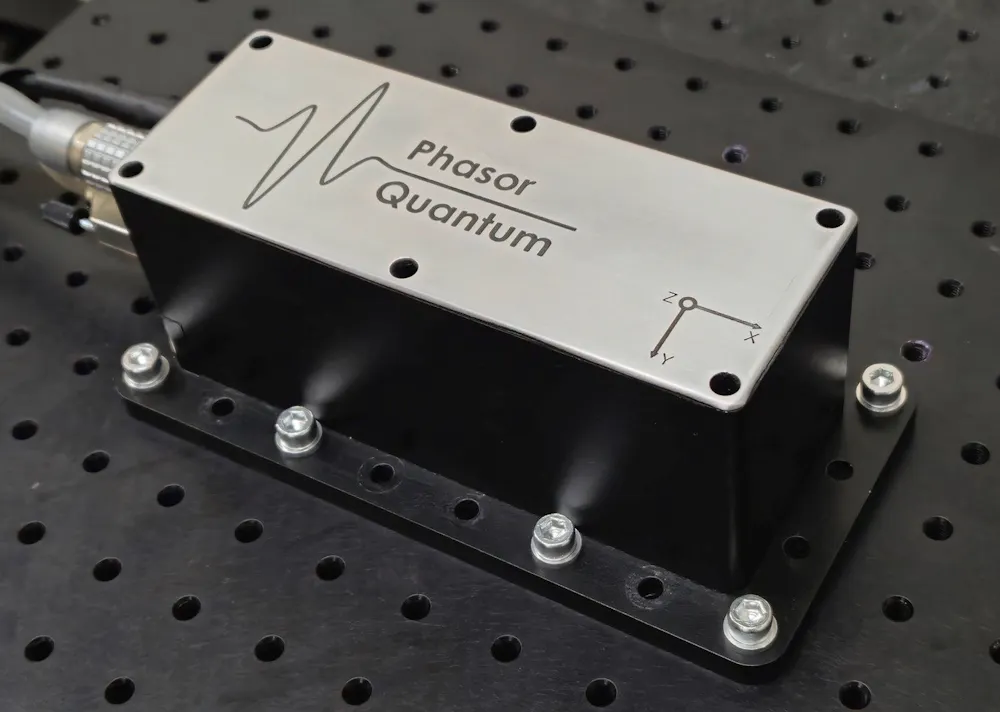
The future of navigation will integrate quantum sensors to enhance location accuracy (via Earth’s magnetic and gravitational fields), improve orientation (via quantum gyroscopes), and enable superior timing (through compact atomic clocks and interconnected timekeeping systems).
These technologies promise to complement and, in some cases, provide alternatives to traditional satellite-based navigation.
However, while the potential of quantum navigation is clear, making it a practical reality remains a significant challenge. Researchers and companies worldwide are working to refine these technologies, with major efforts underway in academia, government labs and industry.
Startups and established players are developing prototypes of quantum accelerometers (devices that measure movement) and gyroscopes, but most remain in early testing phases or specialised applications.
Key hurdles include reducing the size and power demands of quantum sensors, improving their stability outside of controlled laboratory settings, and integrating them into existing navigation systems.
Cost is another barrier – today’s quantum devices are expensive and complex, meaning widespread adoption is still years away.
If these challenges can be overcome, quantum navigation could reshape everyday life in subtle but profound ways. While quantum navigation won’t replace GPS overnight, it could become an essential part of the infrastructure that keeps the world moving.
Authors: Allison Kealy, Director, Innovative Planet Institute, Swinburne University of Technology