

they’re a natural substitute for gesture ???
- Written by Lauren Gawne, David Myers Research Fellow, La Trobe University
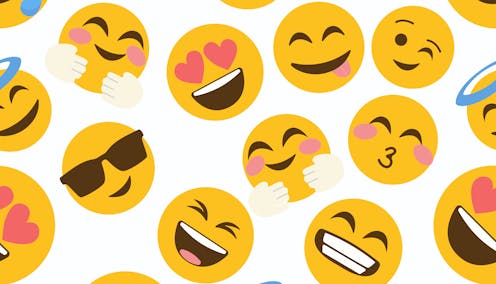
We’re much more likely to be hanging out on social media than at the watercooler these days. But just because we’re no longer face-to-face when we chat, doesn’t mean our communication is completely disembodied.
Over the last three decades, psychologists, linguists, and anthropologists, along with researchers from other traditions, have come together to understand how people gesture, and the relationship between gesture and speech.
The field of gesture studies has demonstrated that there are several different categories of gesture, and each of them has a different relationship to the words that we say them with. In a paper I co-authored with my colleague Gretchen McCulloch, we demonstrate that the same is true of emoji. The way we use emoji in our digital messages is similar to the way we use gestures when we talk.
Read more: What your emojis say about you
What gestures and emoji have in common
We can break speech down into its component parts: sentences are made of words, words are made of morphemes, and morphemes are made of sounds.
Signed languages have the same features of grammar as spoken languages, but with hand shapes instead of sounds. They have some advantages in complex expressions that spoken languages don’t have, but there are gestures as well as grammatical features when people sign.
By contrast, gestures and emoji don’t break down into smaller parts. Nor do they easily combine into larger words or sentences (unless we’re using a clunky version of the grammar of our language).
While there are preferences, there is nothing “grammatical” about using ? instead of ?. Rather, what is most important is context. ? could be a reference to your own dog, a good dog you saw while out for a walk, or a sign of your fondness for puppers over kitties.
There are some gestures that can have a full meaning even in the absence of speech, including the thumbs up ?, the OK sign ? and good luck ?. Gestures like these are known as emblems, some of which are found in the emoji palette. Some object emoji have also developed emblematic meanings, such as the peach ?, which is most typically used non-illustratively to represent a butt.
Many gestures and emoji do not have these specific meanings. So, let’s take a look at different ways emoji are used to communicate with reference to a common framework used to categorise gestures.
Illustrative and metaphoric emoji
Illustrative gestures model an object by indicating a property of its shape, use, or movement, such as the classic “the fish was THIS big” gesture. Similarly, we often use emoji to illustrate the nature of a message. When you wish someone a happy birthday you might use a variety of emoji, such as the cake with candles ?, slice of cake ?, balloon ?, and wrapped gift ?.
It’s not grammatically correct to say “birthday happy”, but there’s no “correct” sequence of emoji, just as there is no one correct way to gesture your description of the fish you caught.
We also have metaphoric uses of gesture and emoji. Unlike a “big fish”, a “big idea” doesn’t have a physical size, but we might gesture that it does. Similarly, our analysis showed that people typically use the “top” emoji ? to mean something is good.
Read more: Emoji are becoming more inclusive, but not necessarily more representative
Beat gestures are used for emphasis
Another common type of gesture used to draw attention is a beat gesture, distinguished by a repetitive “beat” pattern. Some uses of emoji have a direct parallel to beat gestures. For example, using the double clap ? for emphasis, which has its origins in African American English.
The emphatic nature of beat gestures helps explain something about common strings of emoji. When we looked at sequences of emoji the most common patterns are pure repetition, such as two tears of joy emoji ??, or partial repetition such as two heart eyes and blowing a kiss/heart ???. Repetition for emphasis is rare (but possible) with words, but very common for gesture and emoji.
Along with these categories, we also looked at pointing and illocutionary gestures and emoji, which help show your intentions behind what you’re saying – whether that’s amused ? or ambivalent ?.
Read more: Understanding the emoji of solidarity
Emoji have limitations that gestures don’t
There are obviously some differences between online and physical chat. Gestures and speech are closely synchronised in a way emoji and text can’t be. Also, the scope of possibilities with gesture are limited only to what the hands and body can do, while emoji use is limited to the (currently) 2,823 symbols encoded by Unicode.
Despite these differences, people still use the resources available to them online to do what they’ve been doing in face-to-face conversations for millennia. Bringing together research on gesture and internet linguistics, we argue there are far more similarities between emoji and gesture than there are between emoji and grammar.
Instead of worrying that emoji might be replacing competent language use, we can celebrate the fact that emoji are creating a richer form of online communication that returns the features of gesture to language.
Authors: Lauren Gawne, David Myers Research Fellow, La Trobe University

















