

Conquered city, site of revolutions from above and below
- Written by: Adam Morton, Professor of Political Economy, University of Sydney
This article is part of the Revolutions and Counter-Revolutions series, curated by Democracy Futuresas a joint global initiative between the Sydney Democracy Network and The Conversation. The project aims to stimulate fresh thinking about the many challenges facing democracies in the 21st century.
Flowing across Victor Serge’s documentary or witness novels, his political writings, his poetry, or his memoirs as a revolutionary is a sense of possibility rising up from the streets and of the political processes shaping the space of the city. Nowhere is this more evident than in Conquered City, set during the Russian Civil War (1919-1921) in the frontline city of Red Petrograd.
Written just before Serge’s years of captivity in Soviet Russia during Stalin’s purges, and completed in concise fragments that could be hastily sent abroad, Conquered City is a masterwork on the conquest of space.
Encircled by the White Army of General Nikolai Yudenich, Petrograd is on the brink of military defeat. The “endangered city” is threatened by starvation and the vast frozen expanse of winter, and torn between revolution and counter-revolution. Yet, Serge writes:
This city at the very limit of this encircled land, this city prey to famine, at the very limit of the end, lives on with the carelessness of the living!
Petrograd repels these dangers and survives, but the rise of the Red Terror is soon to purge the metropolis of its utopian traces. In 1917, the Special Commission (or Cheka) emerged, soon to be replaced by a permanent secret police, the State Political Directorate (or GPU), by 1921.
In the novel, Petrograd transmits collective memory and resistance prior to the torpor of counter-revolution. Long dark nights and frozen snows grip the urban landscape.
This white, silent, weightless shroud stretched out to infinity in time and space.
The politics of space is expressed through order and disorder, stability and movement, which arise from the modernising revolution of urban society.
The reader is immersed in the former Horse Guards Street that has been renamed Frederick Alder Street and then converted into Barricades Street. There is the evocation of the Smolny Institute (headquarters of the October Revolution and one-time residence of Lenin) now surrounded by barbed wire.
The Trinity Bridge spanning the turbulence of the River Neva, leading to the local headquarters installed at the Peter-Paul Fortress, is represented, as well as the Tsar’s old citadel alongside the digging of trenches at the Field of Mars, the Winter Palace and the old Foreign Ministry building bent sharply toward Cantor’s Bridge.
The logic and conception of space are also raised to a more global level in two senses. First, the grid of urban space – buildings, monuments, large-scale urbanism and transport routes – is seen from the air:
Seen from high above, from the red-starred airplane circling overhead every morning, the Neva looked like a thin white snake darting two thin blue tongues into the desert from its open mouth.
 Map of Petrograd (known previously and today as St Petersburg) in 1922.
Author provided
Map of Petrograd (known previously and today as St Petersburg) in 1922.
Author provided
This is the city that Leon Trotsky assessed in 1919 as essential to defend, if necessary, through the tactics of street fighting to combat the anti-Bolshevik White Army.
Trotsky outlined how the Red Army would occupy a central position and “operate along radial lines running from the centre to the periphery” of the city. Barbed-wire entanglements and barricades, with artillery and machine-gun installations, would be stationed in the streets.
Trotsky notes that “street battles do, of course, entail the risk of accidental victims and the destruction of cultural treasures”. Taking this up in Endangered City: Petrograd Year Two of the Revolution, Serge notes that:
… Petrograd, with its maze-like streets, its canals, its houses turned into fortresses or concealing ambushes, would be a death-trap for the small White Army.
Second, Petrograd is significant at the global level as part of the Marxist struggle for revolutionary internationalism, which stretched across the cityscapes of Europe – London, Paris, Berlin and Vienna – and beyond. Serge describes these as:
Phantom capitals belonging to the past and to another world, which could only be glimpsed through the new prisms of this city: expected uprisings, outcomes always in suspense, dispatches, stunning as blows, from the Rosta wire services proclaiming endless crises, the collapse of old nations, thrilling upheavals.
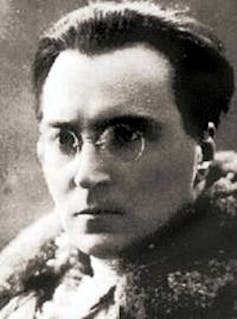 Victor Serge’s writing explored the psychosis of absolute power.
Wikipedia Commons
Victor Serge’s writing explored the psychosis of absolute power.
Wikipedia Commons
Petrograd is therefore the city of urban revolution. Transformation and upheaval are written on its buildings and streets. But it is also the city where the death of counter-revolution is circling not just from without but also from within.
In Memoirs of a Revolutionary, Serge articulated his clear-sighted distrust of the role of the Communist Party as the repository of truth.
“Totalitarianism is within us,” he wrote, not only as a result of the errors in sustaining the Special Commission in 1917, but also with an eye to the events to come. The suppression of the Kronstadt Rebellion in 1921 was just around the historical corner.
The conquest of power established within the conquered city of Petrograd is therefore also a meditation on the psychosis of absolute power. In Conquered City, the Special Commission emerges as an emblem of the future degeneracy of the revolution.
On the Cheka, Serge writes:
We have conquered everything and everything has slipped out of our grasp. We have conquered bread, and there is famine. We have declared peace to a war-weary world, and war has moved into every house.
The work of the character Bobrov, one-time decipherer of codes in the Ministry of the Interior and now employed by the Special Commission, is described thus:
Under the dictatorship of the proletariat, as under the ancien régime, secret directives kept him free of all cares. The furnishings and arrangement of his office, in a building next to the Commission, had remained nearly identical for 25 years; he had personally seen to it that nothing changed when they were moved from the quarters of the Political Police.
Equally, a certain sense of fatalism is at the centre of two historians’ reflections within the novel. Professor Vadim Mikhailovich Lytaev says in conversation with a fellow scholar:
[Tsar] Peter’s Mount has got back into his stride. Russia is beginning her revolution again. After Peter, she drifts slowly back into her past again. The Tsars only borrow two things from the West: uniforms and money.
Behind their false front the old Russia subsists: superstitious, bent under the yoke, floating her huge rafts down the Volga with the same songs as in the 16th century, still dragging the wooden swing plough through the fields, building the same houses as a thousand years ago, getting drunk the same way … This old country is still there, deep down, under a thin layer of burning lava.
We are darkest Asia. We can only be pulled out of ourselves by an iron fist. Peter is the model and precursor of the Revolution.
The riposte from his fellow scholar, Platon Nikolaevich, is:
No, Vadim Mikhailovich; Peter, like the people in the Kremlin, is only an accident — perhaps a necessary one in the accomplishment of certain developments in the history of Russia.
As articulated in his Memoirs of a Revolutionary, between historical and human factors, Serge is grappling with the “fatal stamp” of despotism that undermined the Russian Revolution.
In Conquered City, Comrades Xenia and Ryzhik characterise this tension between revolution and counter-revolution. Both work for the Special Commission, but while Xenia gets “two bullets in the belly”, Ryzhik rises to become the new Commissar of the House of Detention.
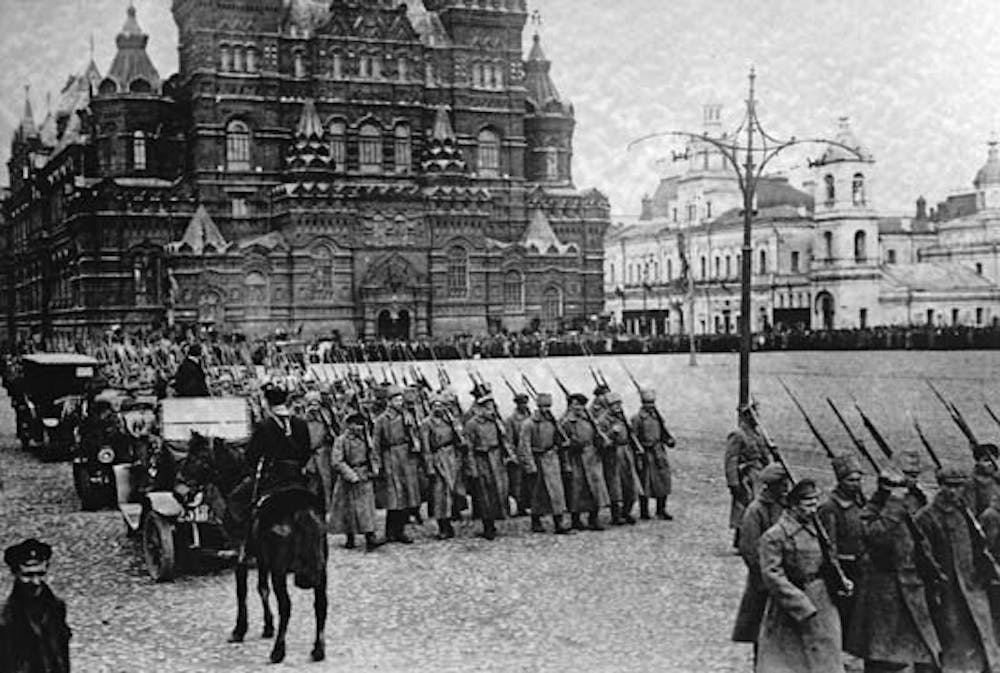 After the tsarist modernisation from above, the Russian Revolution of 1917 was an experiment in modernisation from below.
Wikimedia Commons
After the tsarist modernisation from above, the Russian Revolution of 1917 was an experiment in modernisation from below.
Wikimedia Commons
In All That is Solid Melts Into Air, Marshall Berman details how the traditions of St Petersburg are distinctively modern, “growing out of the city’s existence as a symbol of modernity in the midst of backward society”.
Emerging out of a “brutal but abortive modernisation from above”, revolutionary Petrograd was one of an array of experiments in modernisation from below. For Berman, in the clash of these experiments of modernisation lie clues to some of the mysteries of urban space in alternative contexts of uneven development, as in Lagos, Brasilia, New Delhi or Mexico City today.
Yet what Conquered City is most successful in conveying is the process of urban revolution in Red Petrograd. As Serge pens in his poem, City, written as a paean to Petrograd:
City, city, vast city,
vast, immobile city,
I know full well there are flames
devouring you beneath the snow.
The form and content of new structures, functions and organisations are therefore expressed through the politics of space in these reflections on Petrograd.
The strongest illustration of this in Conquered City is the articulation of what Henri Lefebvre would recognise as differential space: those contrasts, oppositions or juxtapositions that are in conflict with the attempt to enforce and impose homogenous space.
These conflicts over space are expressed within the urban fabric. It’s here the revolutionary and counter-revolutionary struggle becomes enacted in and beyond Conquered City.
Read earlier articles in the series here.
Authors: Adam Morton, Professor of Political Economy, University of Sydney
Read more http://theconversation.com/conquered-city-site-of-revolutions-from-above-and-below-87363



















