

Thinking of laser hair removal? Here's what you need to know
- Written by: Rodney Sinclair, Professor of Dermatology, University of Melbourne
Unwanted facial and body hair can affect the way we feel, our social interactions, what we wear and what we do.
Options to camouflage or remove unwanted hair include plucking, shaving, bleaching, using creams and epilation (using a device that pulls out multiple hairs at once).
Longer-term options include electrolysis, which uses an electrical current to destroy individual hair follicles, and laser therapy.
So what is laser therapy? What can it achieve? And what are the side-effects?
Read more: Friday essay: how 19th century ideas influenced today's attitudes to women’s beauty
How does laser treatment work?
Lasers emit a wavelength of light with a specific single colour. When targeted to the skin, the energy from the light is transferred to the skin and hair pigment melanin. This heats up and damages the surrounding tissue.
But to remove hair permanently and to minimise damage to the surrounding tissue, the laser needs to be targeted to specific cells. These are the hair follicle stem cells, which sit in part of the hair known as the hair bulge.
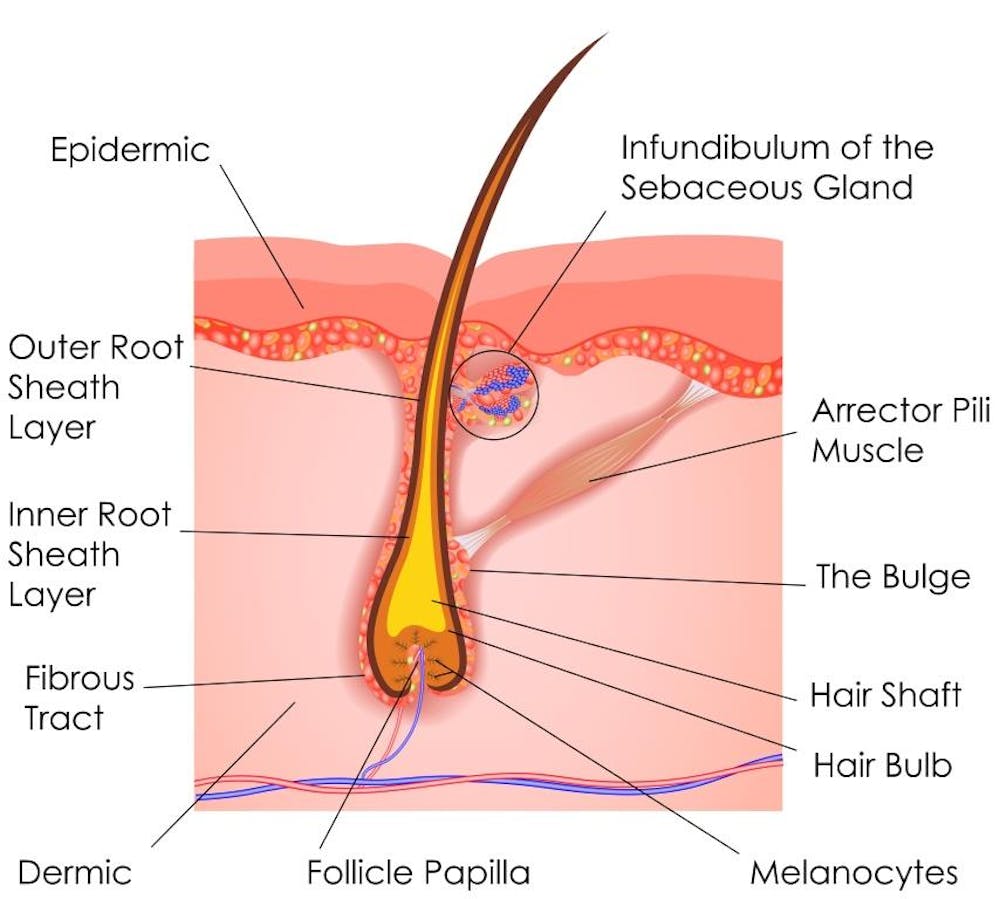 The laser needs to be targeted to stem cells that sit in the hair bulge.
from www.shutterstock.com
The laser needs to be targeted to stem cells that sit in the hair bulge.
from www.shutterstock.com
As the skin surface also contains melanin, which we want to avoid damaging, people are carefully shaved before treatment.
Read more: Monday's medical myth: shaved hair grows back faster and thicker
Will it remove hair permanently?
Laser treatment can either permanently reduce the density of the hair or permanently remove unwanted hair.
Permanent reduction in hair density means some hairs will regrow after a single course of therapy and patients will need ongoing laser treatment.
Permanent hair removal means none of the hairs in the treated area will regrow after a single course of therapy and no ongoing laser therapy is needed.
Whether hair is removed permanently or just reduced in density is influenced by:
- the colour and thickness of the hairs being treated
- the colour of the patient’s skin
- the type and quality of the laser used, and
- the competence and training of the person operating the laser.
However, if you have grey hairs, which have no melanin pigmentation, currently available lasers don’t work.
How many treatments will I need?
The number of treatments you’ll need depends on your Fitzpatrick skin type. This classifies your skin by colour, its sun sensitivity and its likelihood to tan.
Pale or white skin, burns easily, rarely tans (Fitzpatrick types 1 and 2) People with dark hair can usually achieve permanent hair removal with 4-6 treatments every 4-6 weeks. People with fair hair will generally only achieve permanent hair reduction and after an initial course of treatment may need 6-12 treatments a month apart.
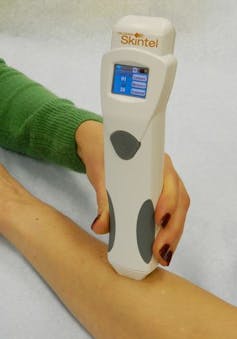 Laser treatment work best in the hands of a professional.
Author provided
Laser treatment work best in the hands of a professional.
Author provided
Light brown skin, sometimes burns, slowly tans to light brown (type 3) People with dark hair can usually achieve permanent hair removal with 6-10 treatments every 4-6 weeks. People with fair hair will generally only achieve permanent hair reduction and after an initial course of treatment may require 3-6 repeat treatments a month apart.
Moderate brown to dark brown skin, rarely burns, tans well or to moderate brown (type 4 and 5) People with dark hair can usually achieve permanent hair reduction with 6-10 treatments every 4-6 weeks. Maintenance will usually be required with 3-6 monthly repeat treatments. People with fair hair are unlikely to respond.
Re-treatments must be long enough apart to allow new hair growth to reach the level of the bulge.
What side effects or complications should I be aware of?
You will be advised to wear goggles during the treatment to prevent eye injury.
You will also experience some pain during treatment, especially the first few. This is mainly due to not removing all hair in the area to be treated before the procedure. Hairs missed while shaving absorb laser energy and heat the skin surface. There is less pain with repeat treatments at regular intervals.
Your skin will feel hot for 15-30 minutes after laser treatment. There may be redness and swelling for up to 24 hours.
More serious side effects include blisters, too much or too little skin pigmentation, or permanent scarring.
These generally occur in people with a recent suntan and the laser settings have not been adjusted. Alternatively, these side-effects can occur when patients are taking medications that affect their skin’s response to sunlight.
Does the type of laser matter?
The type of laser not only influences how well it works, it influences your chance of side-effects.
Lasers suitable for hair removal include: long-pulse ruby lasers, long-pulse alexandrite lasers, long pulse diode lasers and long-pulse Nd:YAG lasers.
Read more: Explainer: how are tattoos removed?
Intense pulsed light (IPL) devices are not laser devices but flash lamps that emits multiple wavebands of light simultaneously. They work in a similar way to lasers, albeit less effectively and they are much less likely to permanently remove hair.
To minimise the risk of damage to melanin producing cells on the skin surface, the choice of laser and how it’s used can be matched to your skin type.
Fair skinned people with dark hair can use an IPL device, an alexandrite laser or a diode laser; people with dark skin and dark hair can use a Nd:YAG or diode laser; and people with blond or red hair can use a diode laser.
To control the spread of heat and unwanted tissue damage, short laser pulses are used. The energy of the laser is also adjusted: it needs to be high enough to damage the bulge cells but not so high to cause discomfort or burns.
Can I buy a home laser device and do it myself?
Home laser devices and IPL home devices are available in Australia and cost between $200 and $1,000. But they don’t tend to work as well and you need to use them repeatedly to maintain hair reduction.
Parameters are only set for people with fair skin (Fitzpatrick types 1 and 2) and dark hair. For safety, energy settings are capped. And in inexperienced hands, complications may still arise. This includes burns, pain, blistering and changes to skin pigmentation.
Read more: 'Do I need to shave my pubic hair before having sex?'
By contrast, medical grade lasers must be registered with the government regulator, the Therapeutic Goods Administration. There are also national and state-based regulations about the facility where the laser is used, compulsory laser safety training requirements and state-based qualifications and licensing for laser operators.
So, a safe and regulated laser in the hands of a skilled professional is recommended.
When to see your GP
Not all excess hair is cause for concern. But severe hirsuitism (excess growth of dark and coarse hair over areas of the body where it ordinarily wouldn’t grow) or hypertrichosis (excess hair growth for someone’s age, sex or race) can be clues to underlying illness.
Hirsutism, especially when associated with symptoms including irregular periods or acne, can be caused by extra androgen hormones. Hypertrichosis later in life can be a sign of malignancy.
Your GP can investigate these.
Authors: Rodney Sinclair, Professor of Dermatology, University of Melbourne
Read more http://theconversation.com/thinking-of-laser-hair-removal-heres-what-you-need-to-know-113561


















