

Study identifies nine research priorities to better understand NZ's vast marine area
- Written by: Rebecca Jarvis, Research Fellow, Auckland University of Technology
The islands of New Zealand are only the visible part of a much larger submerged continent, known as Te Riu a Māui or Zealandia. Most of New Zealand’s sovereign territory, around 96%, is under water – and this means that the health of the ocean is of paramount importance.
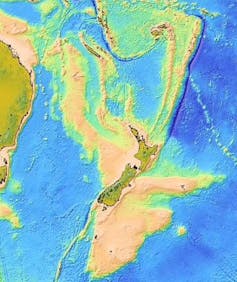 Most of the Zealandia continent is under water.
CC BY-SA
Most of the Zealandia continent is under water.
CC BY-SA
New Zealand’s marine and coastal environments have significant ecological, economic, cultural and social value, but they face many threats. Disjointed legislation and considerable knowledge gaps limit our ability to effectively manage marine resources.
With the UN decade of ocean science starting in 2021, it is essential that we meet the challenges ahead. To do so, we have asked the New Zealand marine science community to collectively identify the areas of research we should focus on.
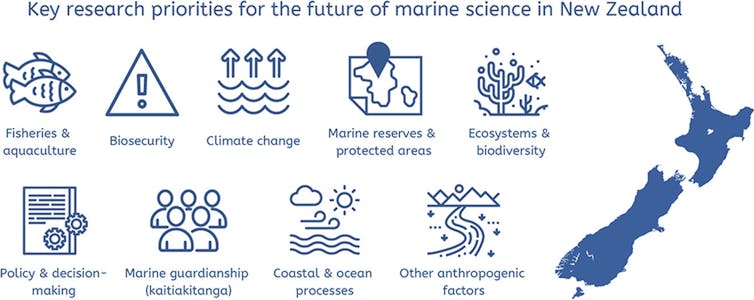
Ten important science questions were identified within nine research areas. The full list of 90 questions can be found in the paper and policy brief, but these are the nine priority areas:
Read more: No-take marine areas help fishers (and fish) far more than we thought
 CC BY-ND
1. Food from the ocean
Fisheries and aquaculture are vital sources of food, income and livelihoods, and it is crucial that we ensure these industries are sustainable. Our study has identified the need for new methods to minimise bycatch, mitigate environmental impacts and better understand the influence of commercial interests in fishers’ ability to adequately conserve and manage marine environments.
2. Biosecurity
The number of marine pests has increased by 10% since 2009, and questions remain around how we can best protect our natural and cultural marine heritage. Future directions include the development of new techniques to improve the early detection of invasive species, and new tools to identify where they came from, and when they arrived in New Zealand waters.
3. Climate change
Climate change already has wide ranging impacts on our coasts and oceans. We need research to better understand how climate change will affect different marine species, how food webs might respond to future change, and how ocean currents around New Zealand might be affected.
CC BY-ND
1. Food from the ocean
Fisheries and aquaculture are vital sources of food, income and livelihoods, and it is crucial that we ensure these industries are sustainable. Our study has identified the need for new methods to minimise bycatch, mitigate environmental impacts and better understand the influence of commercial interests in fishers’ ability to adequately conserve and manage marine environments.
2. Biosecurity
The number of marine pests has increased by 10% since 2009, and questions remain around how we can best protect our natural and cultural marine heritage. Future directions include the development of new techniques to improve the early detection of invasive species, and new tools to identify where they came from, and when they arrived in New Zealand waters.
3. Climate change
Climate change already has wide ranging impacts on our coasts and oceans. We need research to better understand how climate change will affect different marine species, how food webs might respond to future change, and how ocean currents around New Zealand might be affected.
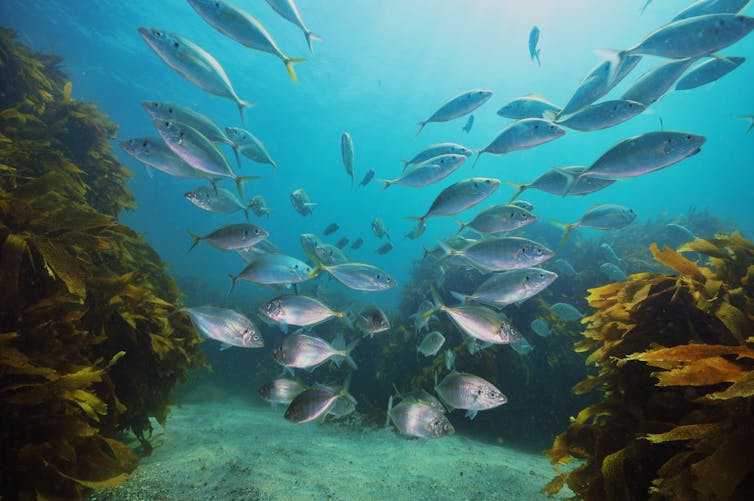 Climate change already affects marine species and food webs.
CC BY-ND
4. Marine reserves and protected areas
Marine protected areas are widely recognised as important tools for marine conservation and fisheries management. But less than 1% of New Zealand’s waters is protected to date. Future directions include research to identify where and how we should be implementing more protected areas, whether different models (including protection of customary fisheries and temporary fishing closures) could be as effective, and how we might integrate New Zealand’s marine protection into a wider Pacific network.
Read more:
Squid team finds high species diversity off Kermadec Islands, part of stalled marine reserve proposal
5. Ecosystems and biodiversity
While we know about 15,000 marine species, there may be as many as 65,000 in New Zealand. On average, seven new species are identified every two weeks, and there is much we do not know about our oceans. We need research to understand how we can best identify the current baseline of biodiversity across New Zealand’s different marine habitats, predict marine tipping points and restore degraded ocean floor habitats.
6. Policy and decision making
New Zealand’s policy landscape is complicated, at times contradictory, and we need an approach to marine management that better connects science, decision making and action. We also need to understand how to navigate power in decision making across diverse interests to advance an integrated ocean policy.
7. Marine guardianship
Marine guardianship, or kaitiakitanga, means individual and collective stewardship to protect the environment, while safeguarding marine resources for future generations. Our research found that citizen science can help maximise observations of change and connect New Zealanders with their marine heritage. It can also improve our understanding of how we can achieve a partnership between Western and indigenous science, mātauranga Māori.
8. Coastal and ocean processes
New Zealand’s coasts span a distance greater than from the south pole to the north pole. Erosion and deposition of land-based sediments into our seas has many impacts and affects ocean productivity, habitat structure, nutrient cycling and the composition of the seabed.
Future research should focus on how increased sedimentation affects the behaviour and survival of species at offshore sites and on better methods to measure physical, chemical and biological processes with higher accuracy to understand how long-term changes in the ocean might influence New Zealand’s marine ecosystems.
9. Other anthropogenic factors
Our study identified a range of other human threats that need more focused investigation, including agriculture, forestry mining and urban development.
We need more research into the relative effects of different land-use types on coastal water quality to establishing the combined effects of multiple contaminants (pesticides, pharmaceuticals, etc) on marine organisms and ecosystems. Pollution with microplastics and other marine debris is another major issue.
We hope this horizon scan will drive the development of new research areas, complement ongoing science initiatives, encourage collaboration and guide interdisciplinary teams. The questions the New Zealand marine science community identified as most important will help us fill existing knowledge gaps and make greater contributions to marine science, conservation, sustainable use, policy and management.
Climate change already affects marine species and food webs.
CC BY-ND
4. Marine reserves and protected areas
Marine protected areas are widely recognised as important tools for marine conservation and fisheries management. But less than 1% of New Zealand’s waters is protected to date. Future directions include research to identify where and how we should be implementing more protected areas, whether different models (including protection of customary fisheries and temporary fishing closures) could be as effective, and how we might integrate New Zealand’s marine protection into a wider Pacific network.
Read more:
Squid team finds high species diversity off Kermadec Islands, part of stalled marine reserve proposal
5. Ecosystems and biodiversity
While we know about 15,000 marine species, there may be as many as 65,000 in New Zealand. On average, seven new species are identified every two weeks, and there is much we do not know about our oceans. We need research to understand how we can best identify the current baseline of biodiversity across New Zealand’s different marine habitats, predict marine tipping points and restore degraded ocean floor habitats.
6. Policy and decision making
New Zealand’s policy landscape is complicated, at times contradictory, and we need an approach to marine management that better connects science, decision making and action. We also need to understand how to navigate power in decision making across diverse interests to advance an integrated ocean policy.
7. Marine guardianship
Marine guardianship, or kaitiakitanga, means individual and collective stewardship to protect the environment, while safeguarding marine resources for future generations. Our research found that citizen science can help maximise observations of change and connect New Zealanders with their marine heritage. It can also improve our understanding of how we can achieve a partnership between Western and indigenous science, mātauranga Māori.
8. Coastal and ocean processes
New Zealand’s coasts span a distance greater than from the south pole to the north pole. Erosion and deposition of land-based sediments into our seas has many impacts and affects ocean productivity, habitat structure, nutrient cycling and the composition of the seabed.
Future research should focus on how increased sedimentation affects the behaviour and survival of species at offshore sites and on better methods to measure physical, chemical and biological processes with higher accuracy to understand how long-term changes in the ocean might influence New Zealand’s marine ecosystems.
9. Other anthropogenic factors
Our study identified a range of other human threats that need more focused investigation, including agriculture, forestry mining and urban development.
We need more research into the relative effects of different land-use types on coastal water quality to establishing the combined effects of multiple contaminants (pesticides, pharmaceuticals, etc) on marine organisms and ecosystems. Pollution with microplastics and other marine debris is another major issue.
We hope this horizon scan will drive the development of new research areas, complement ongoing science initiatives, encourage collaboration and guide interdisciplinary teams. The questions the New Zealand marine science community identified as most important will help us fill existing knowledge gaps and make greater contributions to marine science, conservation, sustainable use, policy and management.
Authors: Rebecca Jarvis, Research Fellow, Auckland University of Technology


















