

Opera is stuck in a racist, sexist past, while many in the audience have moved on
- Written by: Caitlin Vincent, Lecturer in Creative Industries, University of Melbourne
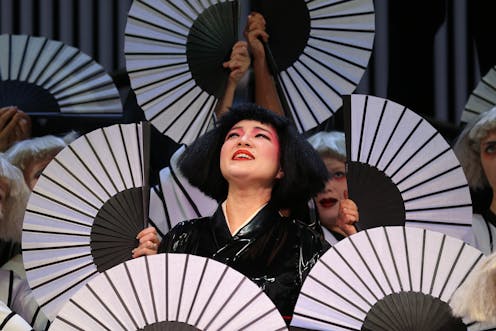
In the first act of Stephen Sondheim and Hugh Wheeler’s musical A Little Night Music, the long-suffering Countess Charlotte Malcolm mentions her younger sister, noting, “Dear Marta has renounced men and is teaching gymnastics in a school for retarded girls in Bettleheim”.
When first written for the show’s Broadway premiere in 1973, this was intended as a laugh line that transitions into the famous duet, Every Day a Little Death. But nearly 50 years later, it stands out for all the wrong reasons.
During Victorian Opera’s recent production of the musical in Melbourne, the use of the pejorative term “retarded” prompted an audible intake of breath from the audience, with many visibly shifting in their seats.
When the performers began the duet, the audience’s discomfort was largely forgotten. Yet the moment highlights one of the most significant challenges facing opera companies in the 21st century: an ever-widening gap between a repertoire that is frozen in time and an audience that is continuing to evolve.
This issue is increasingly coming to the fore in opera circles, as the stories presented on stage seem more and more removed from the modern realities of #MeToo and efforts to achieve racial and gender equality. In Australia recently, more than 190 composers, directors, and musicians signed a call to action to remove sexism and gendered violence from operatic works.
But the problem is deep-rooted and stems from opera’s nature as a historical art form.
The problem of the canon
The music and text of an opera are largely fixed, but stage interpretations can vary wildly depending on the performers, stage direction, design, venue, and budget.
This tension between score and stage has existed since opera’s emergence in 17th century Venice. With the turn of the 20th century, however, the operatic canon became codified as a collection of Greatest Hits, in which long dead composers like Mozart, Puccini, Verdi, Wagner, and Rossini still reign supreme.
Opera companies are diversifying their programming with musical theatre, 20th century offerings (for example, works by British composer Benjamin Britten), and newly-commissioned works. Still, consider the five most performed operas in the world in 2018-2019: La Traviata, The Magic Flute, La bohème, Carmen, and The Barber of Seville. The most recent of these? La bohème, which premiered in 1896.
It’s not surprising that some of opera’s most canonical works struggle to find relevance with a modern-day audience. But this tension reaches a boiling point when it comes to operas that contain racist and misogynistic elements.
See, for example, the ethnic exoticism deployed in Puccini’s Madama Butterfly and Delibes’ Lakmé; the Chinese stereotypes in Puccini’s Turandot, the lightly-veiled anti-Semitism in Wagner’s Ring Cycle, the Muslim caricatures in Mozart’s The Abduction from the Seraglio, and the gendered violence in Bizet’s Carmen and Puccini’s Tosca, to name just a few.
Read more: Why we must keep talking about Wagner and antisemitism
Many of these works have become even more problematic because of longstanding production conventions. Up until 2015, white tenors were still wearing “blackface” makeup when performing the titular role in Otello at The Metropolitan Opera. Productions of Madama Butterfly, Turandot, and The Mikado regularly put non-Asian performers in “yellowface” makeup.
Russian soprano Anna Netrebko recently caused a firestorm on social media after posting a selfie of herself wearing “brownface” makeup for a production of Aida.
Opera Australia prompted a similar backlash after casting a non-Hispanic performer as Maria for its 2019 production of West Side Story, a work with its own lengthy tradition of white performers playing Puerto Rican characters.
Opera traditionalists have long clung to the view that opera productions should function as historical artefacts, adhering to the intentions of the original composer and librettist as well as the way a work has “always” been done. The Facebook page Against Modern Opera Productions, which boasts more than 59,000 followers, is an online bastion of this viewpoint.
But when a work’s score and staging traditions are at odds with modern-day cultural norms, traditionalists may find themselves defending aspects of works that, in any other context, would be classified as racist and/or sexist.
Strategies for change
As opera audiences continue to dwindle, companies need to find a way forward that doesn’t alienate either traditionalists or the younger, more socially-minded generation.
One strategy used by the Canadian Opera Company was to rewrite the dialogue for Mozart’s The Abduction from the Seraglio in order to remove racist language. Companies such as Seattle Opera have endeavoured to foster dialogue around troubling works like Madama Butterfly by scheduling accompanying events on diversity and representation.
Another common strategy is to commission new translations or use modernised supertitles (the opera equivalent of subtitles) that revise outdated language. In the case of Victorian Opera’s A Little Night Music, a minor edit to replace “retarded” with an alternate term might have been appropriate.
More generally, arts organisations are facing broader calls to diversify their casts and creative teams. The US-based organisation Final Bow for Yellow Face actively lobbies companies to “replace caricature with character” in productions across ballet, opera, and theatre.
These goals are difficult to achieve, particularly when traditional productions of works like Madama Butterfly and Turandot regularly pack in audiences worldwide. As audiences continue to evolve, however, the opera industry will soon need to grapple with larger questions about which works still belong in the “canon”.
In the meantime, perhaps the best option is to imagine what the original composer and librettist would really want. Would they rather have an audience that is wholly engrossed in the narrative unfolding on stage … or one that is uncomfortably shifting in their seats?
Authors: Caitlin Vincent, Lecturer in Creative Industries, University of Melbourne


















