

If NZ wants to decarbonise energy, we need to know which renewables deliver the best payback
- Written by: Alan Brent, Professor and Chair in Sustainable Energy Systems, Te Herenga Waka — Victoria University of Wellington
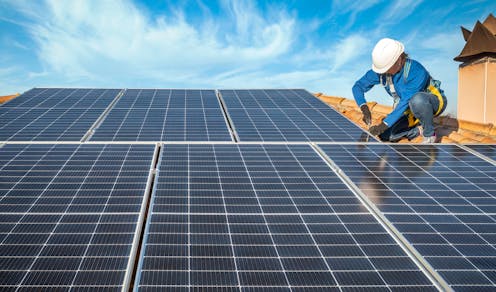
A national energy strategy for Aotearoa New Zealand was meant to be ready at the end of last year. As it stands, we’re still waiting for a cohesive, all-encompassing plan to meet the country’s energy demand today and in the future.
One would expect such a plan to first focus on reducing energy demand through improved energy efficiency across all sectors.
The next step should be greater renewable electrification of all sectors. However, questions remain about the cradle-to-grave implications of investments in these renewable resources.
We have conducted life-cycle assessments of several renewable electricity generation technologies, including wind and solar, that the country is investing in now. We found the carbon and energy footprints are quite small and favourably complement our current portfolio of renewable electricity generation assets.
Meeting future demand
The latest assessments provided by the Ministry of Business, Employment and Innovation echo earlier work by the grid operator Transpower. Both indicate that overall demand for electricity could nearly double by 2050.
Many researchers believe these scenarios are an underestimate. One study suggests the power generation capacity will potentially need to increase threefold over this period. Other modelling efforts project current capacity will need to increase 13 times, especially if we want to decarbonise all sectors and export energy carriers such as hydrogen.
This is, of course, because we want all new generation to come from renewable resources, with much lower capacity factors (the percentage of the year they deliver power) associated with their variability.
Additional storage requirements will also be enormous. Following the termination of work on a proposed pumped hydro project, other options need investigating.
Building renewable generation
The latest World Energy Outlook published by the International Energy Agency (IEA) shows that wind and solar, primarily photovoltaic panels, are quickly taking over as the primary renewable technologies.
This is also true in Aotearoa New Zealand. An updated version of the generation investment survey, commissioned by the Electricity Authority, shows most of the committed and actively pursued projects (to be commissioned by 2030) are solar photovoltaic and onshore wind farms.
Offshore wind projects are on the horizon, too, but have been facing challenges such as proposed seabed mining in the same area and a lack of price stabilisation measures typical in other jurisdictions. New legislation aims to address some of these challenges.
Distributed solar power (small-scale systems to power homes, buildings and communities) has seen near-exponential growth. Our analysis indicates wind (onshore and offshore) and distributed solar will make an almost equal contribution to power generation by 2050, with a slightly larger share by utility-scale solar.
Cradle-to-grave analyses
The main goal is to maintain a stable grid with secure and affordable electricity supply. But there are other sustainability considerations associated with what happens at the end of renewable technologies’ use and where their components come from.
The IEA’s Global Critical Minerals Outlook shows the fast-growing global demand for a suite of materials with complex supply chains. We have also investigated the materials intensity of taking up these technologies in Aotearoa New Zealand, and discussed the greater dependence on those supply chains.
The challenges in securing these metals in a sustainable manner include environmental and social impacts associated with the mining and processing of the materials and the manufacturing of different components that need to be transported for implementation here. There are also operating and maintenance requirements, including the replacement of components, and the dismantling of the assets in a responsible manner.
We have undertaken comprehensive life-cycle assessments, based on international standards, of the recently commissioned onshore Harapaki wind farm, a proposed offshore wind farm in the South Taranaki Bight, a utility-scale solar farm in Waikato and distributed solar photovoltaic systems, with and without batteries, across the country.
The usual metrics are energy inputs and carbon emissions because they describe the efficiency of these technologies. They are considered a first proxy of whether a technology is appropriate for a given context.
Beyond that, we used the following specific metrics, as summarised in the table below:
GWP: global warming potential (carbon emissions during a technology’s life cycle per energy unit delivered).
CPBT: carbon payback time (how long a technology needs to be operational before its life cycle emissions equal the avoided emissions, either using the grid and its associated emissions or conventional natural gas turbines).
CED: cumulative energy demand over the life cycle of a technology.
EPBT: energy payback time (how long a technology needs to be operational before the electricity it generates equals the CED).
EROI: energy return on investment (the amount of usable energy delivered from an energy source compared to the energy required to extract, process and distribute that source, essentially quantifying the “profit” from energy production).
There is much debate about the minimum energy return on investment that makes an energy source acceptable. A value of more than ten is generally viewed as positive.
For all technologies we assessed, the overall greenhouse gas emissions are lower than the grid emissions factor. Because of New Zealand’s already low-emissions grid, the carbon payback time is around three to seven years for utility-scale generation. But for small-scale, distributed generation it can be up to 13 years. If the displacement of gas turbines is considered, the payback is halved.
Energy return on investment is above ten for all technologies, but utility-scale generation is better than distributed solar, with values of between 30 and 75.
To put this into perspective, the energy return on investment for hydropower, if operated for 100 years, is reported to be 110. Utility-scale wind and solar being commissioned now have an operational life of 30 years but are typically expected to be refurbished.
This means their energy return on investment is becoming comparable to hydropower.
Authors: Alan Brent, Professor and Chair in Sustainable Energy Systems, Te Herenga Waka — Victoria University of Wellington


















