

Meet the endangered Bunyip bird living in Australia's rice paddies
- Written by: Matt Herring, PhD Candidate, Charles Darwin University
The debate around the Murray-Darling Basin is often sharply polarised: irrigation is destroying the environment, or water reforms are ruining farming communities.
But there is another story. In the Riverina region of southern New South Wales, a strange waterbird is using rice fields to live in and breed.
The endangered Bunyip Bird, also called the Australasian Bittern, is famous for its deep booming call – for thousands of years thought to be the sound made by the mythical Bunyip.
It’s a sound now familiar to most rice growers. In 2012, Birdlife Australia and the Ricegrowers’ Association teamed up to learn more about bitterns in rice. The total bittern population, including New Zealand and New Caledonia, is estimated at no more than 2,500 adults.
Read more: Why a wetland might not be wet
The first question was how many bitterns are using rice crops. After surveying the birds on randomly selected farms, we crunched the numbers. Our results, just published, are staggering.
Across the Riverina, we conservatively estimate these rice crops attract 500-1,000 bitterns during the breeding season, about 40% of global population. It turns out the way rice is grown provides ideal water depths and vegetation heights for bitterns. It’s also favourable for their prey: frogs and tadpoles, fish and yabbies.
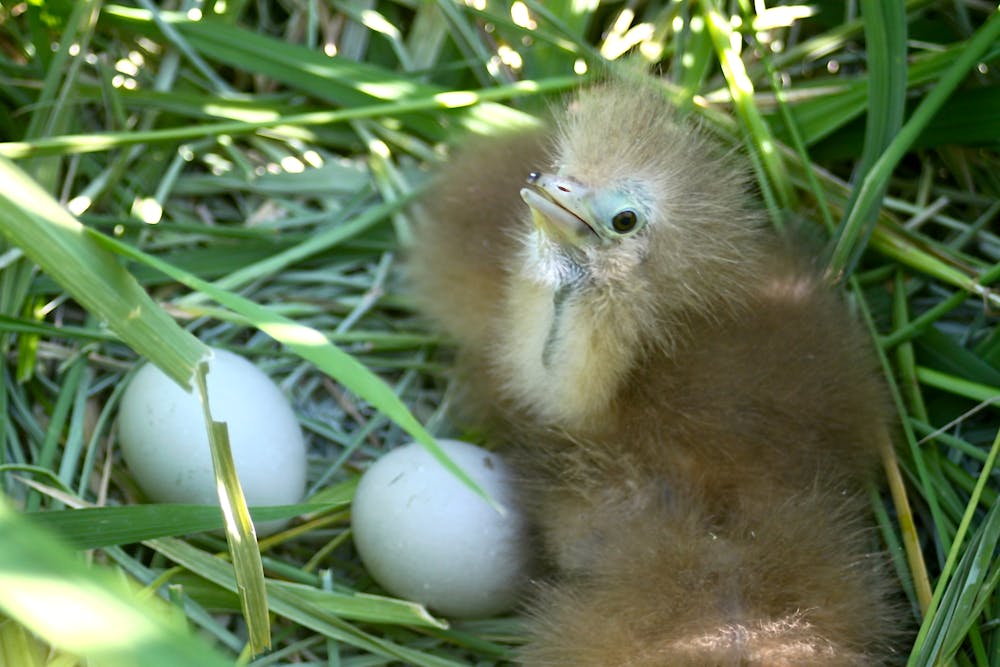 A bittern nest with chicks and eggs.
Matt Herring, Author provided
A bittern nest with chicks and eggs.
Matt Herring, Author provided
There is a growing body of global research investigating how human-made habitats can help fill the gap left by our vanishing wetlands, from ditches for rare turtles to constructed ponds for threatened amphibians. Rice fields around the world show great promise as well, with various “wildlife-friendly” farming initiatives. In California, farmers re-flood harvested fields to support thousands of migratory shorebirds and waterfowl, while in Japan consumers pay a premium for “Stork Rice” to help endangered species.
Read more: For the first time we've looked at every threatened bird in Australia side-by-side
However, rice fields are no substitute for natural wetlands, and it’s now clear both play a crucial role in sustaining the bittern population.
Satellite tracking has shown us that at harvest time bitterns disperse to some of southeastern Australia’s most important wetlands, including the Barmah-Millewa system along the Murray River, Coomonderry Swamp near Shoalhaven Heads in New South Wales, Pick Swamp in South Australia, and Tootgarook Swamp on the Mornington Peninsula near Melbourne.
Rice farming in Australia’s Riverina has a century-long history. The amount grown varies greatly from year to year, depending on water allocations, and ranged from 5,000-113,000 hectares over the past decade. Around 80% is exported and it provides food for up to 20 million people each year.
Driven by water efficiency, many rice growers in the Riverina are switching their methods to intermittent flooding and not “ponding” the water – maintaining inundated fields – until later in the season.
A shorter ponding period will likely reduce opportunities for the bitterns to breed successfully before harvest. Another threat to bitterns is farmers switching to alternative crops and horticulture, none of which provides them habitat.
 Around 40% of the global Australasian bittern population come to the Riverina’s rice fields.
Matt Herring, Author provided
Around 40% of the global Australasian bittern population come to the Riverina’s rice fields.
Matt Herring, Author provided
During the 2017-18 irrigation season, there was more cotton grown than rice for the first time in the Riverina. It’s usually simple economics: irrigators will generally grow whatever gives them the best return per megalitre of water, with their choice having no net effect on the overall amount of irrigation water used in the system.
Water management in the Murray-Darling Basin is complicated, with fluctuating temporary water prices and trading between catchments. Water is allocated to either agriculture or the environment, setting up a dichotomy. But we think allocations to serve a single purpose may be overly simplistic, and the way bitterns use rice offers a case study for considering multi-purpose water use.
Working closely with growers, we are identifying ways to develop cost-effective incentive programs for bittern-friendly rice growing, where a sufficient ponding period is provided, with complementary habitat on banks, in crop edges and adjacent constructed wetland refuges. The aim is to boost the bittern population with the help of rice farmers.
 Bitterns can nest and feed in rice paddies, but they depend on fields being flooded.
Matt Herring, Author provided
Bitterns can nest and feed in rice paddies, but they depend on fields being flooded.
Matt Herring, Author provided
We are also surveying consumers about their attitudes towards bittern-friendly rice. Would you pay a premium for rice products that offset additional costs to growers for bittern conservation? How do you feel about adjusting water and conservation policies?
Read more: Protecting the world's wetlands: 5 essential reads
Bitterns are not the only threatened species that use the Riverina’s rice fields. The endangered Southern Bell Frog and Australian Painted Snipe have also adapted to rice crops, and it’s likely there are significant populations of other species too.
With 61% of Australia managed by farmers, the need to incorporate wildlife conservation on farms has never been greater. We hope our work will help address the divisive, sometimes toxic debate around water use in the Murray-Darling Basin, uniting irrigators and environmentalists.
Authors: Matt Herring, PhD Candidate, Charles Darwin University
Read more http://theconversation.com/meet-the-endangered-bunyip-bird-living-in-australias-rice-paddies-120342


















