

Despite China's denials, its treatment of the Uyghurs should be called what it is: cultural genocide
- Written by: James Leibold, Associate Professor of Politics and Asian Studies, La Trobe University
As China grows more powerful and influential, our New Superpower series looks at what this means for the world – how China maintains its power, how it wields its power and how its power might be threatened. Read the rest of the series here.
In China’s far western region of Xinjiang, Chinese Communist Party officials are persecuting one of the worst human rights abuses of our time, what I labelled an act of cultural genocide in last week’s ABC Four Corners report.
Pressure is mounting on the Australian government to go beyond statements of concern and challenge China over its treatment of the Uyghur minority, particularly those Australian citizens and permanent residents being held in the vast network of “re-education camps” in Xinjiang.
Two Australian Uyghur men are meeting federal politicians in Canberra today to push for the government’s assistance in helping family members trapped in China.
Australia was one of 22 countries to sign a recent letter to the UN High Commissioner for Human Rights expressing concern about the “arbitrary detention” of Uyghurs, but otherwise, its response has been muted.
In recent days, the Chinese government has defended its actions with a dubious propaganda report claiming that Uyghurs were historically forced to become Muslims and have been an integral part of China for thousands of years.
China repeatedly makes false and anachronistic claims like this about the ancient unity of the “Chinese people,” which includes ethnic minorities like the Uyghurs. Its aim is to project modern notions of sovereignty, nationhood and fixed borders back through history.
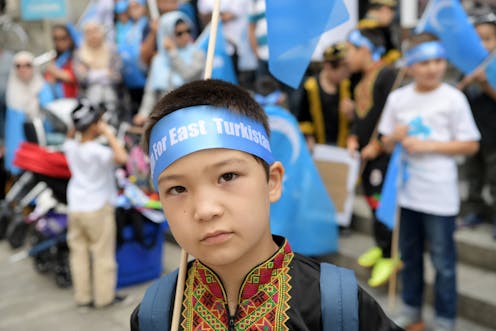
In reality, the 11 million or so Uyghurs are an indigenous Turkic-speaking people who have inhabited what they call “East Turkestan” for over a millennium. Along with the Tibetans, the Uyghurs have born the brunt of China’s settler colonial project, which seeks to assert its control over remote regions that are closer to Moscow and Tehran than Beijing.
Since March 2017, the Chinese government has interned over a million Uyghurs and other Muslim minorities in massive, prison-like camps (including possibly 17 Australian residents), where they are subjected to coercive ideological remoulding.
Detainees are forced to denounce their religion, forbidden to speak their language, and taught how to adopt the norms of China’s Han ethnic majority, while praising President Xi Jinping and the Communist Party for salvation.
In their own words, party officials are “washing brains” and “cleansing hearts” in order to “cure” those bewitched by extremist thoughts. In Xinjiang today, non-Han thoughts and behaviour are pathologised as deviant and thus in need of urgent transformation.
What is genocide?
A litany of words and phrases have been used to describe this process. The Chinese government calls the camps free “vocational education and training centres” where Uyghurs willingly learn Chinese language and employment skills in order to assist with their “rehabilitation and reintegration”.
Scholars, journalists and rights defenders have spoken about cultural and religious “persecution” in Xinjiang, arguing the party-state’s policies amount to mass ethnic cleansing, cultural re-engineering, forced assimilation, brainwashing, or even ethnocide.
In August 2018, Gay McDougall, the vice chair of UN Committee on the Elimination of Racial Discrimination, referred to Xinjiang as a “no-rights zone”.
Yet, I believe the scale, sophistication and intent of China’s policies in Xinjiang merits a stronger description.
Read more: The world has a hard time trusting China. But does it really care?
The term genocide was coined by lawyer Rafael Lemkin in 1944 in reaction to Nazi Germany’s coordinated strategy to annihilate the Jews, gypsies and other non-Aryan peoples. Four years later, the UN General Assembly adopted the Convention on the Prevention and Punishment of the Crime of Genocide, with Australia one of the first counties to ratify it. The People’s Republic of China ratified it in 1983.
The convention defines genocide as
acts committed with intent to destroy, in whole or in part, a national, ethnical, racial or religious group
It also obligates signatories to punish those who engage in genocidal acts through a “competent” domestic or international penal tribunal.
Whether genocide includes only physical acts or can extend to attacks on cultural heritage has elicited intense debate, but for Lemkin, the term includes
drastic methods aimed at the rapid and complete disappearance of the culture, moral and religious life of a group of human beings.
Genocide also requires specific intent. In the words of political scientists Kenneth J. Campbell, genocide is a
premeditated, calculated, systematic, malicious crime authorised by the state’s political leaders.
This is exactly what Communist Party officials did when they authorised and then legalised the mass internment of Uyghurs and other Muslim minorities in “concentrated transformation-through-education centres,” ripping more than 10% of the population away from their communities so they could be deliberately re-programmed.
Various methods for erasing culture
Yet, facts arguably matter more than words when it comes to China’s policies in Xinjiang.
We now have ample evidence (including internal party documents) of the deliberate efforts to destroy Uyghur culture and identity. Everyday actions like avoiding pork, speaking Uyghur, wearing a headscarf or praying quietly are now labelled “manifestations of religious extremism,” or what party officials call “malignant tumors” requiring urgent excising in a radical form of cultural surgery.
In the city of Kashgar, for example, a party document highlights the need to sever the lineages, roots and cultural connections of Uyghurs in order to eliminate the fountainhead of potential extremism.
German researcher Adrian Zenz has uncovered evidence of the party’s efforts to separate Uyghur children from their parents in state institutions, where they can be assimilated and indoctrinated by officials. In these institutions, cultural, religious, and linguistic knowledge is intentionally ruptured.
Read more: Explainer: who are the Uyghurs and why is the Chinese government detaining them?
In some parts of Xinjiang, mosques and shrines are being bulldozed, while others are transformed into empty sites guarded by facial recognition cameras and imams on the party payroll.
In the name of strengthening “bilingual education”, Chinese is now the language of instruction across Xinjiang, from preschool to university. The use of Uyghur language, script, signs and pictures prohibited. Speaking Uyghur is now considered unpatriotic and can get one sent off for re-education.
Perhaps most disturbing, inter-ethnic marriages are being actively promoted to slowly breed out Uyghurness, with cash and other material inducements offered to Han men who take a Uyghur bride.
One can find numerous videos and messages promoting Han-Uyghur inter-marriage on Chinese social media, asserting Xinjiang is now safe and home to many beautiful and eligible Uyghur women who would appreciate a doting Han husband.
Finally, the Chinese government has intensified its family planning regime in Xinjiang to slow the growth of the Uyghur population and eliminate what party officials call “low quality births”.
Beginning in 2017, the region adopted a uniform two children policy that nullified preferential rules allowing rural Uyghur women to have additional births. In the past, Uyghur women were given 3,000 RMB (roughtly A$620) to forgo a third birth and agree to some sort of “long-term contraceptive measure.”
The Communist Party’s calculated war on Uyghur identity is quite literally tearing families and communities apart, while the rich tradition of diversity and tolerance in China is left in tatters.
The resilient nature of culture and memory means that attempts at genocide, thankfully, are rarely successful. Yet the pain they inflict is real.
Authors: James Leibold, Associate Professor of Politics and Asian Studies, La Trobe University


















