

The origin story of the Anzac biscuit is largely myth – but that shouldn’t obscure the history of women during the war
- Written by: Garritt C. Van Dyk, Senior Lecturer in History, University of Waikato
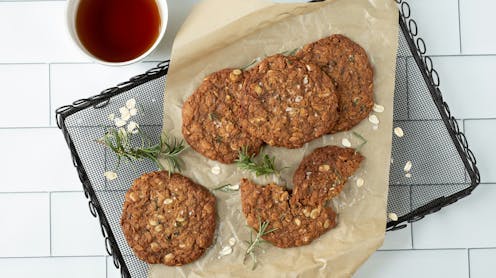
The Anzac biscuit is a cultural icon, infused with mythical value, representing the connection between women on the home front and soldiers serving overseas during the first world war.
A baked good developed to survive the trip to the trenches and lift the spirits of the troops has the seductive appeal of folklore specific to Australia and Aotearoa New Zealand.
There is another story linked to the myth, however, about women who worked to provide necessities and small comforts to those serving in the Australian and New Zealand Army Corps.
The Anzac biscuit myth
Soldiers at the front had biscuits, of a sort, in their rations but these were more like 18th century “ship’s biscuit”, or hard tack, called “tile”, “wafers”, or “army biscuits”.
Made from flour, water and dry milk, tile was nonperishable and didn’t get mouldy, but it was so hard it had to be soaked before eating to avoid cracking a tooth. Soldiers would sometimes grate the moistened biscuit and cook it with water for an improvised porridge.
The biscuits were so tough that soldiers even used them as stationery.
Cakes and biscuits in sealed tins were requested as donations from the public, but had to meet requirements to ensure they would not spoil by the time they arrived.
It is unlikely Anzac biscuits made according to today’s recipe were packed in tins by mothers, wives and girlfriends and shipped overseas to soldiers. As a matter of practicality, shredded coconut included in the recipe would have probably become rancid in transit.

The idea of our modern Anzac biscuits being sent to the front line is most likely an invented tradition, created after the fact. The first thing we would recognise as our current recipe did not appear until 1927.
But women were sending biscuits, and more, to their men on the front lines in the crucial role of providing creature comforts.
The War Chest Cookery Book
The Australian Comforts Fund was a national group founded in 1916 to coordinate state volunteer organisations, run mainly by women.

In 1917, the New South Wales branch printed the The War Chest Cookery Book. Paid advertisements on every page allowed the fund to donate all proceeds from the sale of the cookbook “to substantially augment the funds of the War Chest”.
In this book we find the first printed recipe for a biscuit with “Anzac” in the title. The recipe bears no resemblance to today’s version, except for the name. Neither oats nor coconut were included. Instead, the recipe called for eggs, rice flour, cinnamon and mixed spice, and the baked biscuits were sandwiched together with jam and topped with icing.
The motto of the Australian Comforts Fund, “keep the fit man fit”, differentiated their mission from the lifesaving supplies delivered by the Red Cross.
The war chest allowed the distribution of nonessential items that included necessities like such as socks, mittens and singlets, but also comforts of home like such as pyjamas, razor blades and tobacco.
Special shipments included morale boosters like such as Christmas hampers with plum puddings, gramophones, sporting goods, postcards and pencils.
 Women from the Australian Comforts Fund distributing packages to soldiers in Abbassieh, Egypt, during the first world war.
State Library Victoria
Women from the Australian Comforts Fund distributing packages to soldiers in Abbassieh, Egypt, during the first world war.
State Library Victoria
Women in the fund also ran canteens near the front serving soup, coffee, tea, and cocoa. The fund provided twelve million mugs of hot drinks between January 1917 and June 1918 alone.
A soldier’s memoir from the winter of 1916 in the Somme recalled how the promise of the kitchen kept him going:
We desire to acknowledge our debt to the Australian Comforts Fund. Their soup kitchen was the goal to which even the weariest man persevered during the dreadful outward journeys from the line.
A dubious debut: not your Nan’s Anzac biscuit
Today, Anzac biscuits baked for commercial production and sale must adhere to the Australian Department of Veteran Affairs Guidelines, established in 1994, which regulate the use of the word Anzac (and prohibit the use of the word “cookie” to describe them).
This first iteration of Anzac biscuits would most certainly not comply with the guidelines as they “substantially deviate from the accepted recipe” which features ingredients including oats, golden syrup and coconut.
 The modern day Anzac biscuit is prescriptive – but it took a long time to be standardised.
AAP Image/Stephanie Flack
The modern day Anzac biscuit is prescriptive – but it took a long time to be standardised.
AAP Image/Stephanie Flack
Two other recipes in the War Chest Cookbook for rolled oat biscuits are closer, and omit eggs, but they lack the binding power of golden syrup and the characteristic crunch of desiccated coconut.
The combination of oats and golden syrup first appears in the Melbourne newspaper The Argus on September 15 1920 when Josephine, from East Brunswick, contributed her recipe for “ANZAC Biscuits or Crispies”.
A recipe for Anzac biscuits with “cocoanut” was not published until the late 1920s, in the Brisbane Sunday Mail on June 26 1927.
This late introduction of the full recipe is a reminder that while biscuits got sent overseas, they were not the “official” Anzac biscuits we know today.
 Australian Comforts Fund buffet in Longueval, France, 1916.
Australian War Memorial
Australian Comforts Fund buffet in Longueval, France, 1916.
Australian War Memorial
The story behind the biscuit
Defining and preserving the identity of the Anzac biscuit affirms a tangible symbol of national identity. While the recipe may have been invented after the fact, a consistent standard encourages the continuity of remembrance through the uniformity of a shared tradition.
 Women packing food for the Australian Comfort Fund’s war chests.
Mitchell Library, State Library of New South Wales
Women packing food for the Australian Comfort Fund’s war chests.
Mitchell Library, State Library of New South Wales
The myth of domestic bakers dispatching this specific recipe to soldiers, however, should not eclipse the efforts of the Australian Comforts Fund, fundraising on a national scale, and running makeshift canteens in a war zone.
Women weren’t just baking in their kitchens: they were organising and delivering resources at home and overseas, benefiting soldiers at the front lines.
Authors: Garritt C. Van Dyk, Senior Lecturer in History, University of Waikato

















