

Echidna ancestors lived watery lifestyles like platypuses 100 million years ago – new study
- Written by: Sue Hand, Professor Emeritus, Palaeontology, UNSW Sydney
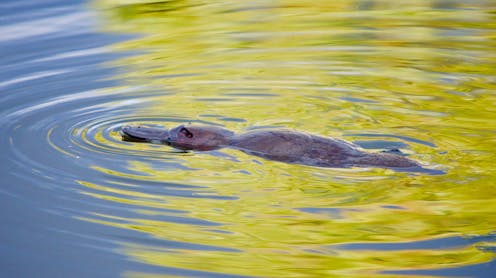
As the world’s only surviving egg-laying mammals, Australasia’s platypus and four echidna species are among the most extraordinary animals on Earth.
They are also very different from each other.
The platypus is well adapted for a semi-aquatic lifestyle, spending up to 20 hours a day swimming in Australian waterways to forage for freshwater invertebrates. Echidnas, on the other hand, live entirely on land. They are widely distributed across Australia and New Guinea, and adapted for feeding on termites, ants and earthworms.
How did these differences emerge? Some researchers think echidnas evolved from a swimming, platypus-like ancestor. This hypothesis is based on evidence from aspects of their genes and anatomy, and from hypotheses about their evolutionary history.
However, this idea is controversial because fossil evidence for such a profound evolutionary transformation has been lacking – until now.

A bone from 108 million years ago
In our study published today in PNAS, we gleaned new data from a 108-million-year-old mammal humerus (arm bone), found 30 years ago at Dinosaur Cove, Victoria, by a team from Museums Victoria.
This arm bone, from a species called Kryoryctes cadburyi, belongs to an ancestral monotreme – a semi-aquatic burrower like the platypus. Our findings support the hypothesis that land-living echidnas evolved from a swimming ancestor.
Kryoryctes lived during the Age of Dinosaurs (the Mesozoic), when monotremes and monotreme relatives were more common than they are today. Glimpses of this past diversity are found in the fossil record in southern Victoria and Lightning Ridge, New South Wales.
Nevertheless, Australian Mesozoic mammal fossils are exceedingly rare, and mostly consist of teeth and jaws. Kryoryctes is the only one known from a limb bone, which provides significant information about its identity, relationships and lifestyle.

Tiny clues inside bones
In order to test the evolutionary relationships of Kryoryctes, we added it to a broader data set of 70 fossil and modern mammals. From there, we calculated an evolutionary tree. This showed Kryoryctes is an ancestral monotreme.
We also compared the external shape of the Kryroryctes humerus bone to living monotremes. These analyses indicated the bone is more like those of echidnas, rather than platypuses.
But it was a different story on the inside. When we looked at the internal structure of the Kryoryctes humerus with several 3D scanning techniques, we uncovered microscopic features of this arm bone that were actually more like those of the platypus.
Such tiny features inside bones yield crucial clues about the lifestyle of an animal. Numerous previous studies link bone microstructure in mammals and other tetrapods (four-limbed animals) with their ecology.
Using the wealth of data available for living mammals, we compared characteristics of the Kryoryctes humerus microstructure to those in platypuses, echidnas and 74 other mammal species.
These analyses confirmed that the Kryoryctes humerus has internal bone features found in semi-aquatic burrowing mammals (such as the platypus, muskrat and Eurasian otter), rather than land-living burrowing mammals such as the echidna.
 The Kryoryctes humerus we studied.
Museums Victoria
The Kryoryctes humerus we studied.
Museums Victoria
From water to land
This discovery suggests that a semi-aquatic lifestyle is ancestral for all living monotremes. It also suggests the amphibious lifestyle of the modern platypus had its origins at least 100 million years ago, during the Age of Dinosaurs.
In this scenario, the modern platypus lineage has retained the ancestral semi-aquatic burrowing lifestyle for more than 100 million years. Echidnas would have reverted to a land-based way of life more recently.
For echidnas, a return to land appears to have resulted in adaptations such as their long bones becoming lighter, as shown in our study.
They possibly also lost several other features more useful for spending time in the water rather than on land, including the loss of a long tail, reduction of webbing between fingers and toes, reduction of the duck-like bill to a narrow beak, and a reduced number of electroreceptors on that beak.
However, precisely when this evolutionary transformation occurred is not yet known. The answer must wait until early echidna fossils are found – so far, nothing definitive has turned up anywhere.
The modern habitats of monotremes are increasingly under threat from environmental degradation, interactions with humans and feral predators, and climate change. This is especially true for platypuses. To ensure the survival of this ancient lineage, we need to better understand how their unique features evolved and adapted.
Authors: Sue Hand, Professor Emeritus, Palaeontology, UNSW Sydney

















