

A rubbish election: voting in Australia produces mountains of waste
- Written by: Lisa M. Given, Professor of Information Sciences & Director, Social Change Enabling Impact Platform, RMIT University
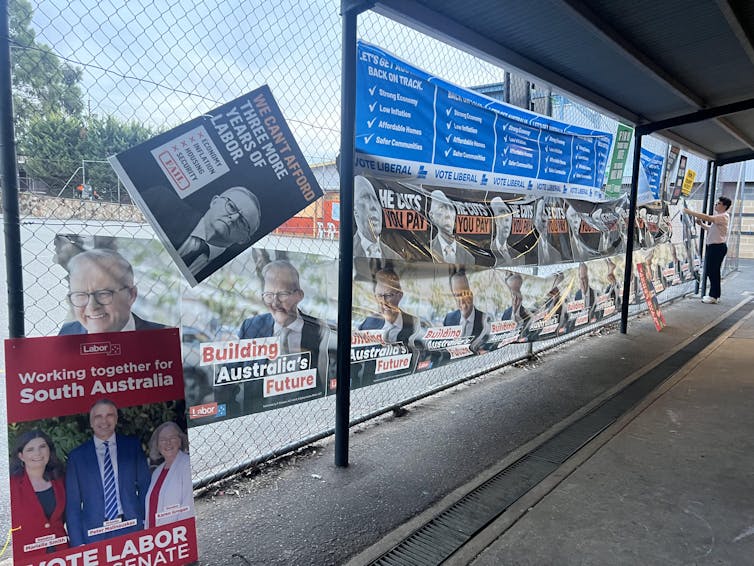
More than 18 million Australians voted on Saturday, after walking past countless corflutes, reading campaign flyers and reviewing how-to-vote cards.
The 2025 federal election was Australia’s biggest yet, with 710,000 more people on the electoral roll than in 2022. The Australian Election Commission amassed 250,000 pencils, 240,000 vests, 80,000 ballot boxes and 5,000 rolls of tamper-proof tape to stock some 7,000 polling places.
So, what happens to these materials after polling day? Some are warehoused, ready for reuse next time around. Others are repurposed. But every election also generates a mountain of waste for landfill.
It doesn’t have to be this way. Australia needs to mandate a cradle-to-grave approach to creating, using, recycling and disposing of election materials. Meanwhile, electronic machines and online voting can reduce the need for paper ballots, just as social media campaigns can reduce paper mail drops.

Where do election materials go after the polls close?
In response to inquiries from The Conversation, the Australian Election Commission said most AEC materials, such as tamper-proof tape, vests and pencils, are stored between elections at counting centres. Other materials, such as cardboard voting booths, are recycled or donated to schools or charities.
Most councils require corflutes to be collected within seven days of an election. But no rules govern reuse or disposal. Corflutes are made from polypropylene, a lightweight plastic that is technically recyclable. But it’s not a straightforward process, so most recycling facilities reportedly cannot accept this waste.
Some candidates donate corflutes to schools, childcare centres and charities, because the white reverse side can be used to mount artworks.
Second-hand corflutes have also been used as shelters for homeless people, heat shields for bee hives, or to repair damaged skylights. But no doubt many end up in landfill.
Are there alternatives?
Many countries are “greening” their elections. In 2019, India’s election commission directed parties to eliminate single-use plastic including corflutes. In 2024, the United Kingdom’s Westminster Foundation for Democracy outlined strategies for reducing election “pollution”, addressing supply chains and packaging.
Australia relies heavily on disposable election materials. While many of these can be recycled, it’s better to avoid single-use materials.
Parties could also display how-to-vote instructions on posters at election sites, rather than handing out individual flyers that are recycled or thrown away.
In 2022, the AEC introduced plain brown cardboard screens and ballot boxes, saying they are easier to recycle and reuse than previous versions “wrapped” in purple-and-white branded paper. However, Australian Electoral Commissioner Tom Rogers says elections will probably always be “highly manual and resource-intensive exercises”. We disagree.
Could Australia use electronic or online voting to reduce waste?
Other countries are introducing online voting to reduce waste. One study in Estonia found the carbon footprint of paper-based voting was 180 times greater than internet-based voting. More than 50% of the population voted online in 2023.
India introduced electronic voting machines in 1982 and mandated them, nationwide, in 2004. In 1999 alone this saved 7,700 tonnes of waste.
The United States introduced mechanical voting machines in the 1890s, punch cards and scanned ballots in the 1960s, and “direct-recording” electronic voting machines in the 1970s. Today, touch screens are used in many voting booths, with paper records for auditing. Now just 7% of districts rely on paper ballots and hand-counted ballots are rarely used.
Yet electronic voting machines are not without controversy. Security concerns after the 2016 US election resulted in 94% of districts shifting to optical scanning, and use of “direct-recording” electronic voting machines almost halved.
Ireland invested €50 million (A$88 million) into electronic voting machines in 2002, but they were never used due to concerns about potential tampering.
Australia should explore secure options for electronic voting machines and online voting. In its response to The Conversation, the AEC said this would be a matter for parliament to consider, because the law currently demands that elections are in-person events.
Can social media campaigning help?
Social media enables candidates and voters to engage in new ways. For instance, Labor senators Katy Gallagher and Penny Wong took part in a Facebook “pop quiz” on April 29, which had 55,000 views. But social media can amplify misinformation, so consumers need to fact-check what they see and hear online.
Combined, the parties and affiliated groups spent more than A$39 million on advertisements on YouTube, Facebook and Google during the 2025 campaign. The AEC had to update its authorisation guidelines to cover podcasters and other content creators.
This mirrors global shifts towards social media campaigning. During Canada’s 2025 campaign, Liberal leader Mark Carney (who went on to be elected prime minister) created a video with celebrity Mike Myers, reaching 10 million views.
While such creative approaches may engage voters, they still carry a carbon footprint. Carney and Myers’ video likely produced about six tonnes of CO₂ emissions due to the energy and electricity used in production, streaming and viewing.
Mike Myers and Mark Carney used social media creatively in Canada’s 2025 election campaign.Text messages also connect candidates with voters. Clive Palmer’s Trumpet of Patriots party sent 17 million texts the election campaign. This equates to 240kg of CO₂ emissions from energy-hungry data centres and personal devices.
This is less than the emissions the average Australian produces in a week. However, the unsolicited texts riled many voters, many concerned about privacy and who wanted to opt out.
What’s the solution?
Australia should mandate a reduction in the disposal of election materials.
Some print materials may always be needed, because not all voters can access digital content or vote online. But the current situation is unsustainable.
Global experiences show innovation is possible. Australia can reduce its reliance on new, physical materials, while maintaining public trust.
Australia’s newly elected officials have an opportunity to green future elections, adopting a more sophisticated approach to voting in a digital age. There’s no excuse for producing mountains of plastic and paper waste every three or four years. Our nation deserves better.
Authors: Lisa M. Given, Professor of Information Sciences & Director, Social Change Enabling Impact Platform, RMIT University


















