

Forest home of ‘polar dinosaurs’ 120 million years ago in southern Australia recreated in detail for the first time
- Written by: Vera Korasidis, Lecturer in Environmental Geoscience, The University of Melbourne
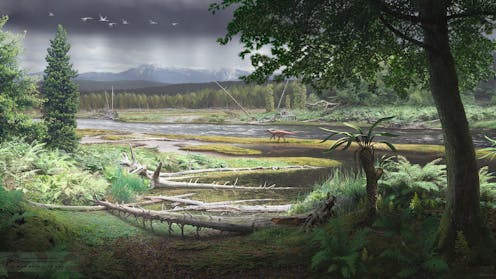
Roughly 140 million to 100 million years ago, the piece of land that is modern day Australia was located much further south on Earth. In fact, what is now Victoria was once within the polar circle, up to 80 degrees south of the equator and shrouded in darkness for months at a time.
Despite these harsh conditions, dinosaurs thrived here, leaving behind evidence of their existence at various palaeontological sites.
For decades, scientists have come to these sites to study the rocks containing the bones of these ancient creatures in order to better understand them.
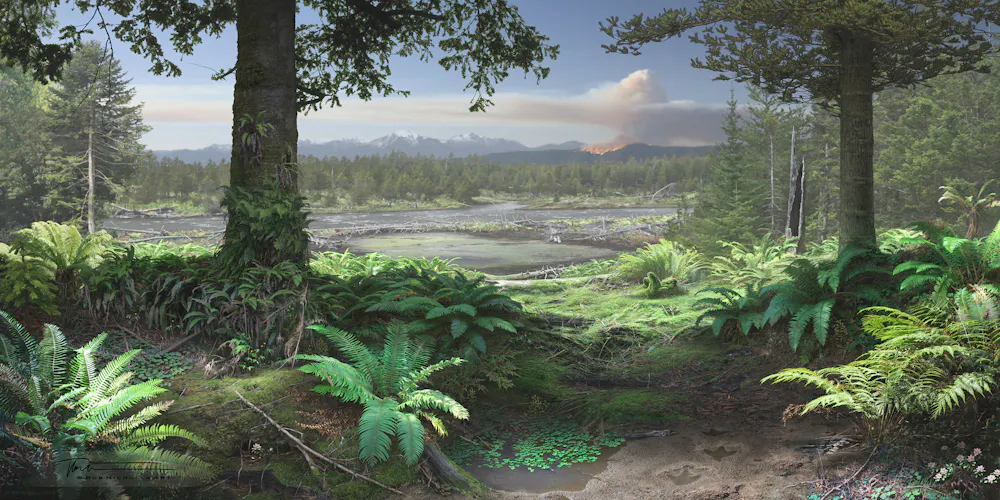
My new research with palynologist Barbara Wagstaff, published in Alcheringa, builds on existing knowledge by using plant fossils from bone-bearing sites in the region to explain how the forests these dinosaurs lived in evolved – and, for the first time, illustrating them in detail.
One of the warmest periods on Earth
The Early Cretaceous epoch – between roughly 140 million and 100 million years ago – represents one of the warmest periods in the last half a billion years of Earth’s history. The sustained warmth was a result of increased volcanic activity, which released large quantities of carbon dioxide levels into the atmosphere.
The sustained warmth resulted in no polar ice caps, high sea levels and flooded continents.
The geographic distribution of land masses was also very different back then. The supercontinent Gondwana, in which most of the southern continents we know today were clumped into a single landmass, had only just started to break apart. At the time, southernmost Australia was in the polar circle.
The dinosaurs that lived in this region are known as “polar dinosaurs”. They included small ornithopods (plant-eaters with beaks and cheeks full of teeth) and therapods (carnivorous and predatory dinosaurs).

Read more: Carnivorous dinosaurs thrived in Australia 120 million years ago, new fossils show
Building a picture of ancient plants
For decades, palaeontologists have been studying rocks from Victorian sites. To establish the age of the recovered dinosaur bones, we’ve needed the expertise of palynologists – palaeontologists who study microscopic fossil spores and pollen produced by plants.
Palynologists identified key species that they dissolved out of rocks. They deduced the dinosaur bones ranged in age from 130 to 100 million years old.
At the same time they were carefully recording all the microscopic spores and pollen they saw in the slides to build a picture of the plants through the Early Cretaceous period.
A planet-altering transition
The transition from a world without flowers to one with flowers has fascinated scientists for centuries, most famously Charles Darwin who labelled them “an abominable mystery”. More importantly, it also forever changed our planet.
Shortly after their first appearance approximately 132 million years ago, albeit in the southern portion of the supercontinent Laurasia, we see an explosive radiation of flowering plants not only in our new record from Victoria, but also globally.
What fuelled the evolution and rapid global expansion of flowering plants that dominate the Australian landscape today?
Our new research suggests warmer conditions helped flowering plants migrate across the globe and colonise understorey habitats shortly after evolving. Increased competition also contributed to the turnover in understorey flora, with flowering plants outcompeting lycophytes in rapidly colonising braided river channels after flooding events.
The appearance of flowering plants in the landscape resulted in the extinction of numerous understorey plants (in particular ferns) with a long fossil record.
As a result, by 100 million years ago, the forests of Victoria included an open conifer-dominated forest canopy. The subcanopy beneath was made up of seed ferns and ferns. Flowering plants and ferns featured in the understorey, alongside liverworts, hornworts, lycophytes and sphagnum-like mosses.
Diversifying in a warming world
High carbon dioxide levels in the past made the planet warmer. This is consistent with what’s happening today. As a result of these warmer conditions cool-temperate forests thrived in the polar circle.
For flowering plants, the warmer conditions provided an opportunity to diversify in an increasingly warm world. However, not all plants adapted to the warming world, with many understorey floras, including ferns, becoming extinct.
The fossil record provides crucial insights into how life will respond to predicted future climate conditions because these have occurred before in Earth’s history.
Knowing this history is crucial to our response to the current climate change challenge.
Some exciting places to visit to see fossils in Australia include Eric the Red West dig site in the Otway Ranges, Inverloch’s Dinosaur Dreaming dig site in Victoria, the Dinosaur Trail along the Queensland towns of Hughenden, Richmond and Winton, and sauropod footprints in Western Australia at Gantheaume Point.
Authors: Vera Korasidis, Lecturer in Environmental Geoscience, The University of Melbourne



















.png)