

Hidden connections of more than 100 migratory marine species revealed in interactive map
- Written by Lily Bentley, Postdoctoral Research Fellow, School of the Environment, The University of Queensland
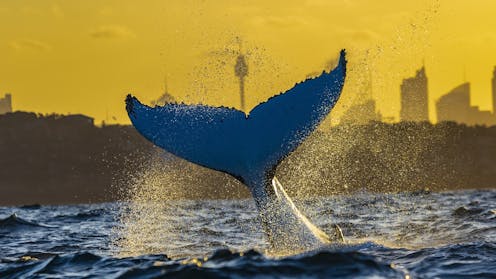
From the enormous blue whale to the delicate monarch butterfly, animals of all shapes and sizes migrate across the globe. These migrations connect distant habitats, from the tropics to the poles. They are also crucial to both the health of species making these epic journeys, and the habitats where they live.
It is hard to visualise these epic, globe-spanning journeys and the habitats they connect. But an interactive map we developed, alongside an international team of scientists from the University of Queensland and Duke University and in partnership with the Global Ocean Biodiversity Initiative, can help.
Known as Mico (Migratory Connectivity in the Ocean), this map is a valuable conservation tool that demonstrates just how connected our oceans are due to animal migration. It is freely available here, and has just been updated with our newly published research in Nature Communications. This research synthesises thousands of records of more than 100 species of birds, mammals, turtles and fish that connect almost 2,000 crucial habitats.

An evolving science
Humans have contemplated animal migrations for millennia. Representations of and theories about these journeys are observable in Stone Age rock art and the writings of Ancient Greek philosophers. Indigenous peoples and local communities have also long relied upon and understood the seasonal movements of culturally important species.
But for much of human history, identifying specific destinations of migratory species was an inexact science. This has started to change in recent decades, as scientists have developed and deployed animal-borne satellite tags which can record and transmit an animal’s location as it migrates.
These tags can be very expensive to deploy and collect data from. They also require enormous investments of time and expertise. But they are crucial if we are to understand where migratory species go when they’re outside the range of normal human observations.

The journeys of migratory species also span multiple jurisdictions. This means cooperation between countries is required to ensure they are protected.
For example, many albatross species receive significant conservation investment at their nesting islands within national jurisdictions. But they are at high risk of being incidentally caught and killed or injured in longline fisheries operating in international waters.
Synthesising more than 1,300 studies
For our new study, we reviewed the literature on the movements of marine migratory species from 1990 to 2017. We synthesised the start and end points of migrations reported in more than 1,300 individual studies. These studies covered 109 marine species.
This information was then aggregated to remove duplicate data and combine sites very near to each other (on a global scale) into one “metasite” to make it easier to display. Each data point is also linked to the study from which it comes. This means you can always find the work of the original team who tagged those animals.
In synthesising the studies in this manner, we created an interactive map and downloadable dataset estimating the measured migratory connections of the global ocean.
If you look up the green turtle map, for example, you can see just how much information there is for this highly-studied species. The red links show many tracked movements from breeding to foraging areas within each ocean basin.
Sperm whales, on the other hand, are globally distributed – you can toggle on the species distribution in the top menu. But we only have information about connectivity for animals in the Atlantic and east Pacific oceans. You can see these sites on the map, mostly in North America and in the Mediterranean.
Because researchers are yet to track animals in all parts of the globe, the map is missing some information about the migratory movements of key species in particular areas. We are planning updates as more information becomes available.
 Sperm whales are globally distributed, but Mico currently only captures their connectivity in the Atlantic and east Pacific oceans.
Migratory Connectivity in the Ocean/Mico
Sperm whales are globally distributed, but Mico currently only captures their connectivity in the Atlantic and east Pacific oceans.
Migratory Connectivity in the Ocean/Mico
A tool for conservation
This summary of migratory information is important for improving global conservation.
Scientists have published many papers on migrations, both of single populations or species, and combining data about taxonomy from several different sources. But these can be difficult to keep up with for managers or policymakers who may not have time to engage with every single piece of emerging scientific literature.
Our information can help identify stakeholders when planning or managing a conservation project. Many of these stakeholders may be across an ocean basin or even in a different hemisphere.
The scientific synthesis we provide can help countries take more informed actions to achieve the Kunming-Montreal Global Biodiversity Framework’s target of conserving a “well-connected” 30% of terrestrial, inland water, coastal and marine areas by 2030. This is particularly true in the high seas, as a mechanism to implement protected areas outside of national waters is developed under the soon-to-be-ratified High Seas Treaty.
 Various seabirds, including the Amsterdam Albatross, are included in the new research.
Sergey 402/Shutterstock
Various seabirds, including the Amsterdam Albatross, are included in the new research.
Sergey 402/Shutterstock
In addition to sharing the enormous scope of work that has been conducted on the migration of large ocean animals over the last decades, our work has already fed into policy processes.
For example, it has been used by seven United Nations conventions or organisations. We hope to formalise the role of our map as a node of the Convention on Migratory Species’ Atlas of Animal Migration at their next meeting in March 2026.
More broadly, we hope this work will support better international collaboration to conserve our incredible oceanic migrants for years to come.
Authors: Lily Bentley, Postdoctoral Research Fellow, School of the Environment, The University of Queensland

















