

the hidden ways Australia relies on foreign satellites
- Written by Cassandra Steer, Chair, Australian Centre for Space Governance, Australian National University
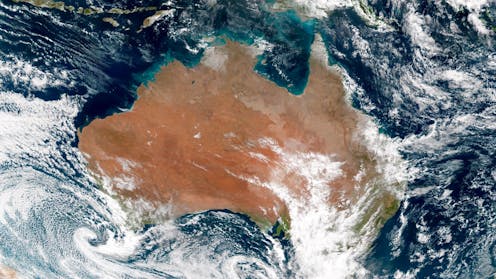
You have probably used space at least 20 times today. Satellites let you buy a coffee with your phone, book a rideshare, navigate your way to meet someone, and check the weather.
Satellites are also essential for monitoring floods, cyclones and bushfires, and supporting the people they affect. Farmers depend on satellite data, too, as does everyone trying to understand and tackle climate change, not to mention our military.
Yet Australia’s access to space services depends almost entirely on satellites owned and run by foreign governments and companies. In an increasingly uncertain world, having our own sovereign space technology is becoming even more important for security.
But what exactly do we need to secure? And how can space help us do it? My colleagues and I at the Australian Centre for Space Governance have thought through these questions and presented them in a policy paper series – and we have some recommendations for the government.
Space services are essential
Since 2022, the Australian government has considered space technology to be “critical infrastructure”. In other words, if the space-based services we use were destroyed or disrupted, it “would have a debilitating impact on Australia’s defence and national security, a destabilising effect on the population, and cause significant damage to the economy”.
However, Australia is entirely dependent on foreign partners for space-based services such as communications and Earth observation.
Another crucial kind of satellite-powered service is “position, navigation and timing” – things like GPS, which is owned and operated by the US government. Even a temporary loss of these services could pose significant risks to Australia’s telecommunications and energy systems, as well as disaster response.
According to Australia’s 2024 National Defence Strategy, space capabilities are “equally as important as the maritime, land and air domains”. But we are in many respects simply users of space infrastructure that belongs to partner countries for our military needs. There are opportunities to increase our role in these partnerships if we place more emphasis on how Australia can be a contributor.
An uncertain world
Almost all the satellite data that supports our agriculture, banking, transport, climate monitoring, bushfire and flood response – and connects rural, remote and regional Australians – comes from the US, Europe and Japan. This dependency poses significant risks.
If any of those countries have to prioritise their own national needs in a natural disaster – such as the Sea of Japan earthquake in January last year – we might lose access. Even temporary loss of service can be disruptive, such as the temporary outage in 2023 of a UK satellite that impacted farmers in Australia and New Zealand.
The same might happen if any of those countries stopped providing data for political or national security reasons.
These risks are only increasing as our dependency on satellite services grows, and our relationship with the United States may become less certain.
What do we want from space?
Many of Australia’s international partners are also questioning their dependence on the US, and prioritising their domestic needs. Many have national space policies, or at least a clear idea of what sovereign space capabilities they want to invest in. This is what Australia needs, too.
Greater cooperation on new space technologies could help our shared interests with our neighbours. Obvious areas include regional security, climate response, supporting agriculture, and internet connectivity needs.
One obstacle, as we discovered when we ran a national public opinion survey last year, is that Australia doesn’t have a clear vision of what it wants from space.
In government, too, there is little shared understanding of how satellites and related infrastructure feed in to our national priorities and needs.
At present, thinking about space is usually the domain of specialists in government. But a better option would be “mainstreaming” space – making it part of the everyday, business-as-usual thinking of policymakers across government.
Sovereign satellites
Our country already excels at what’s called the “ground segment” for space – things like satellite dishes and data management. One example is the satellite dish operated by Geoscience Australia in Alice Springs, on land leased from the Indigenous-owned business, the Centre for Appropriate Technology. But we don’t have any sovereign satellites.
In 2023, the government scrapped a billion-dollar project including four Earth-observation satellites, citing budget constraints. In 2024, a planned military-grade satellite communications system worth $7 billion was also cancelled due to lack of cash.
But in 2025, it’s a new term of government. New minister for industry and science Tim Ayres may revisit these decisions. It certainly aligns with his support for a “Future Made in Australia”.
This time around, the space industry and researchers will need to do a better job at communicating why satellites matter so much to our national well-being and security.
Authors: Cassandra Steer, Chair, Australian Centre for Space Governance, Australian National University

















