

Two lizard-like creatures crossed tracks 355 million years ago. Today, their footprints yield a major discovery
- Written by John Long, Strategic Professor in Palaeontology, Flinders University
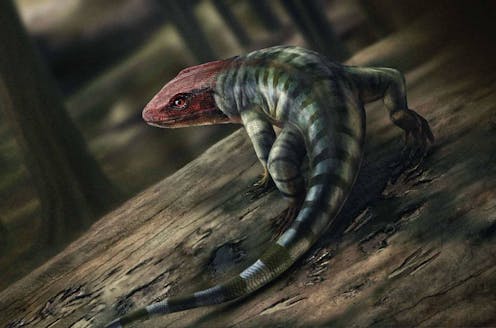
The emergence of four-legged animals known as tetrapods was a key step in the evolution of many species today – including humans.
Our new discovery, published today in Nature, details ancient fossil footprints found in Australia that upend the early evolution timeline of all tetrapods. It also suggests major parts of the story could have played out in the southern supercontinent of Gondwana.
This fossil trackway whispers that we have been looking for the origin of modern tetrapods in the wrong time, and perhaps the wrong place.
The first feet on land
Tetrapods originated a long time ago in the Devonian period, when strange lobe-finned fishes began to haul themselves out of the water, probably around 390 million years ago.
This ancestral stock later split into two main evolutionary lines. One led to modern amphibians, such as frogs and salamanders. The other led to amniotes, whose eggs contain amniotic membranes protecting the developing foetus.
Today, amniotes include all reptiles, birds and mammals. They are by far the most successful tetrapod group, numbering more than 27,000 species of reptiles, birds and mammals.
They have occupied every environment on land, have conquered the air, and many returned to the water in spectacularly successful fashion. But the fossil record shows the earliest members of this amniote group were small and looked rather like lizards. How did they emerge?
The oldest known tetrapods have always been thought to be primitive fish-like forms like Acanthostega, barely capable of moving on land.

Most scientists agree amphibians and amniotes separated at the start of the Carboniferous period, about 355 million years ago. Later in the period, the amniote lineage split further into the ancestors of mammals and reptiles-plus-birds.
Now, this tidy picture falls apart.
A curious trackway
Key to our discovery is a 35 centimetre wide sandstone slab from Taungurung country, near Mansfield in eastern Victoria.
The slab is covered with the footprints of clawed feet that can only belong to early amniotes, most probably reptiles. It pushes back the origin of the amniotes by at least 35 million years.

Despite huge variations in size and shape, all amniotes have certain features in common. For one, if we have limbs with fingers and toes, these are almost always tipped with claws – or nails, in the case of humans.
In other tetrapod groups, real claws don’t occur. Even claw-like, hardened toe tips seen in some amphibians are extremely rare.
Claws usually leave obvious marks in footprints, providing a clue to whether a fossil footprint was made by an amniote.
 Close up showing the oldest known tracks with hooked claws from Mansfield, Victoria. Left, photo; right, optical scan.
The authors
Close up showing the oldest known tracks with hooked claws from Mansfield, Victoria. Left, photo; right, optical scan.
The authors
The oldest clawed tracks
The previous oldest fossil record of reptiles is based on footprints and bones from North America and Europe around 318 million years ago.
The oldest record of reptile-like tracks in Europe is from Silesia in Poland, a new discovery also revealed in our paper. They are around 328 million years old.
However, the Australian slab is much older than that, dated to between 359 and 350 million years old. It comes from the earliest part of the Carboniferous rock outcropping along the Broken River (Berrepit in the Taungurung language of the local First Nations people).
This area has long been known for yielding many kinds of spectacular fossil fishes that lived in lakes and large rivers. Now, for the first time, we catch a glimpse of life on the riverbank.
 Fossil hunters search the Carboniferous red sandstone in the Mansfield area of Victoria. Such outcrops recently yielded the trackways of the world’s oldest reptile.
John Long
Fossil hunters search the Carboniferous red sandstone in the Mansfield area of Victoria. Such outcrops recently yielded the trackways of the world’s oldest reptile.
John Long
Two trackways of fossil footprints cross the slab’s upper surface, one of them overstepping an isolated footprint facing the opposite direction. The surface is covered with dimples made by raindrops, recording a brief shower just before the footprints were made. This proves the creatures were moving about on dry land.
All the footprints show claw marks, some in the form of long scratches where the foot has been dragged along.
The shape of the feet matches that of known early reptile tracks, so we are confident the footprints belong to an amniote. Our short animation below gives a reconstruction of the ancient environment around Mansfield 355 million years ago, and shows how the tracks were made.
A short animation showing the creature making the tracks and its scientific significance. By Flinders University and Monkeystack Productions.Rewriting the timeline
This find has a massive impact on the origin timeline of all tetrapods.
If amniotes had already evolved by the earliest Carboniferous, as our fossil shows, the last common ancestor of amniotes and amphibians has to lie much further back in time, in the Devonian period.
We can estimate the timing of the split by comparing the relative lengths of different branches in DNA-based family trees of living tetrapods. It suggests the split took place in the late Devonian, maybe as far back as 380 million years ago.
This implies the late Devonian world was populated not just by primitive fish-like tetrapods, and intermediate “fishapods” like the famous Tiktaalik, but also by advanced forms including close relatives of the living lineages. So why haven’t we found their bones?
The location of our slab provides a clue.
Big evolutionary questions
All other records of Carboniferous amniotes have come from the northern hemisphere ancient landmass called Euramerica that incorporated present-day North America and Europe. Euramerica also produced the great majority of Devonian tetrapod fossils.
The new Australian fossils come from Gondwana, a gigantic southern continent that also contained Africa, South America, Antarctica and India.
In all of this vast landmass, which stretched from the southern tropics down across the South Pole, our little slab is currently the only tetrapod fossil from the earliest part of the Carboniferous.
The Devonian record is scarcely much better. The Gondwana fossil record of early tetrapods is shockingly incomplete, with enormous gaps that could conceal – well, just about anything.
This find now raises a big evolutionary question. Did the first modern tetrapods, our own distant ancestors, emerge in the temperate Devonian landscapes of southern Gondwana, long before they spread to the sun-baked semi-deserts and steaming swamps of equatorial Euramerica?
It’s quite possible. Only more fieldwork, bringing to light new discoveries of Devonian and Carboniferous fossils from the old Gondwana continents, might one day answer that question.
We acknowledge the Taungurung people of Mansfield area where this scientific work has taken place.
Authors: John Long, Strategic Professor in Palaeontology, Flinders University

















