

Newly discovered frog species from 55 million years ago challenges evolutionary tree
- Written by Roy M. Farman, Adjunct Associate Lecturer, School of Biological, Earth and Environmental Sciences, UNSW Sydney
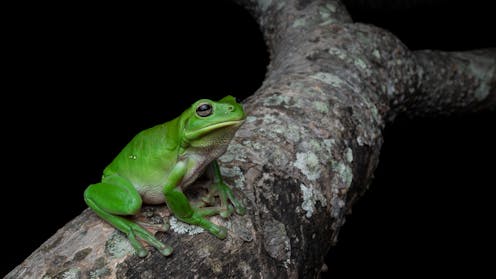
Australian tree frogs today make up over one third of all known frog species on the continent. Among this group, iconic species such as the green tree frog (Litoria caerulea) and the green and golden bell frog (Litoria aurea), are both beloved for their vivid colours and distinctive calls.
In the Early Eocene epoch, 55 million years ago, Australia’s tree frogs were hopping across the Australian continent from one billabong to the next through a forested corridor that also extended back across Antarctica to South America. These were the last remnants of ancient supercontinent Gondwana.
In new research published today in the Journal of Vertebrate Paleontology, we identify Australia’s earliest known species of tree frog – one that once hopped and croaked around an ancient lake near the town of Murgon in south-eastern Queensland.
This research demonstrates tree frogs were present in Australia 30 million years earlier than previously thought, living alongside Australia’s earliest known snakes, songbirds and marsupials.
A common ancestor
Tree frogs (Pelodryadidae) have expanded discs on their fingers and toes enabling them to climb trees. Despite their name, however, they are known to occupy a wide range of habitats, from fast-flowing streams to ephemeral ponds.
Australia’s previously earliest tree frogs were recovered from Late Oligocene (about 26 million years old) and Early Miocene (23 million years old) fossil deposits. Late Oligocene frog fossils were found at Kangaroo Well in the Northern Territory and Lake Palankarinna in South Australia. They were also recently found in many deposits from the Riversleigh World Heritage Area in Queensland.

It has long been known that South American tree frogs and Australian tree frogs shared a common Gondwanan ancestor. What is unknown is when this common ancestor lived.
Based on some molecular data, it has been estimated that the two groups separated from this common ancestor as recent as 32.9 million years ago.
A diverse fossil deposit
Our new study was based on frog fossils from a deposit near the town of Murgon, located on the traditional lands of the Waka Waka people of south-eastern Queensland. These fossils accumulated some 55 million years ago. This was between the time when a colossal meteorite took out the non-flying dinosaurs and the time when Australia broke free from the rest of Gondwana to become an isolated continent.

As well as ancient frog fossils, the Early Eocene freshwater clay deposit also contains fossils of ancient bats, marsupials, snakes, non-marine birds and potentially the world’s oldest songbirds.
We used CT scans of frogs preserved in ethanol from Australian museum collections to compare the three-dimensional shape of the fossil bones with those of living species. This method is called three-dimensional geometric morphometrics. It has only been used on fossil frogs once before.
Using these new methods, we can unravel the relationships of these fossils to all other groups of frogs – both living and extinct.
Pushing back the evolutionary tree
From its diagnostic ilium (one of three paired pelvic bones), we identified a new species of Litoria from the family Pelodryadidae. We named this species Litoria tylerantiqua in honour of the late Michael Tyler, a renowned Australian herpetologist globally celebrated for his research on frogs and toads.
Litoria tylerantiqua joins the only other Murgon frog discovered so far, the ground-dwelling Platyplectrum casca, as the oldest frogs known from Australia. Both species have living relatives in Australia and New Guinea. This demonstrates the remarkable resilience over time of some of Australia’s most fragile creatures.
Our new research provides crucial new understanding that helps to calibrate molecular clock studies. This is a method scientists use to estimate when different species split from a common ancestor based on the calculated rate of genetic change over time.
Our research indicates the separation of Australian tree frogs and South American tree frogs is at minimum 55 million years ago. This pushes back the estimated molecular separation time for these groups by 22 million years.
 Three left sided ilia (pelvic fossil bones) which collectively provided the diagnostic information needed to identify the new species.
UNSW Sydney/Roy Farman
Three left sided ilia (pelvic fossil bones) which collectively provided the diagnostic information needed to identify the new species.
UNSW Sydney/Roy Farman
New insights to help endangered species
Unravelling the deep-time changes in the diversity and evolution of the ancestors of today’s living animals can provide important new insights into the way these groups have responded in the past to previous challenges. These challenges include former natural cycles of climate change.
The more we know about the fossil record, the more likely we will better anticipate future responses to similar challenges, including human-induced climate change.
This is especially important for critically endangered species such as the Southern Corroboree Frog and Baw Baw Frog. Now restricted to alpine habitats in New South Wales and Victoria, they are at serious risk of extinction due to global warming.
Authors: Roy M. Farman, Adjunct Associate Lecturer, School of Biological, Earth and Environmental Sciences, UNSW Sydney

















