

Modern Australian
The Times

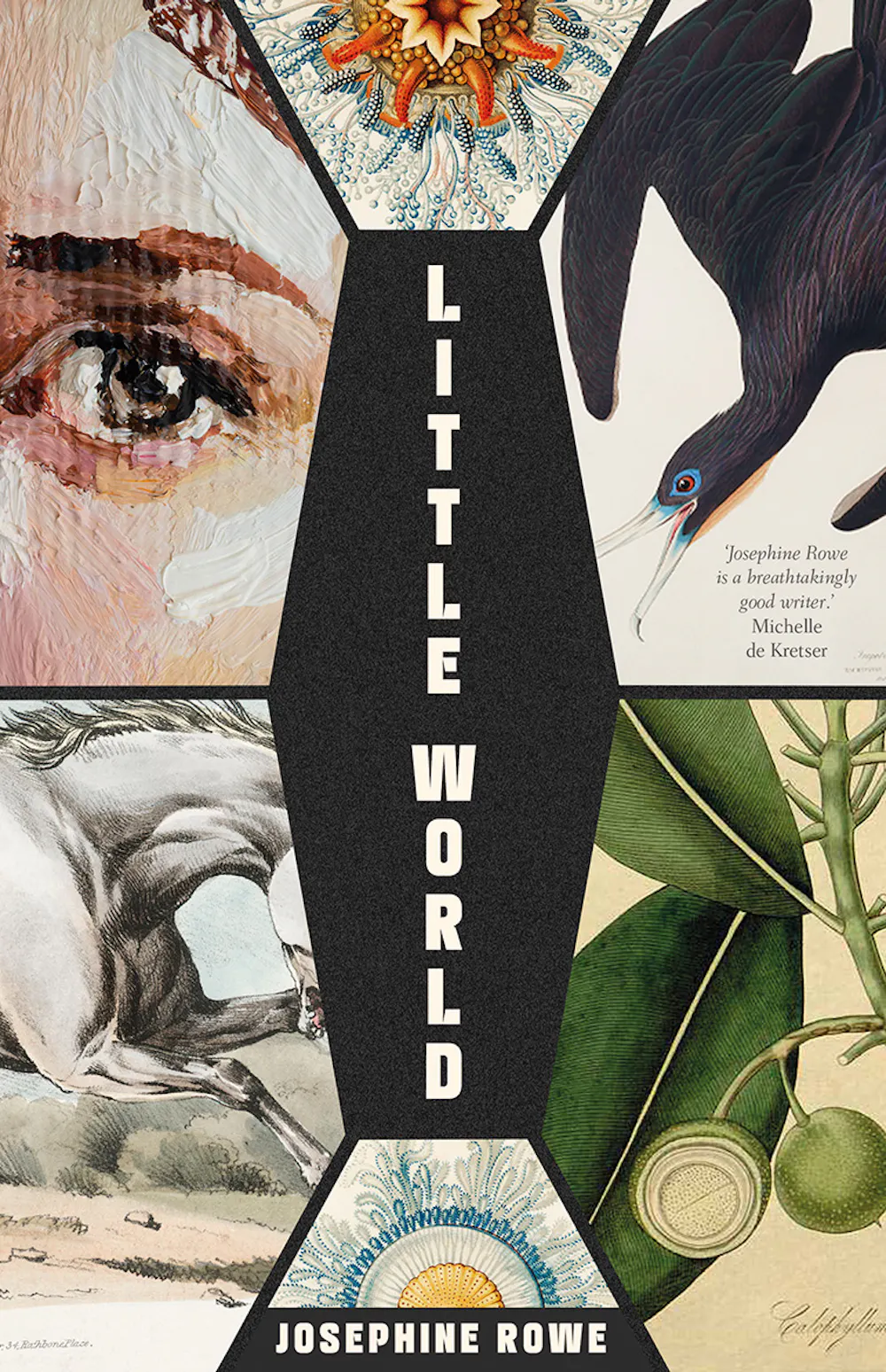
Little World, what are you? Josephine Rowe’s latest novel is a precisely drawn enigma

  • Written by Tony Hughes-d'Aeth, Professor, Chair of Australian Literature, The University of Western Australia
Little World, what are you? Josephine Rowe’s latest novel is a precisely drawn enigma

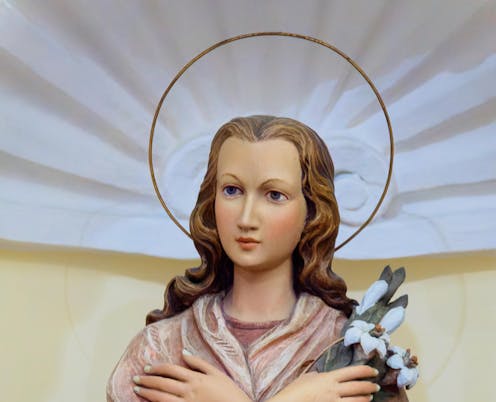
The unusual element of Josephine Rowe’s short novel Little World is that the heroine remains utterly impassive throughout the events of the narrative. This is for the simple reason that she is dead.

This does not mean she does not act, though. In fact, she acts exactly in the way that the dead are wont to do, which is to present themselves in the form of a question to the living.

Irina, if that is indeed her name, was born in Panama in the townships that serviced the canal at some point early in the 20th century. Her life came to its end at the tender age of 14, whereupon something miraculous occurred: her body failed to decay. Or as it is put in the novel, there is “a failing of entropy”.

The inexorable passage of this incorruptible body gives this strange, spare story its shape.

Review: Little World – Josephine Rowe (Black Inc.)

The novel begins with the girl’s body arriving by horse float at the remote home of Orrin Bird, somewhere near Broome, not long after the second world war. The perfectly preserved human form has been bequeathed to Orrin by his recently departed friend Kaspar Isaksen, whom he had met when the two worked on Nauru in the 1930s.

Isaksen had brought the girl’s body from Panama to Nauru in the hope that he might help with her canonisation. Though he is not religious, Orrin sees no other course than to hold on to the girl’s body, hoping that the termites will not devour the coffin. He lives on for another 17 years, protecting and being protected by his dead yet undead companion. When he dies, the house falls into disrepair, but the girl remains preserved in her incorruptible state.
The novel then skips forward to the 1970s, where we meet three women travelling across Australia by van. The group consists of a young lesbian couple, Alex and Suze, both daughters of rich parents, and a slightly older woman, Mathilde, or “Matti” as she is called by the other two. Matti increasingly feels like a third wheel. Sexually excluded from the couple, she also knows that she is beneath them socially. She has spent her life cleaning the kinds of houses that these two women have grown up in. Matti’s childhood was far from idyllic. Her home life was marred by an emotionally abusive mother. She fell pregnant while still a teenager and was taken to a home for unmarried pregnant girls. As was the expectation, she gave up her son for adoption. She often dreams of this boy she was able to hold so briefly. As the group reach the Kimberley, they come upon an abandoned house with a horse float, and we realise they have stumbled on the home of the long-dead Orrin Bird. Giving Alex and Suze the privacy of the van, Matti decides to sleep in the ruined house. It is there she comes face to face with the body of the girl. The feminine image I’ve taken time to narrate the events of the novel to this point, confident this will not deprive the reader of moments of surprise or revelation. This is because Little World does not depend on things happening, so to speak. Instead, the static body at the heart of the narrative is its point of immanence. It is the “little world” of the title. The events of the story, which unfold surely enough despite some cryptic moments, are not what is being revealed; the novel seeks the enigmatic truth of this living-dead feminine image. The comparison that came to mind was Oblivia Ethylene from Alexis Wright’s The Swan Book. In Wright’s novel, an abused Indigenous girl has become magically encased in a tree. Oblivia is not dead; in fact, she narrates the prologue. Her presence in the tree is a kind of absolute subjective retreat from the harm that assailed her to that point. Oblivia is rescued and comes back to life, but remains mute once the novel switches to the third person.
Josephine Rowe. Dom Krapski/Black Inc.

The situation in Little World is of a still more radical quality, in that the feminine centre remains embalmed and immobile. Because Irina is silent and unmoving, it is impossible to draw on her words or actions to interpret her views or intentions. We are restricted to tentative inferences that stem from her appearance – “appearance” meaning, in this context, not so much how she looks, but how she comes to appear in the places that she appears.

Her incorruptible female body represents a paradox, because it has the quality of an announcement – a wordless comment on her surroundings. Her arrival into the scene resembles the visitation of a saintly personage. Those before her stand in mute awe. She is there to deliver her silent message and she stays until that message has worked itself into the recipients.

Irena’s trajectory takes her from the Panama Canal – that marvel of civil engineering that quietly violates the sanctity of oceans and continents – across the Pacific to Nauru, where she lies beside the industrial dismantling of the island. (Before it became the centrepiece of Australia’s offshore gulag archipelago, Nauru had its pristine surface hacked into a tropical moonscape by a century of extractive phosphate mining.)

From there, Irena travels to Australia and into the bemused possession of Orrin, a man who had tried to disappear in the outback. She found him all the same.

What message she delivers to him we never quite know. Nor to Kaspar either. All we know is that she outlasts both of them. And then she waits once more, while Matti, a figure from the margins of 1970s, moves unwittingly from one side of the continent to the other. Again, we do not know the message that Irina has for Matti, or if Matti will ever know its contents.

Oceanic realisation

In the end, it falls to Matti to free the girl: “She knows only that it is for her alone to right something.”

Leaving her friends stranded in the nearest town, Matti commandeers their van and rigs up the horse float. She drives headlong to the sea, crashing and bumping her way in a singular derangement. There, she releases the girl into the ocean.

This moment of oceanic realisation is the decisive point in the novel. The story doesn’t end there, but its unendingness ends there. The body’s lacquer dissolves and the ocean flows through its tissues and vessels. This event is unwitnessed – it seems it must remain foreclosed to sight – but is instead imagined in touching detail:

The water will press in, against the frail seal of eyelids and lips, rushing past the small teeth and flooding the speechless mouth with brine, spilling on into airways, down the long-dormant corridors of arteries, fallow passageways, to reach the dry hollows of lungs and stomach, the empty ventricles of the silent, fist-sized muscle

the ocean like a great hand opening inside her

            Her own hands unclenching in response

Why is it Matti who is called upon to release the girl? Why could neither of the grizzled men, who had held her conscientiously enough in their care before they died, perform this simple act? This is probably the central question of Little World.

The answer the novel offers is that Matti resembles the girl. Both have struggled through a world which had little care for them. The relentless and premature sexual attention of men has blighted their lives. As well as being the object of this external hunger, which must be constantly repelled, there is also a gnawing and all-consuming internal hunger in Matti. This hunger is the concentration of Matti’s being:

Her hunger was its own clarifying force, a secret but not, not anymore a shameful one. She had decided, long ago, to form an allegiance with it.

Indeed, the key correspondence in the novel is between Matti’s hunger and the way the dead girl insinuates herself into the arms of reluctant men. These men hold the girl on the condition that they cannot touch her. Their intimacy depends on the fact that she is already a corpse.

These principles form the strict, perverse coordinates of the novel. But the ethical dimension of Little World is also quite clear. The whole novel orchestrates a sequence of meetings that culminate in Matti consigning the dead girl to a proper death. Little World is a novel for those who find satisfaction in precisely drawn enigmas. The lyricism of the novel is often exquisite, but still more impressive is its fidelity to the dream logic that provides the story with its insistence.

Authors: Tony Hughes-d'Aeth, Professor, Chair of Australian Literature, The University of Western Australia


Read more https://theconversation.com/little-world-what-are-you-josephine-rowes-latest-novel-is-a-precisely-drawn-enigma-254209

Road Signs: Understanding Their Role in Clear and Effective Signage

Effective signage and display hardware can help businesses communicate information, promote products and organise customer or visitor movement. Road...

Bottle Label Printing: Key Factors to Consider Before Your Next Packaging Run

Effective packaging begins with understanding the product, bottle material, artwork and production requirements when planning bottle label printing. H...

Planning a Long-Distance Move With Interstate Movers Melbourne

Moving between states involves more planning than a typical local relocation. Along with packing and transporting household belongings, you need to...

Understanding the Role of an I/O Controller in Industrial Automation

Modern industrial systems depend on accurate communication between sensors, machines and control systems. An I/O controller can help manage this commu...

How the Right Mining Hose Supports Demanding Operations

Mining environments place considerable demands on equipment used for material transfer, water management and processing. Hoses operating in these co...

Simple Ideas for Making Social Gatherings More Memorable

We have all been to those parties where everyone just stands around the kitchen island, staring at their phones, waiting for someone else to make a mo...

Outdoor Wall Lights: Improving Exterior Lighting Around Your Home

Lighting can influence how a room looks, feels and functions, so the right fitting should be selected according to both appearance and practical req...

Commercial Office Cleaning: Combining Routine Office Cleaning With Melbourne Service

Keeping a workplace clean requires a service that can accommodate everyday tasks as well as the particular needs of the business. Professional comme...

Caravan Sales in Queensland: How to Find the Right Caravan for Sale QLD

Caravan ownership is about more than having somewhere to sleep while travelling. For many Queenslanders, it is one of the best ways to explore regio...

What Sir Walter Buffalo Turf Actually Costs in 2026 (And Why Quotes Vary So Much)

Two quotes landed on a Hills District homeowner's kitchen table last spring for the exact same 80-square-metre backyard. One said $12 a metre. The o...

Nearly 1,300 NSW Hospital Beds Are Occupied By People Who Are Ready To Go Home

1,276 people in NSW hospitals have been medically cleared for discharge but remain in hospital because they're still waiting for NDIS or aged care sup...

National Survey Launched to Measure Operational Impacts of Federal NDIS Policy Reforms

The effects of recent NDIS reforms are beginning to move beyond policy papers and into day to day service delivery. A new national survey is asking ...

Beyond the Nappy Cake: Baby Shower Gifts That Get Used

What new Australian parents unwrap, keep, and quietly thank you for months later. Six weeks after my daughter was born, I did an audit of the baby sh...

Parent-Advocates Are Reshaping Frontline Disability Service Delivery

Parents have always been part of the disability sector. They advocate, coordinate services, challenge decisions and often become the person holding ev...

Vista Cruises Enters "Two-Flagship Era" as Vista Aurora Completes Inaugural Voyage

Vista Aurora Sets Sail along the Yangtze. (Photo courtesy of the company)YICHANG, China — August 5, 2026 — Vista Aurora, a high-end interprovinc...

A Digital Preparation Checklist For International Medical Conferences

An international medical conference compresses many responsibilities into a few days. A delegate may need to present research, move between venues, ...

The Growing Popularity of Lab Grown Diamonds in Sydney and Hong Kong

The diamond industry has changed significantly in recent years as more buyers seek ethical, affordable, and sustainable alternatives to mined diamon...

Modern AI SEO Agency vs Traditional SEO: What’s the Difference

Search engine optimisation has changed dramatically over the past few years. Search engines have become smarter, user behaviour has evolved, and bus...















