

The re-emergence of polio in Papua New Guinea shows global eradication remains elusive
- Written by Michael Toole, Associate Principal Research Fellow, Burnet Institute
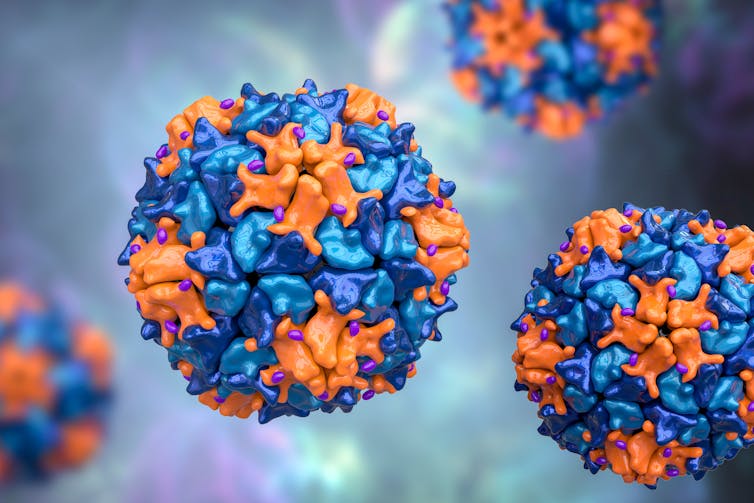
Last week the World Health Organisation (WHO) declared a polio outbreak in Papua New Guinea (PNG).
The highly infectious virus was found in two healthy, polio-vaccinated children who were screened following detection of the virus during routine wastewater sampling in Lae, PNG’s second largest city. Wastewater samples are also positive in the capital Port Moresby, indicating the potential of spread around the country.
The strain has been identified as circulating vaccine-derived poliovirus type 2, similar genetically to a strain circulating in Indonesia.
So what does this mean? And what will happen now in PNG?
First, what is polio?
Polio, or poliomyelitis, is a highly contagious disease caused by the poliovirus. It primarily affects children.
Most infections don’t cause significant symptoms and go largely unnoticed. But less than 1% of infections result in paralysis.
Poliovirus is spread by person-to-person contact or the ingestion of contaminated virus from faeces. The virus multiplies in the gut of people who are infected, and they shed the virus in their stool for several weeks. In this way it can spread through a community, especially in areas with poor sanitation.
A recent review also suggested a greater role for transmission via respiratory particles than we previously thought.
Wild poliovirus (as distinct from vaccine-derived poliovirus, which we’ll discuss shortly) was a major public health issue prior to the rollout of vaccination in 1950s. This campaign led to the virtual elimination of the disease in rich countries such as Australia.
Since the Global Polio Eradication Initiative was launched in 1988, cases have decreased by 99% globally. Wild poliovirus remains endemic only in Pakistan and Afghanistan.
Polio vaccines
There are two types of vaccines – the oral polio vaccine and the inactivated polio vaccine.
Delivered as two drops in the mouth at least four times in early childhood, the oral vaccine contains a live-attenuated (weakened) form of the poliovirus. It triggers a strong immune reaction in the gut that slows the replication of wild poliovirus, and reduces shedding in the stool, limiting transmission.
The oral vaccine does carry a small risk of the weakened vaccine strain causing paralysis. This occurs in roughly one in 2.7 million doses of the oral vaccine administered, usually at the first dose.
The inactivated polio vaccine (part of the routine immunisation program in Australia) contains an inactivated or dead form of the poliovirus, which is unable to cause polio in the recipient.
Given as an injection, this vaccine stimulates the immune system to produce protective antibodies in the blood against poliovirus. Three doses of the inactivated vaccine are highly protective against developing symptoms and paralysis from polio.
However, this vaccine is thought not to be as effective as the oral vaccine at preventing infection and shedding in the gut. Therefore, it doesn’t prevent transmission.
What is vaccine-derived poliovirus?
As the weakened poliovirus in the oral vaccine is still shed in the stool, it can spread in communities with poor sanitation. The vaccine strain can mutate to a form that can cause paralysis, like wild poliovirus. The result, circulating vaccine-derived poliovirus, is a problem particularly when polio immunisation rates are low.
The risk of international spread of vaccine-derived poliovirus has been assessed as high by the WHO and United States Centers for Disease Control and Prevention. There were outbreaks in 39 countries in 2023–24.
A novel oral polio vaccine, nOPV2, which is less likely to mutate, has been used in outbreaks of vaccine-derived poliovirus since 2021.
Routine vaccination with the inactivated polio vaccine is key to preventing vaccine-derived poliovirus, and is recommended by WHO. The polio endgame will involve this transition from the oral vaccine to the inactivated vaccine.
In 2019, all countries had introduced the inactivated vaccine. However uptake remains low because of a lack of resources and inadequate access to health services in poor countries.
What happens now in PNG?
The PNG government has responded swiftly to activate its polio emergency response plan, supported by partners including WHO, UNICEF and the Australian government.
Notably, PNG’s vaccination rate is among the lowest in the world, with only about 50% of children born each year receiving the recommended childhood vaccines, including the oral polio vaccine. To induce herd immunity and prevent outbreaks of disease, coverage should be at least 95%.
PNG was declared polio free in 2000. But there was an outbreak in 2018 of vaccine-derived polio type 1 with 26 cases across nine provinces. The outbreak was brought under control through supplementary rounds of vaccination, enhanced surveillance, and expanded communication and community engagement.
There are many lessons to be learned from the successful response to the 2018 polio outbreak. These three pillars of the response remain relevant:
- mass vaccination (using nOPV2)
- enhanced surveillance for cases and wastewater sampling
- communication (through traditional and social media) and localised community engagement.
Further research will be crucial to understand where transmission is occurring and target the response accordingly. This includes the question of potential for spread between Indonesia and PNG – a neglected health security issue.
How about the risk in Australia?
While the risk of spread of polio in Australia is low, the virus does not respect borders, and we cannot become complacent.
Australia’s overall coverage with the inactivated vaccine is close to 95% but there has been a concerning decline in childhood immunisation since the COVID pandemic. Australia must address this and maintain its polio wastewater monitoring system.
Supporting PNG and working with other countries towards global polio eradication is the best way Australia can protect itself.
This outbreak is a timely reminder that the last mile in the global eradication of polio remains elusive. As we emerge from a pandemic, the need for international cooperation, strengthening health systems and responding swiftly to health emergencies such as polio couldn’t be stronger.
Authors: Michael Toole, Associate Principal Research Fellow, Burnet Institute

















