

Could cold sores increase the risk of Alzheimer’s disease? A new study is no cause for panic
- Written by Joyce Siette, Associate Professor | Deputy Director, The MARCS Institute for Brain, Behaviour, and Development, Western Sydney University
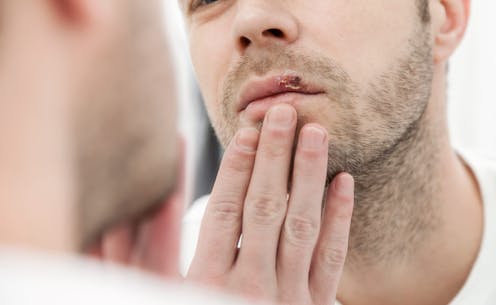
A new study has found the herpes simplex virus type 1 (HSV-1), which causes cold sores, may be linked to the development of Alzheimer’s disease.
This idea is not entirely new. Previous research has suggested there may be an association between HSV-1 and Alzheimer’s disease, the most common form of dementia.
So what can we make of these new findings? And how strong is this link? Let’s take a look at the evidence.
First, what is HSV-1?
HSV-1 is a neurotropic virus, meaning it can infect nerve cells, which send and receive messages to and from the brain. It’s an extremely common virus. The World Health Organization estimates nearly two-thirds of the global population aged under 50 carries this virus, often unknowingly.
An initial infection can cause mild to severe symptoms including fever, headache and muscle aches, and may manifest as blisters and ulcers around the mouth or lips.
After this, HSV-1 typically lies dormant in the body’s nervous system, sometimes reactivating due to stress or illness. During reactivation, it can cause symptoms such as cold sores, although in many people it doesn’t cause any symptoms.
What did the new research look at?
In a study published this week in BMJ Open, researchers analysed data from hundreds of thousands of people drawn from a large United States health insurance dataset.
They conducted a matched “case-control” analysis involving more than 340,000 adults aged 50 and older diagnosed with Alzheimer’s disease between 2006 and 2021. Each Alzheimer’s disease patient (a “case”) was matched to a control without a diagnosis of Alzheimer’s disease based on factors such as age, sex and geographic region, a method designed to reduce statistical bias.
The team then examined how many of these people had a prior diagnosis of HSV-1 and whether they had been prescribed antiviral treatment for the infection.
Among people with Alzheimer’s disease, 0.44% had a previous HSV-1 diagnosis, compared to 0.24% of controls. This translates to an 80% increased relative risk of Alzheimer’s disease in those diagnosed with HSV-1, however the absolute numbers are small.
The researchers also found people who received antiviral treatment for HSV-1 had roughly a 17% lower risk of developing Alzheimer’s disease compared to those who were untreated.
Not a new hypothesis
This isn’t the first time researchers have speculated about a viral role in Alzheimer’s disease. Earlier studies have detected HSV-1 DNA in postmortem brain tissues from people who had Alzheimer’s disease.
Laboratory research has also shown HSV-1 can trigger amyloid-beta plaque accumulation in nerve cells and mouse brains. Amyloid-beta plaques are one of the defining features of Alzheimer’s disease pathology, so this has led to speculation that reactivation of the virus may contribute to brain inflammation or damage.
But importantly, previous research and the current study show associations, not proof HSV-1 causes Alzheimer’s disease. These links do not confirm the virus initiates or drives disease progression.
Some other important caveats
The study relied on insurance claim data, which may not always reflect accurate or timely clinical diagnoses. HSV-1 is also frequently underdiagnosed, especially when symptoms are mild or absent. These points could explain why both the Alzheimer’s group and the control group saw such low rates of HSV-1, when population rates of this virus are estimated to be far higher.
This means many carriers of HSV-1 in the study may have gone unrecorded and therefore makes the link harder to interpret clearly. The dataset also doesn’t capture how often people had recurring symptoms, or the severity or duration of infections – conditions which might influence risk more directly.
Another complicating factor is people with HSV-1 might differ in other ways from those without it. Differences in health-care access, the health of a person’s immune system, lifestyle, genetics, or even education – could all influence Alzheimer’s disease risk.
So should you be concerned if you have cold sores?
The short answer is no – at least not based on current evidence. Most people with HSV-1 will never develop Alzheimer’s disease. The vast majority live with the virus without any serious neurological issues.
The “herpes hypothesis” of Alzheimer’s disease is an interesting area for further research, but far from settled science. This study adds weight to the conversation but doesn’t offer a definitive answer.
Alzheimer’s disease is a complex condition with multiple risk factors, including age, genetics, heart health, education, lifestyle and environmental exposures.
Infections such as HSV-1 may be one part of a larger, interconnected puzzle, but they are highly unlikely to be the sole cause.
With this in mind, the best thing to do is to focus on what we already know can help keep your brain healthy as you age. Regular physical activity, good quality sleep, social engagement, a balanced diet and managing stress can all support long-term brain health.
Authors: Joyce Siette, Associate Professor | Deputy Director, The MARCS Institute for Brain, Behaviour, and Development, Western Sydney University

















