

What if Hitler was assassinated and World War II ended in compromise? Catherine Chidgey imagines a parallel reality
- Written by Julian Novitz, Senior Lecturer, Writing, Department of Media and Communication, Swinburne University of Technology
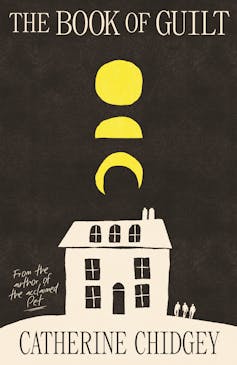
Catherine Chidgey’s ninth novel, The Book of Guilt, has been hotly anticipated. Following the critical and commercial success of her last two novels, it was the subject of a bidding war between UK publishers. The Book of Guilt is also now the first of her books to be released in Australia at launch: a depressingly rare feat for a New Zealand author.
Chidgey’s career has been defined by a willingness to experiment and innovate with new genres, subjects and forms. Shifting from the New Zealand focus of her recent novels, The Book of Guilt is set in a version of 1979 Britain. It operates as a disturbing thriller that unfolds from three different perspectives.
Review: The Book of Guilt – Catherine Chidgey (Penguin)
While its setting is something of a departure for Chidgey, the novel continues her interest in the legacy of Nazi Germany, which some of her previous works have examined. It also explores the questions of guilt, awareness and moral responsibility which have preoccupied Chidgey in her earlier novels, particularly with regard to characters who are trapped within, or even victimised by, exploitative systems.
A government program for orphans
Vincent and his triplet brothers William and Lawrence, at 13, are the last children living in Captain Scott House, an isolated countryside home in the Sycamore Scheme (a government program for the care of orphans). Their days are strictly regimented by their three guardians – Mother Morning, Mother Afternoon and Mother Night – who record both their dreams and transgressions, and administer medication to help them overcome a mysterious “Bug”.


But there are also differences. In this world, the moon landing occurred in 1957, not 1969. The polio vaccine and mass-produced penicillin have been available for far longer than they have in our history. And, crucially, the Sycamore Scheme was established in 1944, following the successful assassination of Adolf Hitler.
The Book of Guilt, then, can be understood as an alternative history novel. This genre typically explores the timelines and scenarios that might result from a historical event having a different outcome. Within this tradition, World War II is a frequent subject of speculation.
Famously, works like Philip K. Dick’s The Man in the High Castle, and Robert Harris’ Fatherland have depicted dramatically changed worlds following the victory of Nazi Germany.
Chidgey’s alternative history hinges on a more subtle difference. What if Major Axel von dem Bussche’s 1943 attempted suicide bombing of Hitler had succeeded? As a result, the Nazi leadership are unseated and an interim government negotiates a surrender to the Allied powers. Rather than Germany’s total defeat and capitulation, the European war ends in compromise and “difficult decisions”.
We are not told exactly what Nazi crimes went unpunished because of this determination to secure “peace at any price”. But one of the terms of the “Gothenburg Treaty” that ended the war was that the results of the inhumane, often deadly medical research performed in the concentration camps by SS physician Josef Mengele and others should be shared with the Allies.
It is clear from early in the novel that the Sycamore Scheme operates as a sinister continuation of these practices, though its exact nature – and the origins of Vincent and his brothers – are a slowly unravelling mystery.
Literary thrillers and Nazi legacy
As New Zealand literary critic Philip Matthews observes, the Book of Guilt can be read as a meeting point between two strands in Chidgey’s writing. It follows the Axeman’s Carnival (2022) and Pet (2023) as the third in a string of tightly plotted literary thrillers.
 Catherine Chidgey.
Ebony Lamb/Penguin Random House
Catherine Chidgey.
Ebony Lamb/Penguin Random House
It is also her third novel to consider the legacy of Nazi Germany and the Holocaust. Like The Wish Child (2016) and Remote Sympathy (2020), the Book of Guilt is preoccupied with the subject of complicity: how characters live within, accept and deflect their full awareness of systems that exploit, violently dehumanise and murder others. What subtle, internal trades and compromises are they prepared to make for their own comforts and security? Or even just to preserve their own self image?
These are always pertinent themes, and Chidgey’s alternative history provides her with a new lens for exploring them. Her vision of slightly altered late-70s Britain, one that has become rapidly tawdry, bleak and cruel for the sake of a few limited advancements, is powerful.
The novel also offers an intriguing commentary on 1979 itself as a tipping point in British history. The cold pragmatism of the new conservative government justified sacrificing the welfare of a considerable portion of the population for greater prosperity. Chidgey’s scenario recalls Thatcher’s positioning of herself as the ruthless, unflinching doctor capable of curing the “British Disease”.
In this regard, the Book of Guilt joins a small tradition of literary alternative histories, which use a skewed perspective on the period they examine to reflect contemporary anxieties and preoccupations.
It brings to mind Philip Roth’s The Plot Against America, which explores how a populist leader – elected at exactly the wrong time – can light a powder keg of racist resentment.
Chidgey’s novel brings to mind Philip Roth’s Plot Against America (adapted for HBO by David Simon).And also Ian McEwan’s Machines Like Me, where the continued work of mathematician and code-breaker Alan Turing on artificial intelligence gives rise to an alternative 1980s Britain. There, new forms of robotic consciousness are the subject of both fascination and uneasy suspicion.
But, of course, the novel Book of Guilt most closely recalls is Kazuo Ishiguro’s Never Let Me Go, which also features a remote country home for mysteriously parentless children, in an alternative Britain where medical history has taken a different, sinister path.
Reading The Book of Guilt with an awareness of Never Let Me Go makes it almost impossible to not anticipate key revelations quite early on. However, Chidgey’s approach to this scenario serves as an interesting counterpoint to Ishiguro’s in some ways.
 In Never Let Me Go, the adolescent protagonists are prompted by their guardians to attempt to demonstrate their humanity to a largely indifferent world. It ends with their melancholic, fatalistic acceptance of their lot.
The Book of Guilt, by contrast, follows Vincent’s attempts to comprehend his place in a setting gradually revealed to be inexplicably hostile. As his suspicions of his “mothers” mount, he slowly realises he and his brothers are being constantly tested for signs of “brutish” behaviour, ethical lapses and hidden, subliminal urges.
The reasons for this scrutiny speak to broader themes around nature and nurture explored in the novel, and the temptation and dangers of arbitrary, “scientific” classifications and definitions of human life and value. The Book of Guilt is not derivative of Never Let Me Go, but a rewarding variation on a similar theme.
Adolesence as liminal space
The Book of Guilt is also the third of Chidgey’s novels to focus on characters entering early adolescence, and interrogate their developing knowledge and moral responsibility – even within systems and circumstances arguably beyond their control.
In Never Let Me Go, the adolescent protagonists are prompted by their guardians to attempt to demonstrate their humanity to a largely indifferent world. It ends with their melancholic, fatalistic acceptance of their lot.
The Book of Guilt, by contrast, follows Vincent’s attempts to comprehend his place in a setting gradually revealed to be inexplicably hostile. As his suspicions of his “mothers” mount, he slowly realises he and his brothers are being constantly tested for signs of “brutish” behaviour, ethical lapses and hidden, subliminal urges.
The reasons for this scrutiny speak to broader themes around nature and nurture explored in the novel, and the temptation and dangers of arbitrary, “scientific” classifications and definitions of human life and value. The Book of Guilt is not derivative of Never Let Me Go, but a rewarding variation on a similar theme.
Adolesence as liminal space
The Book of Guilt is also the third of Chidgey’s novels to focus on characters entering early adolescence, and interrogate their developing knowledge and moral responsibility – even within systems and circumstances arguably beyond their control.
 The Wish Child examines the perspective of children who come of age while indoctrinated in the poisonous ideologies of Nazi Germany. Pet follows the narrative of 12-year-old Justine, who falls under the thrall of a charismatic yet strangely malicious teacher, Ms Price, who both woos and exploits her.
Like Chidgey’s other adolescent protagonists, Vincent is not positioned as a perfect victim. While thoughtful and sympathetic, he is also complicit in various acts of cruelty. He ultimately makes a fraught, highly compromised “ethical” choice at the novel’s denouement, which will haunt him, and likely the reader as well. In the Book of Guilt, Chidgey continues to explore early adolescence as a liminal stage of life, where levels of awareness and accountability are often frustratingly (and fascinatingly) unclear.
Though Chidgey’s handling of her younger characters remains astute, I was most taken with the Minister of Loneliness in this novel (though it did take me a moment to remember this is now an actual position in the UK government). Her narrative delivers some much needed humour at various points, particularly in her interactions with the implacable, Thatcher-like prime minister.
Tangled and morally complex
While the Minister of Loneliness occupies a more remote and peripheral role in the novel than Vincent and Nancy, her weary adult perspective provides a necessary point of contrast. Her initial attempts to deny the horrors that have landed at her door are immediately, damningly, relatable. As the novel develops, her reluctance and inertia give way to rushed, desperate decisions and ruinous consequences. She feels very familiar. Very human.
But what at first seems like a simple satire of an ineffectual bureaucrat proves surprising. The Minister is not ultimately overwhelmed by either the history she is forced to confront, nor by her own failings. She recognises, in the end, the weight of her responsibilities, even when she is given leeway to ignore or deflect them.
In the Minister of Loneliness, Chidgey delivers an acutely realised portrait of a faintly good person who resolves, miraculously, to do a little better. Hers is arguably not the most heroic trajectory in this dark, tangled and compelling novel – but it feels like the closest it comes to a moment of moral triumph.
Authors: Julian Novitz, Senior Lecturer, Writing, Department of Media and Communication, Swinburne University of Technology
The Wish Child examines the perspective of children who come of age while indoctrinated in the poisonous ideologies of Nazi Germany. Pet follows the narrative of 12-year-old Justine, who falls under the thrall of a charismatic yet strangely malicious teacher, Ms Price, who both woos and exploits her.
Like Chidgey’s other adolescent protagonists, Vincent is not positioned as a perfect victim. While thoughtful and sympathetic, he is also complicit in various acts of cruelty. He ultimately makes a fraught, highly compromised “ethical” choice at the novel’s denouement, which will haunt him, and likely the reader as well. In the Book of Guilt, Chidgey continues to explore early adolescence as a liminal stage of life, where levels of awareness and accountability are often frustratingly (and fascinatingly) unclear.
Though Chidgey’s handling of her younger characters remains astute, I was most taken with the Minister of Loneliness in this novel (though it did take me a moment to remember this is now an actual position in the UK government). Her narrative delivers some much needed humour at various points, particularly in her interactions with the implacable, Thatcher-like prime minister.
Tangled and morally complex
While the Minister of Loneliness occupies a more remote and peripheral role in the novel than Vincent and Nancy, her weary adult perspective provides a necessary point of contrast. Her initial attempts to deny the horrors that have landed at her door are immediately, damningly, relatable. As the novel develops, her reluctance and inertia give way to rushed, desperate decisions and ruinous consequences. She feels very familiar. Very human.
But what at first seems like a simple satire of an ineffectual bureaucrat proves surprising. The Minister is not ultimately overwhelmed by either the history she is forced to confront, nor by her own failings. She recognises, in the end, the weight of her responsibilities, even when she is given leeway to ignore or deflect them.
In the Minister of Loneliness, Chidgey delivers an acutely realised portrait of a faintly good person who resolves, miraculously, to do a little better. Hers is arguably not the most heroic trajectory in this dark, tangled and compelling novel – but it feels like the closest it comes to a moment of moral triumph.
Authors: Julian Novitz, Senior Lecturer, Writing, Department of Media and Communication, Swinburne University of Technology 
















