

how post-war Japanese dance and theatre shaped performance in Australia
- Written by Jonathan W. Marshall, Associate Professor & Postgraduate Research Coordinator, Western Australian Academy of Performing Arts, Edith Cowan University
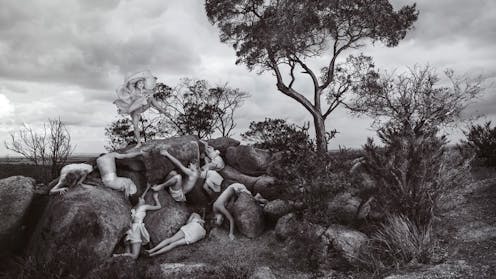
Post-war Japan was home to exciting new theatrical forms. These included the often grotesque and contorted, but at times flowing, dance style “butoh”, created by dancer/choreographer Hijikata Tatsumi – and the intensely focused, sometimes militaristic, sometimes dreamy theatre of Suzuki Tadashi.
Both Hijikata’s and Suzuki’s work attracted followers in Australia, and continue to have influence today. They often exchanged ideas, and several of Hijikata’s former dancers performed in Suzuki’s productions.
Here’s a brief history of how these two helped bring Japanese performance to Australia – and how local artists made it their own.
Suzuki’s training method
Visits by Japanese performing artists to Australia increased during the 1990s, with Melbourne’s Playbox Theatre commissioning Suzuki Tadashi to direct an Australian cast in The Chronicle of Macbeth (1992). But even before he came here, several Australians visited his training institution in the Japanese mountains.

Suzuki is best known for his training method, in which performers stomp up and down in a line, or swiftly move from one physical position to another.
Suzuki claims this generates an actor who, even when standing still, is full of suppressed energy like a “Boeing 747, its brakes on and engines full-throttle just before take-off”.
The performances themselves often have a dreamlike quality, similar to the Japanese noh theatre that inspired Suzuki.
Tanaka brings butoh to Australia
The first of Hijikata’s students to reach Australia was Japanese performer Tanaka Min. Tanaka appeared at the 1982 Sydney Biennale, showcasing his dance style of “Body Weather”.
The Sydney Morning Herald described it as “the relationship between body and place […] improvisation and […] textures” – viewed as a shifting microclimate of impulses moving between the dancer’s body and their surroundings.
Tanaka claimed Hijikata and his principal dancer Ashikawa Yoko taught him 1,000 embodied states that were prompted or described by poetic images or motifs. He passed these on to several Australian performers through his own training.
Although similar to Hijikata’s approach, Tanaka’s focus on the body as an interactive landscape was unique to his version of butoh.
Yumi Umiumare
Japanese choreographer-director Maro Akaji had the greatest influence on Australian physical performance. His butoh company, Dairakudakan, appeared at the 1992 Melbourne Festival and left behind dancer Yumi Umiumare, who settled in the city. Dairakudakan established some of the key motifs recognisable in early Australian butoh.
Maro’s Tale of the Sea-Dappled Horse (1991), opens with a group of almost-naked dancers in white makeup performing a grotesque group dance, coming together in a pulsating mass. As author Bruce Baird describes it, “on their hands and knees […] they convulse progressively energetically”.
Umiumare’s Japanese heritage gives her the most direct link to butoh’s origins. After performing solos, duets and character roles, she developed what she calls “butoh cabaret”. This often surrealistically funny style is similar to Melbourne’s zanier comedy shows, as well as Dairakudakan’s own “grand seminarrative spectacles”.
Umiumare says even her serious works in Melbourne were aimed at “audiences [who] really wanted a laugh”. In a 1995 cabaret skit, she parodied Madonna’s famous pointed cone bra costume. She pulled out accordian-style tubes placed over her breasts to render herself a phallic woman, before threatening and flirting with spectators.
Umiumare continues to train and direct ensembles.
Tess de Quincey
Choreographer-dancer Tess de Quincey was the first non-Japanese, Australian-based artist to focus on Japanese physical theatre. She trained with Tanaka in Japan from 1985, before returning to performing in Sydney in 1988.
De Quincey’s early Australian shows of 1988 and 1989 featured her naked body, all white like the Japanese butoh dancers, twisting and shifting in semi darkness.
She later produced introspective multimedia works such as Nerve 9 (2001-05), structured around the slow unfolding of dissociated bodily gestures.
Zen Zen Zo Physical Theatre
Hijikata’s butoh style was further explored by the Brisbane-based Zen Zen Zo Physical Theatre, founded by performer/director/trainer Lynne Bradley and director/trainer Simon Woods. The pair also witnessed Suzuki’s training in Japan.
Zen Zen Zo’s fusion of butoh, Suzuki’s method, and Jacques Lecoq’s approach to clowning culminated in the 1996 production The Cult of Dionysus, performed at the Brisbane Festival.
Audiences described a “glamorously grotesque” chorus, attired in “ragged skirts of rich reds, oranges and pinks, and strings of beads across their […] bare torsos,” “smeared” with ochre.
Although Zen Zen Zo’s work became increasingly varied during the 2000s, it still trains in Suzuki’s method.
Frank Theatre
Another pair dedicated to Suzuki’s theatre and training were former contemporary dancers Jacqui Carroll and John Nobbs. The pair founded Frank Theatre in Brisbane in 1992, drawing on many of the same performers as Zen Zen Zo.
Nobbs rejected any dilution of Suzuki’s method, going on to develop what he characterises as an unsullied “regional variant”. Carroll and Nobbs also retained the often riotous grotesquerie and absurdism of Suzuki’s productions.
Frank Theatre’s masterpiece was Carroll’s Doll Seventeen (2002), an adaptation of Ray Lawler’s Summer of the Seventeenth Doll (1955). Very similar to a Japanese noh play in its sense of inevitability, the characters intoned their words as though trapped in a slowly unfolding nightmare.
Crisscrossing the Pacific
Hijikata and Suzuki have also inspired performance-makers more distant from Japanese tradition.
Australian dance company Marrugeku combines certain elements of Japanese theatre with First Nations performance.
Similarly, multidisiplinary Māori–Australian artist Victoria Hunt combines butoh influences with her own whakapapa, or Māori genealogy.
And Tony Yap, of Malaysian Chinese descent, has developed what he calls “trance dance”, drawing on Hijikata’s writings, Polish theatre director Jerzy Grotowski’s’s theatre of bodily and spiritual transfiguration, and Yap’s own background in Southeast Asian possession rituals.
In these, and other exchanges, performance practices crisscross the Pacific, from Japan to Aotearoa New Zealand, to Australia, to Malaysia, and back.
Authors: Jonathan W. Marshall, Associate Professor & Postgraduate Research Coordinator, Western Australian Academy of Performing Arts, Edith Cowan University

















