

Your smartphone is a parasite, according to evolution
- Written by Rachael L. Brown, Director of the Centre for Philosophy of the Sciences and Associate Professor of Philosophy, Australian National University
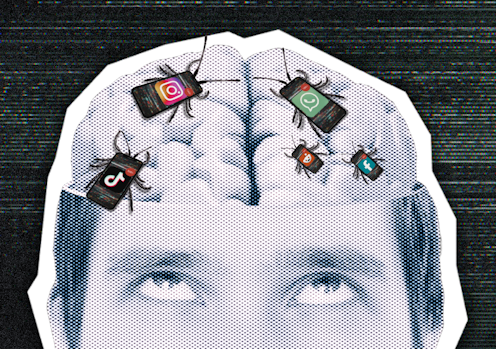
Head lice, fleas and tapeworms have been humanity’s companions throughout our evolutionary history. Yet, the greatest parasite of the modern age is no blood-sucking invertebrate. It is sleek, glass-fronted and addictive by design. Its host? Every human on Earth with a wifi signal.
Far from being benign tools, smartphones parasitise our time, our attention and our personal information, all in the interests of technology companies and their advertisers.
In a new article in the Australasian Journal of Philosophy, we argue smartphones pose unique societal risks, which come into sharp focus when viewed through the lens of parasitism.
What, exactly, is a parasite?
Evolutionary biologists define a parasite as a species that benefits from a close relationship with another species – its host – while the host bears a cost.
The head louse, for example, is entirely dependent on our own species for its survival. They only eat human blood, and if they become dislodged from their host, they survive only briefly unless they are fortunate enough to fall onto another human scalp. In return for our blood, head lice give us nothing but a nasty itch; that’s the cost.
Smartphones have radically changed our lives. From navigating cities to managing chronic health diseases such as diabetes, these pocket-sized bits of tech make our lives easier. So much so that most of us are rarely without them.
Yet, despite their benefits, many of us are hostage to our phones and slaves to the endless scroll, unable to fully disconnect. Phone users are paying the price with a lack of sleep, weaker offline relationships and mood disorders.
From mutualism to parasitism
Not all close species relationships are parasitic. Many organisms that live on or inside us are beneficial.
Consider the bacteria in the digestive tracts of animals. They can only survive and reproduce in the gut of their host species, feeding on nutrients passing through. But they provide benefits to the host, including improved immunity and better digestion. These win-win associations are called mutualisms.
The human-smartphone association began as a mutualism. The technology proved useful to humans for staying in touch, navigating via maps and finding useful information.
Philosophers have spoken of this not in terms of mutualism, but rather as phones being an extension of the human mind, like notebooks, maps and other tools.
From these benign origins, however, we argue the relationship has become parasitic. Such a change is not uncommon in nature; a mutualist can evolve to become a parasite, or vice versa.
Smartphones as parasites
As smartphones have become near-indispensible, some of the most popular apps they offer have come to serve the interests of the app-making companies and their advertisers more faithfully than those of their human users.
These apps are designed to nudge our behaviour to keep us scrolling, clicking on advertising and simmering in perpetual outrage.
The data on our scrolling behaviour is used to further that exploitation. Your phone only cares about your personal fitness goals or desire to spend more quality time with your kids to the extent that it uses this information to tailor itself to better capture your attention.
So, it can be useful to think of users and their phones as akin to hosts and their parasites – at least some of the time.
While this realisation is interesting in and of itself, the benefit of viewing smartphones through the evolutionary lens of parasitism comes into its own when considering where the relationship might head next – and how we could thwart these high-tech parasites.
Where policing comes in
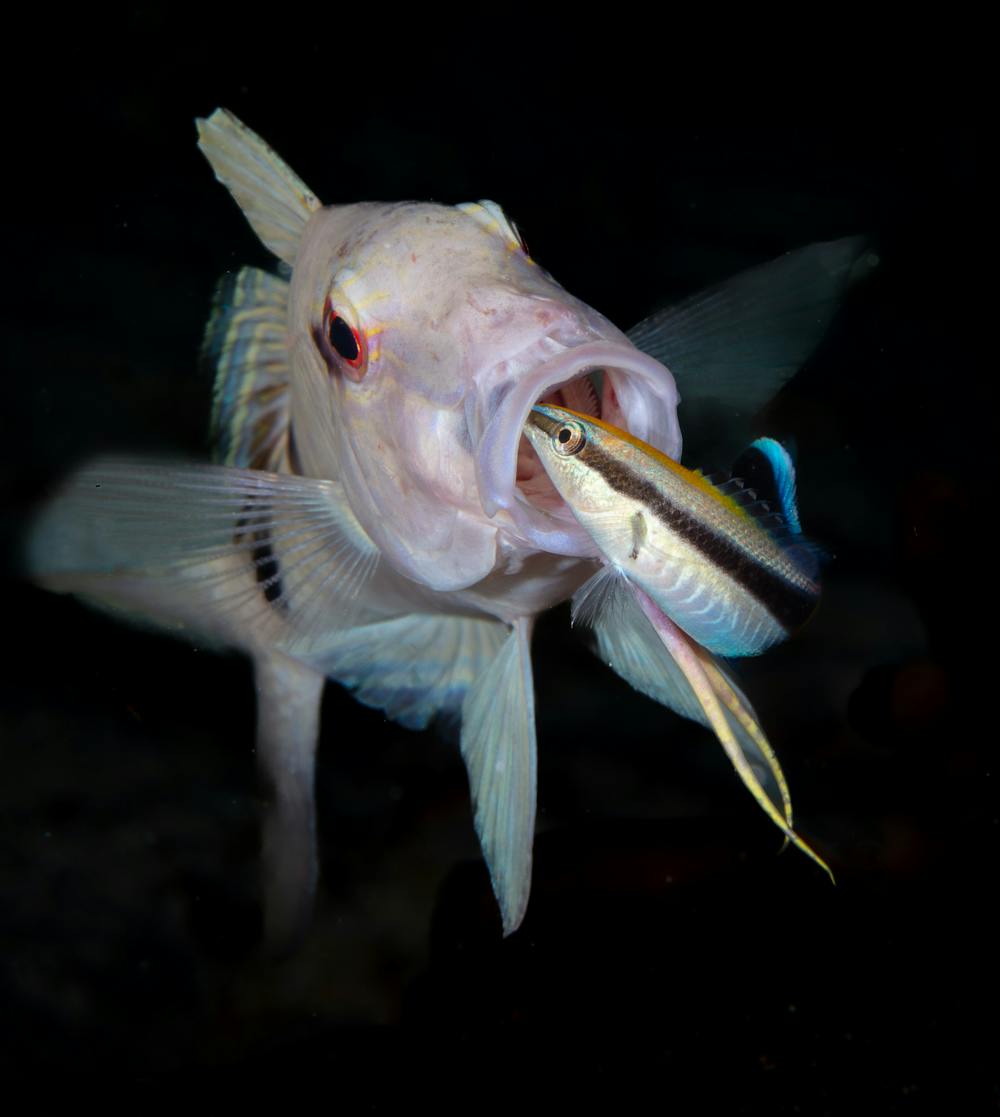
On the Great Barrier Reef, bluestreak cleaner wrasse establish “cleaning stations” where larger fish allow the wrasse to feed on dead skin, loose scales and invertebrate parasites living in their gills. This relationship is a classic mutualism – the larger fish lose costly parasites and the cleaner wrasse get fed.
Sometimes the cleaner wrasse “cheat” and nip their hosts, tipping the scale from mutualism to parasitism. The fish being cleaned may punish offenders by chasing them away or withholding further visits. In this, the reef fish exhibit something evolutionary biologists see as important to keeping mutualisms in balance: policing.
Could we adequately police our exploitation by smartphones and restore a net-beneficial relationship?
Evolution shows that two things are key: an ability to detect exploitation when it occurs, and the capacity to respond (typically by withdrawing service to the parasite).
A difficult battle
In the case of the smartphone, we can’t easily detect the exploitation. Tech companies that design the various features and algorithms to keep you picking up your phone aren’t advertising this behaviour.
But even if you’re aware of the exploitative nature of smartphone apps, responding is also more difficult than simply putting the phone down.
Many of us have become reliant on smartphones for everyday tasks. Rather than remembering facts, we offload the task to digital devices – for some people, this can change their cognition and memory.
We depend on having a camera for capturing life events or even just recording where we parked the car. This both enhances and limits our memory of events.
Governments and companies have only further cemented our dependence on our phones, by moving their service delivery online via mobile apps. Once we pick up the phone to access our bank accounts or access government services, we’ve lost the battle.
How then can users redress the imbalanced relationship with their phones, turning the parasitic relationship back to a mutualistic one?
Our analysis suggests individual choice can’t reliably get users there. We are individually outgunned by the massive information advantage tech companies hold in the host-parasite arms race.
The Australian government’s under-age social media ban is an example of the kind of collective action required to limit what these parasites can legally do. To win the battle, we will also need restrictions on app features known to be addictive, and on the collection and sale of our personal data.
Authors: Rachael L. Brown, Director of the Centre for Philosophy of the Sciences and Associate Professor of Philosophy, Australian National University
Read more https://theconversation.com/your-smartphone-is-a-parasite-according-to-evolution-256795

















