

Modern Australian
The Times

Astronomers thought the Milky Way was doomed to crash into Andromeda. Now they’re not so sure

  • Written by Ruby Wright, Forrest Fellow in Astrophysics, The University of Western Australia
Astronomers thought the Milky Way was doomed to crash into Andromeda. Now they’re not so sure

For years, astronomers have predicted a dramatic fate for our galaxy: a head-on collision with Andromeda, our nearest large galactic neighbour. This merger – expected in about 5 billion years – has become a staple of astronomy documentaries, textbooks and popular science writing.

But in our new study published in Nature Astronomy, led by Till Sawala from the University of Helsinki, we find the Milky Way’s future might not be as certain previously assumed.

By carefully accounting for uncertainties in existing measurements, and including the gravitational influence of other nearby galaxies, we found there is only about a 50% chance the Milky Way and Andromeda will merge in the next 10 billion years.

Why did we think a collision was inevitable?

The idea that the Milky Way and Andromeda are on a collision course goes back more than a century. Astronomers discovered Andromeda is moving toward us by measuring its radial velocity – its motion along our line of sight – using a slight change in the colour of its light called the Doppler shift.

But galaxies also drift sideways across the sky, a movement known as proper motion or transverse velocity. This sideways motion is incredibly difficult to detect, especially for galaxies millions of light years away.

Earlier studies often assumed Andromeda’s transverse motion was small, making a future head-on collision seem almost certain.

What’s different in this study?

Our study did not have any new data. Instead, we took a fresh look at existing observations from the Hubble Space Telescope and the Gaia mission.

Unlike earlier studies, our work incorporates the uncertainty in these measurements, rather than assuming their most likely values.

We simulated thousands of possible trajectories for the Milky Way and Andromeda trajectories, slightly varying the assumed initial conditions – things such as the speed and position of the two galaxies – each time.

When we started from the same assumptions the earlier studies made, we recovered the same results. However, we were also able to explore a larger range or possibilities.

We also included two additional galaxies that influence the future paths of the Milky Way and Andromeda: the Large Magellanic Cloud, a massive satellite galaxy currently falling into the Milky Way, and M33, also known as the Triangulum Galaxy, which orbits Andromeda.

A detailed photo of a white-and-pink pinwheel-shaped galaxy.
The new study took into account the gravitational effect of the Triangulum Galaxy, which orbits Andromeda. ESO, CC BY

These companion galaxies exert gravitational tugs that change the motions of their hosts.

M33 nudges Andromeda slightly toward the Milky Way, increasing the chance of a merger. Meanwhile, the Large Magellanic Cloud shifts the Milky Way’s motion away from Andromeda, reducing the likelihood of a collision.

Taking all of this into account, we found that in about half of the simulated scenarios, the Milky Way and Andromeda do not merge at all within the next 10 billion years.

What happens if they do – or don’t – collide?

Even if a merger does happen, it’s unlikely to be catastrophic for Earth. Stars in galaxies are separated by enormous distances, so direct collisions are rare.

But over time, the galaxies would coalesce under gravity, forming a single, larger galaxy – probably an elliptical one, rather than the spirals we see today.

If the galaxies don’t merge, they may settle into a long, slow orbit around each other – close companions that never quite collide. It’s a gentler outcome, but it still reshapes our understanding of the Milky Way’s distant future.
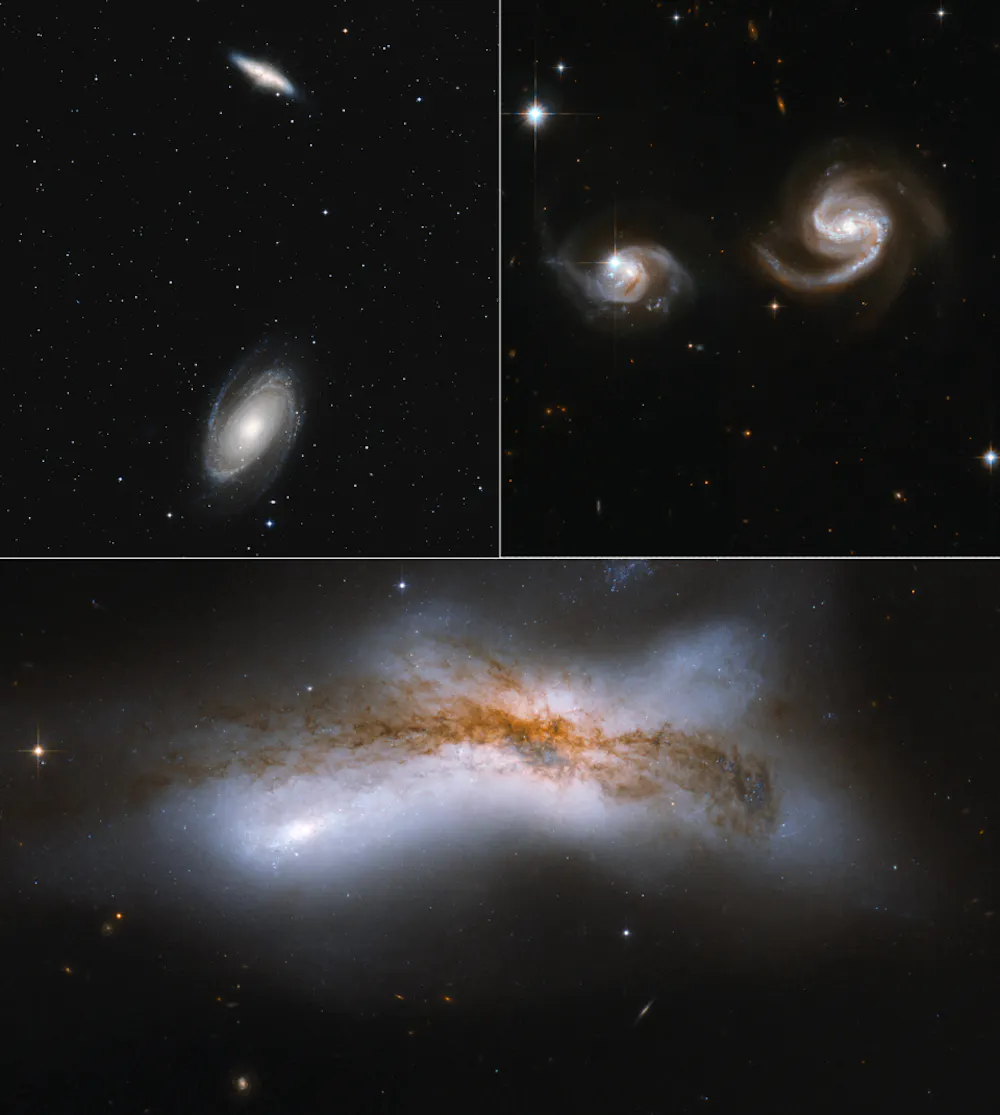
Three images of pairs of galaxies in increasingly close proximity.
Other galaxies show examples of three future scenarios for the Milky Way and Andromeda: galaxies passing in the night, a close encounter, a full collision and merger. NASA / ESA

What comes next?

The biggest remaining uncertainty is the transverse velocity of Andromeda. Even small changes in this sideways motion can make the difference between a merger and a near miss. Future measurements will help refine this value and bring us closer to a clearer answer.

We don’t yet have a definitive answer about our own galaxy’s future. But exploring these possibilities shows just how much we’re still learning about the universe – even close to home.

Authors: Ruby Wright, Forrest Fellow in Astrophysics, The University of Western Australia

Read more https://theconversation.com/astronomers-thought-the-milky-way-was-doomed-to-crash-into-andromeda-now-theyre-not-so-sure-257825

What’s Trending in Men’s Jewellery This Father’s Day!

Finding a Father’s Day gift that feels personal, stylish and genuinely wearable is not always easy. While socks and novelty mugs have traditionall...

Road Signs: Understanding Their Role in Clear and Effective Signage

Effective signage and display hardware can help businesses communicate information, promote products and organise customer or visitor movement. Road...

Bottle Label Printing: Key Factors to Consider Before Your Next Packaging Run

Effective packaging begins with understanding the product, bottle material, artwork and production requirements when planning bottle label printing. H...

Planning a Long-Distance Move With Interstate Movers Melbourne

Moving between states involves more planning than a typical local relocation. Along with packing and transporting household belongings, you need to...

Understanding the Role of an I/O Controller in Industrial Automation

Modern industrial systems depend on accurate communication between sensors, machines and control systems. An I/O controller can help manage this commu...

How the Right Mining Hose Supports Demanding Operations

Mining environments place considerable demands on equipment used for material transfer, water management and processing. Hoses operating in these co...

Simple Ideas for Making Social Gatherings More Memorable

We have all been to those parties where everyone just stands around the kitchen island, staring at their phones, waiting for someone else to make a mo...

Outdoor Wall Lights: Improving Exterior Lighting Around Your Home

Lighting can influence how a room looks, feels and functions, so the right fitting should be selected according to both appearance and practical req...

Commercial Office Cleaning: Combining Routine Office Cleaning With Melbourne Service

Keeping a workplace clean requires a service that can accommodate everyday tasks as well as the particular needs of the business. Professional comme...

Caravan Sales in Queensland: How to Find the Right Caravan for Sale QLD

Caravan ownership is about more than having somewhere to sleep while travelling. For many Queenslanders, it is one of the best ways to explore regio...

What Sir Walter Buffalo Turf Actually Costs in 2026 (And Why Quotes Vary So Much)

Two quotes landed on a Hills District homeowner's kitchen table last spring for the exact same 80-square-metre backyard. One said $12 a metre. The o...

Nearly 1,300 NSW Hospital Beds Are Occupied By People Who Are Ready To Go Home

1,276 people in NSW hospitals have been medically cleared for discharge but remain in hospital because they're still waiting for NDIS or aged care sup...

National Survey Launched to Measure Operational Impacts of Federal NDIS Policy Reforms

The effects of recent NDIS reforms are beginning to move beyond policy papers and into day to day service delivery. A new national survey is asking ...

Beyond the Nappy Cake: Baby Shower Gifts That Get Used

What new Australian parents unwrap, keep, and quietly thank you for months later. Six weeks after my daughter was born, I did an audit of the baby sh...

Parent-Advocates Are Reshaping Frontline Disability Service Delivery

Parents have always been part of the disability sector. They advocate, coordinate services, challenge decisions and often become the person holding ev...

Vista Cruises Enters "Two-Flagship Era" as Vista Aurora Completes Inaugural Voyage

Vista Aurora Sets Sail along the Yangtze. (Photo courtesy of the company)YICHANG, China — August 5, 2026 — Vista Aurora, a high-end interprovinc...

A Digital Preparation Checklist For International Medical Conferences

An international medical conference compresses many responsibilities into a few days. A delegate may need to present research, move between venues, ...

The Growing Popularity of Lab Grown Diamonds in Sydney and Hong Kong

The diamond industry has changed significantly in recent years as more buyers seek ethical, affordable, and sustainable alternatives to mined diamon...
















