

Australian kids BYO lunches to school. There is a healthier way to feed students
- Written by Liesel Spencer, Associate Professor, School of Law, Western Sydney University
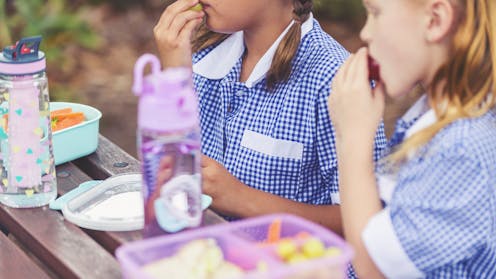
Australian parents will be familiar with this school morning routine: hastily making sandwiches or squeezing leftovers into containers, grabbing a snack from the cupboard and a piece of fruit from the counter.
This would be unheard of in many other countries, including Finland, Sweden, Scotland, Wales, Brazil and India, which provide free daily school meals to every child.
Australia is one of the few high-income countries that does not provide children with a daily nutritious meal at school.
As families increasingly face food insecurity and a cost-of-living crisis, here’s how school lunches could help.
School lunches are important
During the week, children get a third of their daily food intake at school. What they eat during school hours has a significant impact on their health.
Australian children have much higher rates of obesity than children in countries with healthy lunch programs.
As children’s diets affect physical and cognitive development, and mental health, poor diet can also affect academic performance.
International research shows universal school meal programs – where all children are provided with a healthy meal at school each day – can improve both health and educational outcomes for students.
The problem with BYO lunchboxes
In Australia, children either bring a packed lunch or buy food at the school canteen. But the vast majority of these lunches don’t meet kids’ dietary needs.
As a 2022 Flinders University report notes, more than 80% of Australian primary school lunches are of poor nutritional quality. Half of students’ school-day food intake comes from junk food and fewer than one in ten students eat enough vegetables.
While these figures are based on 2011–2012 data, subsequent national survey data does not show significant improvements in children’s healthy diet indicators, including fruit and vegetable consumption. Time pressures on carers mean pre-packaged food can be a default lunchbox choice.
At the same time, many families with school students are not able to provide their children with healthy lunches. Food insecurity — not having regular access to enough safe, healthy and affordable food — affects an estimated 58% of Australian households with children, and 69% of single-parent households.
Hot weather also raises food safety concerns, as it’s hard to keep fresh food cool in schoolbags.
School meals programs in Australia
There are some historical examples of providing food to children at school in Australia. This includes the school milk program which ran from 1950s to 1970s. There were also wartime experiments in the 1940s. For example, the Oslo lunch (a cheese and salad sandwich on wholemeal bread, with milk and fruit) was provided at school to improve the health of children.
Today, there is a patchwork of school food programs run by not-for-profit organisations providing breakfast and/or lunch, and various schemes, including kitchen garden and school greenhouse programs.
There are also pilot schemes providing hot meals. For example, in Tasmania, the current pilot school lunch program feeds children in participating schools a hot lunch on some days of the week with state government support. Evaluation of the program showed strong benefits: healthier eating, calmer classrooms, better social connections from eating lunch together, and less food waste.
The 2023 parliamentary inquiry into food security recommended the federal government work with states and territories to consider the feasibility of a school meals program.
In May, the South Australian parliament opened an inquiry into programs in preschools and schools to ensure children and young people don’t go hungry during the day.
What would it take to introduce school meals?
Rolling out universal school meal programs across Australian schools would require cooperation between government and private sectors.
It could build on what already exists – including canteens, school gardens, food relief and breakfast clubs – to create a more consistent and inclusive system.
There’s a strong evidence base to guide this, both from Australian pilot programs and international examples.
Decisions would have to be made about regulation and funding – whether to opt for a federally-funded and regulated scheme with federal and state cooperation, or a state-by-state scheme.
Funding mechanisms from international models include fully government-funded, caregiver-paid (but with subsidies for disadvantaged families) and cost-sharing arrangements between government and families.
Costs per child per day are around A$10, factoring in economies of scale. Some pilot programs report lower costs of around $5, but involve volunteer labour.
More research is needed to determine parent and community attitudes and model these funding options, including preventative health benefits.
Delivery models may also vary depending on each school’s size, location and infrastructure. This could include onsite food preparation, central kitchens delivering pre-prepared meals, or partnerships with not-for-profit providers.
Ultimately, providing food at school could save parents valuable time and stress, and ensure all Australian students can access the health and education benefits of a nutritious school meal.
Authors: Liesel Spencer, Associate Professor, School of Law, Western Sydney University

















