

why Australia’s Indigenous people must be a part of our sports strategy
- Written by Stuart Murray, Associate Professor, International Relations and Diplomacy, Bond University
Since coming to power in 2022, the Albanese government has focused strongly on the Indo-Pacific.
The prime minister’s recent trip to Indonesia was the latest high-level bilateral summit as Australia seeks to recalibrate relationships, enhance security and, where possible, win the battle for hearts and minds in the region.
Read more: There's no country more important to Australia than Indonesia. Trouble is, the feeling isn't mutual
In a world slipping further into “strategic atrophy,” art, music, food, culture, sport and other forms of soft power are no longer peripheral.
In the foreword to the recently launched Australian Sports Diplomacy 2032+ strategy, for example, Labor MP Tim Watts stated:
Sport is an important tool for Australia’s diplomatic engagement at a time when Australia needs to use every dimension of our national power to advance our interests.
The First Nations of Australia are mentioned in this strategy but it fails to reflect the depth, power and influence Indigenous sports diplomats could bring.
Arguably, our sports diplomacy would be more authentic, unique and effective (especially in the Pacific) if First Nations people, perspectives and programs were genuinely integrated from the outset – baked in, not bolted on.
The epic history of First Nations sport
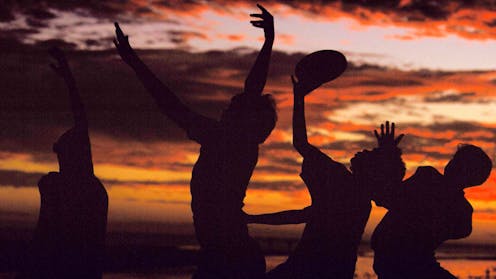
Indigenous Australians were the first people to play sport on this land.
Before colonisation, Australia’s population was around 750,000, divided into about 500 nations.
Though sometimes hostile, these communities shared a common language: sport.
Physical pursuits served, and still serve, many purposes for Aboriginal and Torres Strait Islander people: fostering communication, preserving lore, teaching youth to be effective providers and most importantly, practising survival skills.
Sport was also a civilising force used for social, cultural and diplomatic ends. Games and carnivals increased contact between clans, easing tension, division, xenophobia and misunderstandings that could spark violence.
Battendi (spear-throwing), Marngrook (football), Koolchee (ball games), and Prun (mock war) are examples of diplomatic games that predate the ancient Greek Olympics by tens of thousands of years.
Sport became central to Aboriginal and Torres Strait Islander history, culture, identity and diplomacy.
“Deadly” – a term meaning excellent – sports diplomacy is a more fitting way to describe this unique form of diplomacy. Done well, it offers a more accurate, authentic brand of Australia to the region and beyond.
The battle for the Blue Pacific
The “Blue Pacific” – a term describing a shared Pacific culture, identity and collective diplomatic strategy – offers an opportunity to harness the power of deadly sports diplomacy.
If Australia hopes to win Pacific hearts and minds, it should send more Aboriginal and Torres Strait Islander sports diplomats and teams to countries such as Fiji, Papua New Guinea (PNG) and New Zealand, because the nations of the Blue Pacific deeply respect the old, wise First Peoples of Australia.
These relationships are built on shared values: culture, family, spirituality and sport.
The Black Swans – Australia’s First Nations netball team, which debuted at the PacificAus Sports netball series in 2024 – are included as a case study in Sports Diplomacy 2032+. However, it’s the government’s A$600 million NRL project in PNG that has dominated headlines.
Read more: Sports diplomacy: why the Australian government is spending $600 million on a new NRL team in PNG
The Albanese government’s backing of this initiative has sparked criticism among supporters of other codes in Australia with strong ties to Pacific nations – especially rugby union, which until recently was the code of choice in Fiji and throughout Polynesia.
A rise in Pacific Island interest in rugby league may impact rugby union, some argue.However, rugby league may be a more effective sports diplomacy tool. It enjoys growing popularity in those locations and has undisputed national sport status in PNG, the most populous Pacific nation by far.
It’s also arguably more “deadly,” with its Indigenous All Stars team and an Indigenous Round.
In the NRL, 48% of players have Pasifika heritage, and 12% identify as Aboriginal or Torres Strait Islander, compared to 3% across the Australian population.
Should rugby union receive similar support? Perhaps, but first, it must address the absence of Indigenous players.
Since Rugby Australia’s founding in 1949, only 15 Aboriginal men have played Test rugby for Australia.
What about similar funding for soccer, the national obsession of strategically important near neighbours Solomon Islands and Vanuatu?
It too has had a relative absence of Indigenous players at Australia’s highest levels, notwithstanding the pioneering careers of Charlie Perkins, John Moriarty, Archie Thompson and recent Matildas Lydia Williams and Mackenzie Arnold.
Extra time
Integrating the world’s oldest living culture in Australia’s sports diplomacy program can only enhance our relationships, diplomacy and national brand.
The Australian Institute of Sport (AIS)’s Share a Yarn initiative is helping lead the way.
Established in 2020, it connects elite First Nations athletes with respected Aboriginal and Torres Strait Islander mentors.
Throughout the year, athletes and mentors meet online, attend monthly storytelling sessions and attend an annual cultural connection camp at the AIS campus.
As Marissa Williamson Pohlman, the first Aboriginal woman to compete in boxing at the Olympics in 2024, noted:
Mainstream sport can be challenging but having the unwavering support of mob keeps me grounded and focused on my goals.
The fact Aboriginal and Torres Strait Islanders have practised sports diplomacy for more than 60,000 years is a powerful story. It is one that should be celebrated at every international sporting event we attend, bid for, or host.
Including Aboriginal and Torres Strait Islander people, programs and perspectives would strengthen and innovate our strategies, add vital cultural iconography, inspire like-minded nations and help win hearts and minds from Honiara to Hawaii.
The authors would like to thank Kombumerri woman Emily Pugin (DFAT) and Butchulla/Goreng Goreng Paul Martin for their contribution, teaching and help in commissioning and drafting the report that informs this article.
Authors: Stuart Murray, Associate Professor, International Relations and Diplomacy, Bond University

















