

E-bikes and e-scooters are popular – but dangerous. A transport expert explains how to make them safer
- Written by Geoff Rose, Professor in Transport Engineering, Monash Institute of Transport Studies, Monash University
Last weekend a pedestrian in Perth tragically died after being struck by an e-scooter.
This followed the death of another person in Victoria last month who was hit and killed by a modified e-bike which police alleged could travel at 90 kilometres per hour.
A study published earlier this week also found nearly 180 e-scooter injuries in young people aged five to 15 at the Sunshine Coast University Hospital in 2023 and 2024. One in ten injuries were life-threatening or potentially life-threatening.
Even though e-bikes and e-scooters have many benefits, such as improving urban accessibility and giving people scope to reduce or even eliminate carbon-emitting car use, these examples highlight their associated risks.
For these risks to be properly addressed, an overhaul of regulations covering e-bikes and e-scooters is urgently needed.
All to do with power
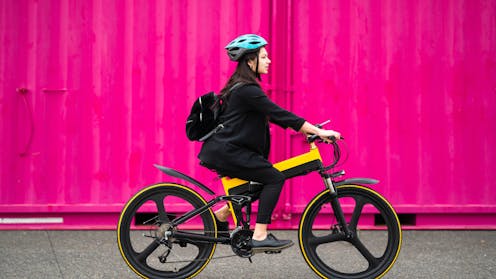
E-bikes have a battery-powered motor to assist the rider. The key word there is “assist”: to be legal the rider has to be pedalling to get the power assistance.
E-scooters are a new variant of the once humble children’s kick scooter. They are more sturdy to support an adult rider, and the battery-powered motor provides all the power.
Some e-bikes and e-scooters have throttles, which enable riders to accelerate to higher speeds without pedalling. Technically, these are illegal.
These new forms of urban transport are surging in popularity. This year alone, about 150,000 e-bikes are forecast to be sold across the country. An estimated 350,000 Australians – about 1.3% of the population – owned an e-scooter in 2024.
Regulations governing e-bikes and e-scooters were historically designed with reference to the power required to ride a regular bicycle.
A person needs to provide power equal to 220 watts to propel a regular bicycle at 32km/h on a flat road without a headwind.
The figure of 250 watts emerged as the baseline in Europe for the power limit on e-bikes. It is 500 watts in Canada and 750 watts in the United States.
In 2017, Australia harmonised its e-bike regulations with with those in Europe.
The regulations specify that power-assisted e-bikes can have a motor up to 250 watts. But the rider must pedal to get the power assistance and it must cut out above 25km/h.
E-bikes can travel faster than 25km/h. But the rider has to be providing all the power above that speed.
The same power limit was applied to e-scooters. But given their design and smaller wheels, regulators in Australia were more conservative, specifying a 20km/h maximum speed.
Differences across Australian states have since emerged with New South Wales allowing e-bikes up to 500 watts. Queensland has also removed motor power output from its e-scooter regulations and allows them to travel at speeds up to 25km/h.
There are two main problems with the existing system of regulations. First, there is nothing to stop the import of high-performance e-bikes and e-scooters from overseas. Second, enforcement is difficult and rarely occurs, because the police don’t have the equipment to easily test motor power.

What needs to change?
The federal government has a clear role to play in stemming the import of e-bikes and e-scooters that exceed the legal limits for public use in Australia.
However there is no evidence the government has engaged with the issue. This is inconsistent with its commitment to the National Road Safety Strategy and the approach taken to the management of vehicle safety and import regulations which apply to motor vehicles.
State and territory governments must revise and simplify their e-bike and e-scooter regulations.
Tasmania is on the front foot with its review of e-bike regulations. But e-scooter regulations also need reform – to make them easier for the public to understand, to ensure these devices offer a viable travel option for people and, importantly, to enable efficient enforcement.

A few changes to the rules could then make a big difference.
For a start, references to motor power should be removed because the severity of a crash depends on speed not the power of the device. Having the regulations framed in terms of power is a complication for enforcement and we don’t use it to regulate motor vehicles.
Then we need to focus on where, and how fast, these vehicles can be ridden.
A good first step would be to follow the lead of Queensland and Tasmania and legalise footpath riding, subject to a 12km/h or 15km/h speed limit as is the case in those states.
Restricting e-scooters to low-speed roads (up to 50km/h), and with a lower speed limit when ridden on the footpath, would minimise the risk of dangerous collisions with pedestrians and reduce the risk of dangerous collisions with cars on high-speed roads.
Specifying a max speed under power assistance for e-bikes of 32km/h would bring us in line with the regulations for countries that have cities similar to Australia’s such as Canada and New Zealand.
This would open our market to more models from overseas. It would also ensure e-bikes are better able to keep up with traffic when ridden on roads and are more competitive in terms of travel time relative to the car, to help further reduce car use.
When it comes to e-scooters, moving to a 25km/h speed limit (as is the case in Queensland), combined with restricting their use to roads of up to 50km/h, would improve their compatibility with the flow of motor vehicles on local streets.
Local government and road authorities should also have the power to declare areas where footpath riding is not permitted – for example, inner-city footpaths with heavy pedestrian activity. They should also have the power to set speed limits for riders on shared paths and bicycle lanes where there is likely to be interaction with pedestrians.
With those changes in place, police would be able to enforce displayed speed limits for e-bikes and e-scooters using radar guns, as is already done in Queensland, and issue fines where appropriate.
Authors: Geoff Rose, Professor in Transport Engineering, Monash Institute of Transport Studies, Monash University

















