

The kimono is more than an artefact and more than clothing. It is a concept artists will make their own
- Written by Sasha Grishin, Adjunct Professor of Art History, Australian National University
The kimono garment, the national dress of Japan, carries within itself all of the magic and traditions of Japanese culture.
The basic features of the kimono are fairly simple. It is a wrapped front garment with square sleeves that has a rectangular body where the left side is wrapped over the right, except in funerary use.
The garment may be traced back to the Heian period as a distinctive style of dress for the nobility. In the Edo period (1603–1867) it came to a glorious culmination with colourful and expensive fabrics.
The great poet Matsuo Bashō once wrote “Spring passes by / again and again in layers / of blossom-kimono”. Since childhood I’ve loved the mystical image “blossom-kimono”.
In 2020, the Victoria and Albert Museum in London staged their epic exhibition Kimono: Kyoto to Catwalk, where hundreds of garments, accessories, prints and photographs charted the history of the kimono from the 17th century through to the present.
A new exhibition from the National Gallery of Victoria is similarly ambitious. Over 70 fabulous garments of exquisite craftsmanship – some made of silk with gold and silver embroidery and dazzling designs – have been assembled within a context of over 150 paintings, posters, wood block prints, magazines and decorative arts.
Although many of the items have never been previously exhibited in Australia, most are now in the collection of the NGV, with many specifically acquired for this exhibition.
Exquisite production
There are seven newly acquired Edo-period silk and ramie kimonos, richly decorated with leaves, tendrils and falling snow. They provide us with a glimpse at the wealth and sophistication of the samurai and merchant classes of the 18th and 19th centuries.
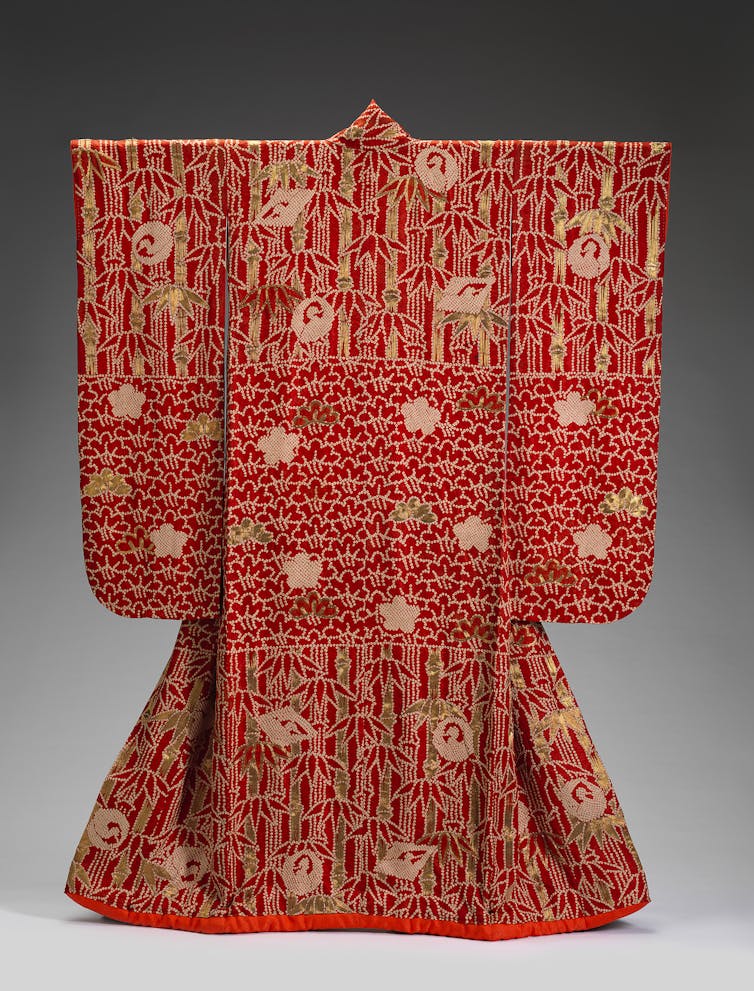
One of the highlights is the Uchikake Furisode wedding kimono with pine, bamboo, plum and cranes, from the early to mid-19th century.
It is a display of exquisite taste with satin silk, shibori tie dyeing, and embroidery with gold thread. The birds and the vegetation seem to float on the surface and must have created an amazing sight when worn.

The garment is simple and functional and, despite the exquisiteness of its production, it is also restrained in contrast to the conspicuous exuberance of some examples of 19th century European courtly dress.
Some of these Edo period kimonos can become quite narrative-driven in their design, as with the Hitoe kosode kimono with themes alluding to eight Noh theatre plays of the late Edo period. Slightly smaller than the wedding kimono, that was 177.5 cm long as opposed to 167 cm, this one revels in a blue background on gauze satin silk with a multiplicity of little narrative scenes like an assembly of diverse stage sets.

The exhibition also includes the work of contemporary Japanese kimono designers including Hiroko Takahashi, Jotaro Saito, Modern Antenna, Tamao Shigemune, Y&SONS, Rumi Rock and Robe Japonica.
The kimono as a concept
The kimono is more than an historic artefact, one where ideas and methods of production were to remain constant for centuries. It is also an idea that inspires designers working in international fashion houses.
The NGV exhibition includes kimono-inspired works of Issey Miyake, Yohji Yamamoto, John Galliano, Comme des Garçon, Alexander McQueen, Givenchy, Zambesi and Rudi Gernreich.
Alexander McQueen’s Gown, belt and sandals (Dégradé) (2007) is one of the takeaway memories from this exhibition. The humble functional kimono has been totally transfigured.
To the silk-satin shell there have been added leather, metal and rubber accessories and synthetic shoulder pads. The purple and pink colour scheme and the sweeping sleeves that trail along the ground create a mesmerising and dominant phantom-like character that owns and dominates the space.
 Gown, belt and sandals (Dégradé), 2007. The blue lady (La Dame Bleue) collection, spring-summer 2008. Silk (satin), patent leather, leather, synthetic fabric (shoulder pads, wadding), cotton (laces), metal (fastenings), rubber, (a) 176.0 cm (centre back) 33.5 cm (waist, flat) (dress) (b) 37.0 × 61.0 cm (belt) (c-d) 23.0 × 19.5 × 80.0 cm (each) (sandals).
National Gallery of Victoria, Melbourne, Gift of Krystyna Campbell-Pretty AM and Family through the Australian Government’s Cultural Gifts Program, 2021 ©Alexander McQueen
Gown, belt and sandals (Dégradé), 2007. The blue lady (La Dame Bleue) collection, spring-summer 2008. Silk (satin), patent leather, leather, synthetic fabric (shoulder pads, wadding), cotton (laces), metal (fastenings), rubber, (a) 176.0 cm (centre back) 33.5 cm (waist, flat) (dress) (b) 37.0 × 61.0 cm (belt) (c-d) 23.0 × 19.5 × 80.0 cm (each) (sandals).
National Gallery of Victoria, Melbourne, Gift of Krystyna Campbell-Pretty AM and Family through the Australian Government’s Cultural Gifts Program, 2021 ©Alexander McQueen
It is difficult not to be impressed by McQueen’s vision, but we have now moved quite a long way from the kimono.
The kimono is a wonderful concept – an armature on which to hang many different ideas. The beauty of this exhibition is that it frees the idea of a garment from a static piece of cloth, at best to be displayed on a dummy, to something approaching a concept in design that artists will clasp and from which they will create their own work.
There are many rich nuances in the show, for example the superb almost monochrome and somewhat gothic Men’s undergarment (nagajuban) with graveyard, skulls and crescent moon (c.1930).
 Men’s undergarment (nagajuban) with graveyard, skulls and crescent moon c. 1930. Silk, wool, cotton 127.0 cm (centre back) 130.5 cm (cuff to cuff).
National Gallery of Victoria, Melbourne Maureen Morrisey Bequest, 2018
Men’s undergarment (nagajuban) with graveyard, skulls and crescent moon c. 1930. Silk, wool, cotton 127.0 cm (centre back) 130.5 cm (cuff to cuff).
National Gallery of Victoria, Melbourne Maureen Morrisey Bequest, 2018
At the same time, we have Women’s kimono with geometric design and accessories (c.1930) with its polychrome exuberance with reds, blacks and greys combining geometric motifs with soft organic feather-like forms.
Bashō’s “blossom-kimono” was a meditation on the passing of time and the hope that a young girl will live to experience wrinkles that come with old age. The kimono in this exhibition celebrates the passing of time and generational change within the life of an immortal idea about function, form and ideas of beauty.
Kimono is at the National Gallery of Victoria until October 5.
Authors: Sasha Grishin, Adjunct Professor of Art History, Australian National University

















