

Australia’s government is pledging better protection for our vulnerable seas – but will it work?
- Written by Carissa Klein, Associate Professor in Conservation Biology, The University of Queensland
Ahead of this week’s crucial United Nations ocean conference, federal Environment Minister Murray Watt promised that by 2030, 30% of Australian waters would be “highly protected”.
This is a telling pledge. After all, 52% of Australian waters are now protected following years of rapid expansion. But many are “paper parks” – lines on a map with very little real protection.
Watt is proposing to expand the area under gold-standard protection, meaning fishing, mining and drilling would be banned inside the parks. This is welcome. But it must be done strategically, protecting ecologically representative and high biodiversity areas.
If Watt is serious, he must ensure these upgraded marine parks cover poorly protected habitats important for biodiversity. These include shallow coastal zones, submarine canyons, seamounts and rocky reefs on the continental shelf. It’s not just about protecting 30% of the seas – marine parks must protect the full range of species and habitats in Australia.

Impressive on paper
Australia’s waters cover all five of the world’s climate zones, from the coral reefs of the tropics to the icy shores of Antarctica. At least 33,000 marine species are found in the nation’s marine boundaries – the most on Earth. Australia also has the most endemic marine species.
For more than 30 years, successive federal and state governments in Australia have claimed global leadership roles in conserving ocean areas. Just last year, the Albanese government claimed the latest expansion meant Australia now protected “more ocean than any other country on earth”.
When 196 countries committed to the goal of “30% by 2030” – the effective protection and management of at least 30% of the world’s coastal and marine areas by decade’s end – Australia was already well past that in terms of the size of areas considered marine protected areas.
About 45% of marine waters were protected in 2022, up from 7% in 2002. Now that figure is 52%.
Job done? Not even close. Even as Australia’s marine protected areas have rapidly expanded, marine species populations have shrunk while entire ecosystems hover on the brink.
More than half of Australia’s marine parks allow commercial fishing and mining. The latest large protection around the sub-Antarctic Heard and McDonald Islands doesn’t give strong protection to species-rich areas such as seamounts and undersea canyons.
Losses everywhere
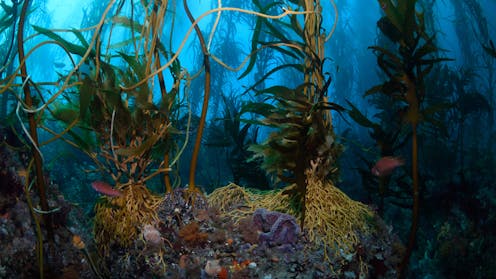
Tasmania’s giant kelp forests once ringed the island state. At least 95% have vanished since the 1990s, wiped out by warmer waters and voracious sea urchins.
Before European settlement, oyster reefs carpeted shallow sea floors in temperate east coast waters. But 99% of these have gone.
Half the Great Barrier Reef’s coral cover died between 1995 and 2017 – a period with only two mass bleaching events. Bleaching has become more regular and more severe since then.
Many marine species are in serious trouble. The most comprehensive assessment to date found populations of 57% of species living on coral, rocky and kelp reefs had fallen between 2011 and 2021. In 2020, a Tasmanian endemic species, the smooth handfish, became the first marine fish officially listed as extinct on the IUCN Red List of Threatened Species.

As the oceans get hotter, coral reefs are forecast to be wiped out. Poor marine water quality is drowning coastal species and ecosystems in sediments, nutrients, chemicals, and pathogens, including in The Great Barrier Reef.
That’s not to say marine park expansion and other government efforts have been worthless. Far from it.
Some whales have rebounded strongly due to the moratorium on commercial whaling. Good management of the southern bluefin tuna led to its removal from the threatened species list last year.
Efforts to phase out gill net fishing are bearing fruit, while water quality has improved a little in the Great Barrier Reef.
But these wins don’t offset an overall rapid decline.
Action needed on climate and improving marine parks
Giving Australia’s marine parks better protection won’t solve the problem of hotter, more acidic oceans due to climate change.
Australia’s current emission target is consistent with a 2°C warming pathway. That level of warming would mean the loss of 99% of the world’s coral reefs.
Australia is one of the world’s biggest producers of coal and liquefied natural gas and still has one of the world’s highest rates of land clearing, accounting for up to 12% of the country’s total emissions in some years.
Protecting life in the seas means Australia must dramatically reduce emissions, end widespread land clearing and halt the approval of new coal and gas projects.
Better protection inside marine parks will stop other major threats, such as seabed mining, gas and oil exploration and fishing.
To date, Australia’s marine parks with high levels of protection are typically in remote areas with minimal human activity threatening biodiversity.
From paper parks to real conservation leadership
For decades, Australian leaders have touted their efforts to protect the seas. It’s now abundantly clear that paper protection isn’t enough.
To arrest the steep decline in marine life, Australia must properly protect its marine areas by preventing fishing and mining in areas important for all marine species, while expanding its highly protected marine parks to save unprotected ecosystems.
Minister Watt’s pledge is welcome. But it must actually prevent damaging human activities such as fishing and oil and gas extraction which are major contributors to the extinction crisis.
Leaders must also focus on sustainable production and consumption of seafood and ramp up their ambition to tackle climate change and marine pollution.
If Australia continues to expand paper parks without doing the hard work of genuine protection, it will set a dangerous precedent.
Authors: Carissa Klein, Associate Professor in Conservation Biology, The University of Queensland

















