

A solar panel recycling scheme would help reduce waste, but please repair and reuse first
- Written by Deepika Mathur, Senior Research Fellow, Northern Institute, Charles Darwin University
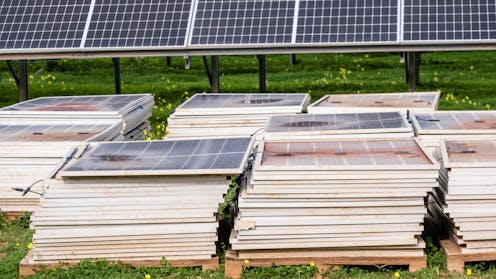
Australia’s rooftop solar industry has renewed calls for a mandatory recycling scheme to deal with the growing problem of solar panel waste. Only about 10% of panels are currently recycled. The rest are stockpiled, sent overseas or dumped in landfill.
One in three Australian homes now have rooftop solar panels, and new systems are being installed at the rate of 300,000 a year. Meanwhile, older systems are being scrapped – often well before the end of their useful life.
This has made solar panels Australia’s fastest-growing electronic waste stream. Yet federal government plans for a national scheme to manage this waste appear to have stalled.
Clearly, solar panel waste is a major problem for Australia. Recycling is one part of the solution. But Australia also needs new rules so solar panels can be repaired and reused.
Millions of solar panels dumped as upgrades surge (ABC News, June 12, 2025)What are product stewardship schemes?
The Smart Energy Council, which represents the solar industry, is calling for a national product stewardship scheme.
Product stewardship schemes share responsibility for reducing waste at the end of a product’s useful life. They can involve people all along the supply chain, from manufacturers to importers to retailers.
Such schemes may be voluntary, and industry-led, or mandatory and legislated. Alternatively, they can be shared – approved by government but run by an organisation on behalf of industry.
Existing schemes manage waste such as oil, tyres, paper and packaging, mobile phones, televisions and computers.
Depending on the product, a levy is paid by the manufacturer, product importer, network service provider (in case of mobile muster), retailer or consumer – or a combination of these. The money raised is then invested in recycling, research or raising awareness and administering the scheme.
Establishing a solar panel product stewardship scheme
Solar panel systems were added to a national priority list for a product stewardship scheme in 2017.
In December 2020, the federal government called for partners to help develop the scheme, but later stated that no partnership would be struck.
The government released a discussion paper for comment in 2023. The scheme has not yet been established.
This is particularly problematic given Australia’s commitment to renewable energy, which will entail a rapid expansion of solar technology.
Recycling should be the last resort
Product stewardship schemes assume recycling is the main solution to the waste problem.
Australia’s National Waste Policy also focuses on on recycling, rather than reuse or repair. This is despite recycling being the last resort on the “waste hierarchy”, just slightly above disposal.
Solar photovoltaic panels are built to last 30 years or more, and are “not made to be unmade”. They are not easy to dismantle for recycling because they are built to withstand harsh conditions.
It’s difficult for Australia to influence the design of solar panels, given 99% are imported. Just one manufacturer, Tindo Solar in Adelaide, assembles solar panels on Australian soil, using imported silicon cells.
Many solar panels are being removed well before their end of life, generating waste ahead of time. This is rarely because they have stopped producing power.
In our previous research, we found many reasons why people chose to take solar panels down. Consumers are often advised to replace the whole system when just a few panels are faulty. Or they may simply be upgrading to a larger, more efficient system. Sometimes it’s because they want to access a new renewable energy subsidy.
Renewable subsidies and other solar panel policies should be redesigned to keep panels on roofs for longer.
Functioning solar panels removed before the end of their life should be reused. This would require new regulations including quality-control measures certifying second-hand solar panels, and second-hand markets. This is a much neglected field of research and development.

What else should such a scheme include?
Others have discussed what a solar panel product stewardship scheme could include and the possible regulatory environment.
We think the scheme should also involve collecting and transporting panels around Australia, including remote areas.
Unfortunately, existing product stewardship schemes do not differentiate between urban, regional and remote areas. The same is likely to be the case for a solar panel collection and recycling scheme.
This leaves regional and remote areas with fewer recycling facilities and collection points. With a growing number of large solar projects in Northern Australia, reducing waste is imperative.
Remote island communities in the Northern Territory bundle up their recyclables and ship it to Darwin. Removed solar panels are then transported to urban Victoria, New South Wales or South Australia for processing. Who should bear the cost of transporting this waste? Consumers, remote regional councils with small ratepayer bases, or manufacturers and retailers?
A well-designed scheme would help recover valuable resources across Australia for reuse in new products.
However, large volumes of solar panels would be required for recycling schemes to become commercially viable. That’s why the solar recycling industry is concerned about exporters and scrap dealers collecting panels rather then certified solar panel recyclers.
Even if the technology for recycling solar panels is nascent in Australia, it’s worth stockpiling panels in Australia for later.
Considering these issues in the design of a product stewardship scheme would help ensure we can maximise the benefits of renewable energy, while minimising waste.
Authors: Deepika Mathur, Senior Research Fellow, Northern Institute, Charles Darwin University

















