

A weird group of boronias puzzled botanists for decades. Now we’ve solved the pollination mystery
- Written by Douglas Hilton, Chief Executive, CSIRO
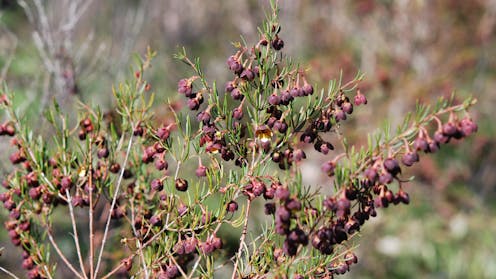
Boronias, known for their showy flowers and strong scent, are a quintessential part of the Australian bush. They led Traditional Owners to the best water sources and inspired Australian children’s author and illustrator May Gibbs to pen one of her earliest books, Boronia Babies.
But a weird group of boronias has puzzled botanists for decades. They have closed flowers that thwart most insect visitors. Those that do gain entry may encounter alternating sterile and fertile anthers (the male part that produces pollen) and sometimes, an enlarged stigma (the female part that receives pollen).
Since the early 1960s, scientists speculated this group of boronias relied on an “unusual agent for effective pollination”. Moths were occasionally mentioned in the botanical literature as potential pollinators, but the full story remained elusive – until now.
As my colleagues and I detail in our new research, moths are indeed the mystery pollinators of this strange group of flowers. This knowledge is crucial to ensuring their long-term survival.

Sweeping plants, far and wide
My interest in the boronia pollinators began 15 years ago. I was studying a family of moths in my spare time, with a group of friends.
These moths, called Heliozelidae, are tiny. Their wings are just a few millimetres long, smaller than a grain of rice.
They fly during the day and are seldom attracted to lights, so they are poorly represented in museum collections. The best way to find them is to sweep plants with a butterfly net then look inside it.

After sweeping plants all over Australia, we discovered this country is a hotspot for Heliozelidae. Hundreds – if not thousands – of these species are new to science and yet to be described. In comparison, only 90 species of Heliozelidae have been described from the rest of the world.
We consistently found one group of 15 moth species on the boronias with the weird flowers in the biodiversity hotspot of Western Australia’s South West. Each moth species was found only on a specific boronia species.
When we took a closer look, we found each of the 15 Heliozelidae has an intricate structure at the tip of its abdomen that collects pollen. There’s nothing else quite like this in the 150,000 known species of moths and butterflies. At last, the mystery of the boronia pollinators was solved.
 Pollen-collecting structure, replete with pollen, on the dorsal tip of the abdomen of the moth that pollinates Boronia crenulata.
Dr Qike Wang
Pollen-collecting structure, replete with pollen, on the dorsal tip of the abdomen of the moth that pollinates Boronia crenulata.
Dr Qike Wang
The process of pollinating boronias
In spring, female moths lay many eggs inside flowers. While moving about inside the flower, she collects pollen in the little structure on her abdomen. She enters and exits multiple flowers, pollinating as she goes.
When the eggs hatch, the caterpillars eat some of the flowers’ developing seeds. When they are fully grown, they leave the flower and burrow into the soil to pupate in a cocoon. When they emerge in spring as moths, the flowers are blooming again and the life cycle repeats.
For some species, such as brown boronia, the moths may be the only visitor the flowers ever receive. This suggests the moth and the plant have a reciprocal relationship, depending on each other for reproduction and ultimately, survival.
This is unusual in nature. The poster-child for this type of relationship is the figs and fig wasps.
 Tiny metallic day-flying moths are the boronia pollinators.
Andy Young
Tiny metallic day-flying moths are the boronia pollinators.
Andy Young
What’s in a name?
When a scientist discovers and officially describes a new species in the academic literature, they have to name it. Scientific names have two parts. The first part is the genus or group of closely related species and the second identifies the individual species.
We built a family tree which included the new pollinating moths using their DNA sequences. We showed the pollinators belong to the genus Prophylactis meaning “to guard before”, which previously contained four non-pollinating species. This gives us the first part of the name.
For the second part, we used the name of the plant each moth pollinates and added the suffix -allax, meaning “alternately” or “in exchange”. This shows their close relationship to the plant.
So, the moth that pollinates Boronia megastigma is called Prophylactis megastigmallax. The moth that pollinates the endangered Boronia clavata is Prophylactis clavatallax – and so on.
Much to learn
The pollinating moths are more closely related to each other than to other species in the Prophylactis genus. This suggests they inherited their pollen-collecting structure from a long-gone common ancestor.
As with all good science, this research leads to new questions. For example, we are now studying which moth-plant pairs fully depend on each other.
Other Australian plant species may also have intimate relationships with moths. Current field work is exploring which of Australia’s 486 plant species in the citrus-family (Rutaceae) are linked to moths and how often moths have evolved to pollinate them.
Bush secrets brought to life
Our research shows just how much of Australia’s biodiversity is yet to be understood and protected.
As climate change and land-clearing drive biodiversity loss at an unprecedented rate, this is a challenge we must tackle with renewed urgency. Otherwise our children and grandchildren may only experience the full glory of Gibb’s characters on a page, and not in the natural world.
 Boronia Babies on Boronia megastigma
2025 © The Northcott Society and the Cerebral Palsy Alliance.
Boronia Babies on Boronia megastigma
2025 © The Northcott Society and the Cerebral Palsy Alliance.
Authors: Douglas Hilton, Chief Executive, CSIRO

















