

why we need to make the term ‘hysterectomy’ history
- Written by Theresa Larkin, Associate Professor of Medical Sciences, University of Wollongong
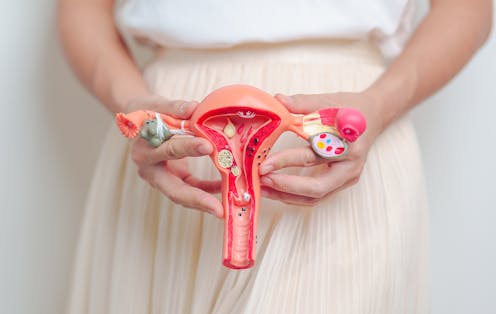
Have you had a tonsillectomy (your tonsils taken out), appendectomy (your appendix removed) or lumpectomy (removal of a lump from your breast)? The suffix “ectomy” denotes surgical removal of the named body part, so these terms give us a clear idea of what the procedure entails.
So why is the removal of the uterus called a hysterectomy and not a uterectomy?
The name hysterectomy is rooted in a mental health condition – “hysteria” – that was once believed to affect women. But we now know this condition doesn’t exist.
Continuing to call this significant operation a hysterectomy both perpetuates misogyny and hampers people’s understanding of what it is.
From the defunct condition ‘hysteria’
Hysteria was a psychiatric condition first formally defined in the 5th century BCE. It had many symptoms, including excessive emotion, irritability, anxiety, breathlessness and fainting.
But hysteria was only diagnosed in women. Male physicians at the time claimed these symptoms were caused by a “wandering womb”. They believed the womb (uterus) moved around the body looking for sperm and disrupted other organs.
Because the uterus was blamed for hysteria, the treatment was to remove it. This procedure was called a hysterectomy. Sadly, many women had their healthy uterus unnecessarily removed and most died.
The word “hysteria” did originally came from the ancient Greek word for uterus, “hystera”. But the modern Greek word for uterus is “mitra”, which is where words such as “endometrium” come from.
Hysteria was only removed as an official medical diagnosis in 1980. It was finally recognised it does not exist and is sexist.
“Hysterectomy” should also be removed from medical terminology because it continues to link the uterus to hysteria.
Common but confusing
About one in three Australian women will have their uterus removed. A hysterectomy is one of the most common surgeries worldwide. It’s used to treat conditions including:
- abnormal uterine bleeding (heavy bleeding)
- uterine fibroids (benign tumours)
- uterine prolapse (when the uterus protrudes down into the vagina)
- adenomyosis (when the inner layer of the uterus grows into the muscle layer)
- cancer.
However, in a survey colleagues and I did of almost 500 Australian adults, which is yet to be published in a peer-reviewed journal, one in five people thought hysterectomy meant removal of the ovaries, not the uterus.
It’s true some hysterectomies for cancer do also remove the ovaries. A hysterectomy or partial hysterectomy is the removal of only the uterus, a total hysterectomy removes the uterus and cervix, while a radical hysterectomy usually removes the uterus, cervix, uterine tubes and ovaries.
There are important differences between these hysterectomies, so they should be named to clearly indicate the nature of the surgery.
Research has shown ambiguous terminology such as “hysterectomy” is associated with low patient understanding of the procedure and the female anatomy involved.
Uterectomy should be used for removal of the uterus, in combination with the medical terms for removal of the cervix, uterine tubes and ovaries as needed. For example, a uterectomy plus cervicectomy would refer to the removal of the uterus and the cervix.
This could help patients understand what is (and isn’t) being removed from their bodies and increase clarity for the wider public.
Other female body parts and procedures have male names
There are many eponyms (something named after a person) in anatomy and medicine, such as the Achilles tendon and Parkinson’s disease. They are almost exclusively the names of white men.
Eponyms for female anatomy and procedures include the Fallopian tubes, Pouch of Douglas, and Pap smear.
The anatomical term for Fallopian tubes is uterine tubes. “Uterine” indicates these are attached to the uterus, which reinforces their important role in fertility.
The Pouch of Douglas is the space between the rectum and uterus. Using the anatomical name (rectouterine pouch) is important, because this a common site for endometriosis and can explain any associated bowel symptoms.
Pap smear gives no indication of its location or function. The new cervical screening test is named exactly that, which clarifies it samples cells of the cervix. This helps people understand this tests for risk of cervical cancer.
Language matters in medicine and health care
Language in medicine impacts patient care and health. It needs to be accurate and clear, not include words associated with bias or discrimination, and not disempower a person.
For these reasons, the International Federation of Associations of Anatomists recommends removing eponyms from scientific and medical communication.
Meanwhile, experts have rightly argued it’s time to rename the hysterectomy to uterectomy.
A hysterectomy is an emotional procedure with not only physical but also psychological effects. Not directly referring to the uterus perpetuates the historical disregard of female reproductive anatomy and functions. Removing the link to hysteria and renaming hysterectomy to uterectomy would be a simple but symbolic change.
Educators, medical doctors and science communicators will play an important role in using the term uterectomy instead of hysterectomy. Ultimately, the World Health Organization should make official changes in the International Classification of Health Interventions.
In line with increasing awareness and discussions around female reproductive health and medical misogyny, now is the time to improve terminology. We must ensure the names of body parts and medical procedures reflect the relevant anatomy.
Authors: Theresa Larkin, Associate Professor of Medical Sciences, University of Wollongong

















