

how ancient Romans used public baths to relax, work out and socialise
- Written by Peter Edwell, Associate Professor in Ancient History, Macquarie University
Standing in the vast ruins of the Baths of Caracalla in Rome, hundreds of gulls circle above. Their haunting cries echo voices from 1,800 years ago. Today, the bare shell of what was one of Rome’s largest bath complexes mostly sits empty, occasionally playing host to opera performances.
But what were the baths of ancient Rome actually like back then? And why were the Romans so into public bathing?
Public baths everywhere
While living in Rome for almost a year, I noticed the remains of ancient baths (thermae in Latin) everywhere.
Virtually every emperor built them, and by the middle of the fourth century there were 952 public baths in the city.
The largest were the baths built by the emperor Diocletian (284–305). Around 3,000 people a day could bathe at this 13-hectare complex.
These baths, like most, contained a room (the caldarium) heated by air ducts in the walls and floors. The floors were so hot special sandals were worn.
Another room leading from it was milder (the tepidarium), before bathers entered the frigidarium, which contained a cold pool. A 4,000-square-metre outdoor swimming pool was the central feature.
Public baths also often featured gymnasiums, libraries, restaurants and exercise yards.

‘Baths, wine, and sex make life worth living’
The philosopher Seneca, also an advisor to the emperor Nero, lived above a bath complex around 50 CE.
He described the sounds of people “panting in wheezy and high-pitched tones” as they lifted weights. Others plunged into swimming tanks with a loud splash. Shop-owners selling food yelled out the prices of their wares. Some sang loudly for their own pleasure in the bathroom.

One 4th-century CE account describes how aristocrats sometimes arrived at the baths with 50 servants attending them.
Sections of the baths were reserved for these guests, who brought their finest clothes and expensive jewellery.
While emperors built large public bath complexes, there were many smaller private ones. Entry fees were low and sometimes free during festivals and political campaigns. This allowed all social classes to use the baths.
Women and men bathed separately and used the baths at different times of the day. Some bath complexes had areas designated for women only. The physician Soranus of Ephesus, who wrote a treatise on gynaecology in the second century CE, recommended women go to the baths in preparation for labour.
In a crowded and polluted city like Rome, the baths were a haven. Warm water, smells of perfumed ointments, massages and a spa-like environment were pleasures all could indulge in.
A first-century CE inscription declared that
baths, wine, and sex make life worth living.
Baths and the grim reality of slavery
Baths were places of great social importance, and nudity allowed bathers to show off their physical prowess.
Archaeological evidence suggests even dentistry was performed at the baths.
Behind these images of indulgence, however, lay the grim reality of slavery. Slaves did the dirtiest work in the baths.
They cleaned out cinders, emptied toilets and saw to the clearing of drains.
Slaves came to the baths with their owners, whom they rubbed down with oil and cleaned their skin with strygils (a type of scraper). They entered the baths through a separate entrance.
Baths across the empire
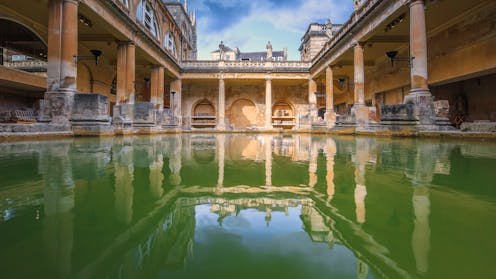
Baths were popular in every city and town across the Roman Empire. A famous example is Aquae Sulis – the modern town of Bath – in England (which was under Roman rule for hundreds of years). At Aquae Sulis, a natural hot spring fed the baths. The goddess Minerva was honoured at the complex.
The remains of similar bath complexes have been found in North Africa, Spain and Germany.
Extensive remains of a Roman bath at Baden Baden in Germany are among the most impressive.
Similarly, at Toledo in Spain, a public Roman bath complex measuring almost an acre has been found.
Baths were often built in military camps to provide soldiers with comforts during their service. Remains of military baths have been found all over the empire. Researchers have found and excavated the baths for the army camp at Hadrian’s wall, a wall built to help defend the Roman Empire’s northern frontier in what is now modern Britain.
The baths at Chester contain hot rooms (caldaria), cold rooms (frigidaria) and also a sweat room (sudatoria), which is similar to a sauna.
A long history
The Romans weren’t the first to use public baths. Their Greek forebears had them too. But the Romans took public bathing to a empire-wide level. It became a marker of Roman culture wherever they went.
Public bathing would continue in the empire’s Islamic period and became famously popular under the Ottomans, who ruled the empire between 1299 and 1922. Turkish hammams (baths) remain an important public institution to this day and they descend directly from the Romans. Istanbul still contains 60 functioning hammams.
Roman baths were not only technically ingenious and architecturally impressive, they connected people socially from all walks of life. As the gulls circle over the baths of Caracalla in Rome, their haunting cries connect us to that very world.
Authors: Peter Edwell, Associate Professor in Ancient History, Macquarie University

















