

The ancients also had to deal with a cost-of-living crisis. Here’s how they managed
- Written by Konstantine Panegyres, Lecturer in Classics and Ancient History, The University of Western Australia
Talk to anyone today, and they will probably have something to say about how expensive life has become. While the rate of inflation has slowed, prices for many goods and services are still much higher than pre-pandemic.
Cost-of-living crises are not new. They have occurred at various times and places throughout the millennia.
If we look at cost-of-living pressures in ancient Greek and Roman times and how people back then dealt with them, we can learn something about how to face our own issues.
‘The price of land has gone up’
The cost of living was a conversation topic in antiquity, especially the price of land and food.
The Roman writer Pliny the Younger (circa 61–113 CE) in one of his letters remarked to his friend about the rising cost of real estate:
Have you heard that the price of land has gone up, particularly in the neighbourhood of Rome? The reason for the sudden increase in price has given rise to a good deal of discussion.
The ancient Greek scholar Athenaeus, who lived in Naukratis, in Egypt, around 200 CE, wrote a long book called The Learned Banqueters, depicting a dinner party.
The characters at this dinner party often complain about the price of food and goods. For example, one character complains about the price of fish:
I don’t think I’ve ever seen fish more expensive. Poseidon, if you got 10% of what’s spent on them every day, you’d be far away the richest god there is!
People often said that fish was exorbitantly expensive and thought fish sellers were trying to rip them off.
In fact, the poet Antiphanes (circa 408–330 BCE) complained “there’s no group more abominable” than fish sellers and money lenders.
How to lower costs?
Ancient people were well aware that a cost-of-living crisis can cause political disturbances.
As the Roman poet Lucan (39–65 CE) wrote:
the causes of hatred and mainsprings of political popularity are determined by the price of food.
So, how did ancient leaders deal with this sort of problem?
One solution was for the ruler to cover the cost of inflation.
For example, the Athenian statesman Demosthenes (384–322 BCE) mentions a problem with the price of grain that was solved by boosting imports:
When grain earlier advanced in price and reached sixteen drachmae per medimnus, we imported more than ten thousand medimni of wheat, and measured it out at the normal price of five drachmae a medimnus.
Another solution was to put extreme regulations on the market.
For example, the Roman emperor Alexander Severus (ruled 222–235 CE) was once faced by a group of angry citizens.
They demanded a reduction in the price of beef and pork, which had become unaffordable.
Alexander Severus “did not proclaim a general reduction in prices”, says the anonymous biographer who recounts this anecdote. Instead, the emperor
ordered that no one should slaughter a sow or a suckling pig, a cow, or a calf. In two years or even in little more than one year, there was such an abundance of pork and beef that while a pound previously cost eight minutili, the price of both these meats was reduced to two and even one per pound.
The city is so expensive
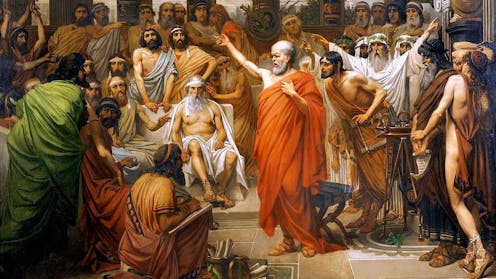
The Greek writer Plutarch of Chaeronea (46–119 CE) records a story about the famous philosopher Socrates (circa 470–399 BCE), who lived in Athens.
One day, according to Plutarch, a friend of Socrates complained to him about “how expensive the city was”:
Chian wine costs a mina, a purple robe three minae, a half-pint of honey five drachmas!
In response, Socrates took his friend by the hand and told him to search for bargains or for cheaper items, saying:
A sleeveless vest for ten drachmas! The city is cheap!
Socrates’ point was that even in expensive times it’s still possible to find bargains to save money. You just have to look harder for them and lower your standard of living. It can be difficult to do that, but it’s necessary.
Socrates also gave out employment advice for people who were struggling.
According to Socrates’ friend, the historian Xenophon of Athens (430–350 BCE), when a poor veteran came to Socrates complaining about lack of money and asking how to cope with expenses, Socrates told him to
take up some kind of work at once that will assure you a living when you get old.
Socrates thought making sure you still have money when you are old is more important than fully enjoying your current job. You will likely have to put up with things you don’t like to achieve security.
From ancient to modern
Most ancient people would probably have said that during a cost-of-living crisis it’s best to be patient, live simply, and wait for better times to come.
As Pliny the Younger (circa 61–113 CE) once wrote in one of his letters, “my income is small or precarious, but its deficiencies can be made up by simple living”.
If politicians cannot solve the problems, then it is up to us to cope with them as best as we can.
Authors: Konstantine Panegyres, Lecturer in Classics and Ancient History, The University of Western Australia



















.jpg)