

Remote cave discovery shows ancient voyagers brought rice across 2,300km of Pacific Ocean
- Written by Hsiao-chun Hung, Senior Research Fellow, School of Culture, History & Language, Australian National University
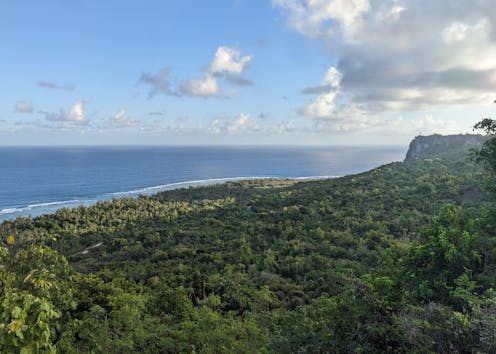
In a new study published today in Science Advances, my colleagues and I have uncovered the earliest evidence of rice in the Pacific Islands – at an ancient cave site on Guam in the Mariana Islands of western Micronesia.
The domesticated rice was transported by the first islanders, who sailed 2,300 kilometres of open ocean from the Philippines about 3,500 years ago.
The discovery settles long-standing academic debates and satisfies decades of curiosity about the origins and lifestyles of early Pacific peoples.
The case of the Marianas, located more than 2,000km east of the Philippines and northeast of Indonesia, is especially intriguing. These islands were the first places in Remote Oceania reached by anyone, in this case inhabited for the first time by Malayo-Polynesian-speaking populations from islands in Southeast Asia.
For nearly two decades, scholars debated the timing and the overseas source of these first islanders, the ancestors of today’s Chamorro people. How did they come to Guam and the Marianas?
Archaeological research has confirmed settlement in the Mariana Islands 3,500 years ago at several sites in Guam, Tinian and Saipan.
In 2020, the first ancient DNA analysis from Guam confirmed what archaeology and linguistics had suggested: the early settlers came from central or northern Philippines. Further ancestral links trace them back to Taiwan, the homeland of both their language and their genetics.
A well-planned journey with rice onboard
Was this epic voyage intentional or accidental? What food source allowed these early seafarers to survive?
Today, Pacific islanders rely mostly on breadfruit, banana, coconut, taro and yams. Rice, though a staple food in ancient and modern Asian societies, is challenging to grow in the Pacific due to environmental constraints, including soil type, rainfall and terrain.
Rice was originally domesticated in central China about 9,000 years ago and was spread by Neolithic farming communities as they migrated to new regions. One of the most remarkable of these expansions began in coastal southern China, moved to Taiwan, and spread through the islands of Southeast Asia into the Pacific.
The migration laid the foundations of the Austronesian world, which today comprises nearly 400 million individuals dispersed across an expansive area stretching from Taiwan to New Zealand, and from Madagascar to Easter Island.
For more than a decade, we searched for evidence of early rice in open archaeological sites across the Mariana Islands, but found nothing conclusive.
This study marks the first clear evidence of ancient rice in the Pacific Islands. It also confirms renowned American linguist Robert Blust’s hypothesis that the earliest Chamorros brought cultivated plants with them, including rice.

How we identified the rice
Our research took us to Ritidian Beach Cave in Guam. To confirm what we found in the cave were rice remains, we used phytolith analysis. Phytoliths are microscopic silica structures formed in plant cells that persist long after the plant has decayed.
Once our initial results confirmed the presence of rice, a more detailed analysis revealed we had found the traces of rice husks preserved on the surfaces of ancient earthenware pottery.
Next, we used detailed microscopic analysis to figure out whether these husks had been mixed into the clay to keep it from cracking when it dried (a tempering technique commonly used by ancient potters) or had arrived by other means. We also analysed the sediment to rule out that the husks were deposited at the site later than the pottery.
Our findings showed the rice husks were not used for manufacturing the pottery. Rather, they came from a separate, deliberate activity using the finished pottery bowls.

Ritual use in sacred caves?
The setting of the discovery – a beach cave – gives us another interpretive perspective.
In Chamorro traditions, caves are sacred places for important spiritual practices.
According to records of 1521 through 1602, the Chamorro people in the Marianas grew rice in limited amounts and consumed it only sparingly, reserved for special occasions and critical life events, such as the impending death of a loved one. Rice became more common after the intensive Spanish colonial period, after 1668.
In this context, the ancient islanders more likely used rice during ceremonial practices in or around caves, rather than as a staple food for daily cooking or agriculture.
 An archaeological dig near Ritidian Beach in Guam told us of a well-planned journey across the ocean.
Hsiao-chun Hung, Author provided (no reuse)
An archaeological dig near Ritidian Beach in Guam told us of a well-planned journey across the ocean.
Hsiao-chun Hung, Author provided (no reuse)
One of the greatest journeys in human history
This study provides strong evidence that the first long-distance ocean crossings into the Pacific were not accidental. People carefully planned the voyages. Early seafarers brought with them not only the tools of survival but also their symbolic and culturally meaningful plants, such as rice.
They were equipped, prepared and resolute, completing one of the most extraordinary voyages in the history of humanity.
Authors: Hsiao-chun Hung, Senior Research Fellow, School of Culture, History & Language, Australian National University

















