

Technology is transforming the face of modern warfare, but some things never change
- Written by Kevin Foster, Associate Professor, School of Languages, Literatures, Cultures and Linguistics, Monash University
Over the past decade or so, the weapons, channels and terrain of conflict have radically changed. Drones, autonomous weapons systems, algorithmic target selection, information offensives, cyberwar and anti-satellite weapons have become the swords, shields and battlefields of modern war, mesmerising the media and terrifying people around the world.
In Gaza, the Israel Defense Forces have deployed AI targeting systems. One, called “Lavender”, is used to identify Hamas operatives; another, “Where’s Daddy?” follows them to their homes where they can be attacked.
In Israel, the vaunted Iron Dome missile defence system has been punctured by Iranian missiles, some equipped with hypersonic glide vehicles that travel at five times the speed of sound and are capable of complex evasive manoeuvres.
In Ukraine, meanwhile, Operation Spider Web combined the new with the old in early June. Wooden cabins, transported deep into Russia on the backs of trucks, peeled back their remotely operated roofs to release more than 100 drones. Each sought out and destroyed its designated target, attacking Russian strategic bombers and military installations.
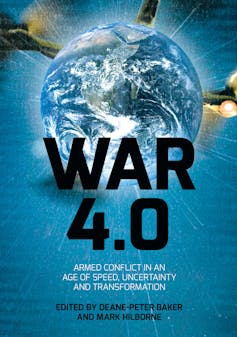
Review: War 4.0: Armed Conflict in an Age of Speed, Uncertainty and Transformation – edited by Deane-Peter Baker and Mark Hilborne (ANU Press)
Advances in digital technologies, nanotechnology, robotics, biotechnology and new materials constitute a so-called fourth industrial revolution. These innovations have produced a rapidly evolving conflict environment, which challenges militaries and the publics they serve to think deeply about the connections between the human and technological elements of war. They raise core questions about how, when, where and why we should fight.
To what degree will war remain a principally human endeavour? How best can we protect the physical and moral wellbeing of combatants, while defending innocent civilians from the worst that man and machine can impose? Is it safe, efficient or ethical to hand over critical decisions about life and death to AI systems? How can we harness the benefits and check the potential pitfalls of innovations whose scope, velocity and effects on existing systems seems to be without historical precedent?
These questions, and more, are examined in War 4.0. The book’s editors, Deane-Peter Baker and Mark Hilborne, are conscious of the velocity of change. The introduction notes that, since the essays were submitted, further innovations – highlighted in the Russia-Ukraine conflict, the war in Gaza, and the current Israel-Iran conflict – have already outpaced some of the conclusions reached by the contributors.
Despite this, the essays are valuable, insightful and packed with enough arresting detail to please the specialist and stagger the general reader. It is especially pleasing to see a volume of this kind with a certain focus on our own region. While most, though not all, of the innovations examined come from current and emerging superpowers, their applications and consequences will be universal.

Wars 1, 2, 3 and 4
But what is War 4.0? Suffice to say it is not yet an acknowledged phenomenon.
One aim of the book is to map out some of its core features and tease out the implications for future battlefields. In doing so, it seeks to define a new configuration of conflict. This is no small ambition, especially when there is ongoing dispute about the nature and scope of War 3.0.
War 1.0 refers to traditional, mechanised, state-on-state warfare. Such traditional fighting is “predominantly a military exercise”. It “focuses on enemy formations, aims to interrupt decision cycles, has short duration, progresses quickly, ends in clear victory, uses destructive methods […] and is run by top-down initiatives with a clear chain of command.”
World War II, the Korean War, the invasions and swift battlefield victories in the first and second Gulf Wars against Iraq in 1993 and 2003, and Afghanistan in 2002, were models of War 1.0. Greater force of arms, superior manoeuvrability and better intelligence were regarded as the keys to what, at the time, looked like decisive military triumphs.
In War 1.0, the media and the public are “a side problem, to be ignored. Information is protected, secret, and used primarily for internal purposes”. War 2.0, by contrast, is as much a political, social and cultural exercise as it is a military venture. While it is underpinned by brute force, its focus is on the population.
In War 2.0, the military contest for physical territory is a proxy for the war’s true centre of gravity: the struggle for the loyalty and trust of the public, both local and dispersed. The terrain to be conquered is human and cognitive, not geographical and inert. The media and the public thus “have the highest priority. Information is predominantly public, open-source, and intended for external consumption”.
The aim in War 2.0 is “to establish alternative decision cycles”; its initiatives “often come from the bottom up, with decentralized structures of authority”. As a result, “its duration is long, its progress slow, its end a diffuse success at best, its methods productive (such as nation-building)”.
In their efforts to win trust in Iraq and Afghanistan through counter insurgency strategies and operations, the US and its allies increasingly used military power to advance the strategies and tactics of War 2.0.
There is ongoing debate about the nature and location of War 3.0, but some of its terms are familiar. It is a form of hybrid warfare, combining traditional and irregular tactics, mixing the kinetic with the subversive.
This can involve targeted assaults on individuals, power and communications infrastructure, cyberattacks, the planting of computer malware, programs of disinformation, electoral interference and regime change. These assaults are often undertaken by non-state proxies, trolls, hackers and militias.
This results in actions that occur in the “grey zone” between war and peace, and so generally fall below the threshold of conventional acts of war. The duration of War 3.0 is medium or long term. Its tactics are attritional. The attacks on gas and communications pipelines in the Baltic Sea, carried out over the past decade, usually by unspecified actors, are a textbook example of hybrid warfare.
The important point to grasp is that none of these approaches to warfare is a replacement for or exclusive of the others. It is not that one abandons the tools and tactics of War 1.0 for later iterations.
As current events in Ukraine, Gaza and Iran make clear, the traditional aim of warfare – to compel the enemy to bend to his adversary’s will – has not changed. Where information offensives, cyberattacks, infrastructure assaults and selective assassinations prove unpersuasive, bullets, bombs, boots on the ground and the promise of worse will likely be called upon to carry the argument.

The space war
It is not only the tools and tactics of war that have changed; its terrain has also broadened.
In February 1993, little more than a year after the dissolution of the Soviet Union, Bill Clinton’s nominee as Director of the CIA, James Woolsey, told a congressional committee that, while the US had “slain a large dragon”, this did not mean it was more secure. “We now live in a jungle filled with a bewildering variety of poisonous snakes,” he said. If anything, the nation’s security position was more perilous, because “the dragon was easier to keep track of”.
War 4.0 considers how the technology of war has evolved to deal with the proliferation of threats (Woolsey’s “poisonous snakes”) in the multi-polar world that emerged after the Cold War. The US still dominates in terms of traditional militarily power. But its leadership is under threat in in a range of emerging technologies: autonomous weapons systems and the AI that underpins them, satellites and space weaponry, nanotechnology and new materials.
The threat is not only from traditional foes Russia and China, and emerging powers like India, but from the commercial sector, whose investment in research and development in many of these fields now far exceeds that of nation states.
These trends are particularly prominent in space. We now depend on satellites for many of the technologies we carry in our mobile phones or wear on our wrists. Space is an increasingly contested, congested and competitive domain. It is essential to modern communications systems, time synchronisation, precision location and navigation, as well as more advanced systems of surveillance, intelligence gathering and targeting.
The power that dominates space controls access to the critical technologies needed to operate in the remaining domains of conflict: land, sea, air and information. Knock out the enemy’s satellite communications and he is blind, deaf, dumb and all but defenceless.
Yet in the West, most research and development in this domain is carried out by the commercial sector, which is now responsible for approximately 80% of the space economy by value. As of 2023, around 60% of the US satellites in orbit were commercial. Elon Musk’s company SpaceX has made more than 40,000 launch requests, more than 12,000 of which have been approved.
The extent to which the nation state can exercise effective control over these assets to deny their use by foreign powers has yet to be tested.
Meanwhile, China has identified space as a strategic domain of critical significance. It is at the forefront of strategy, doctrine and investment in space warfare capabilities, in pursuit of its avowed aim of space dominance.
Commercial satellite imagery is another contested area. French and US companies can supply affordable, real-time imagery at extraordinarily high resolutions, down to 30 centimetres. With ever more probing eyes in the sky, it is increasingly difficult for governments to conceal assets or disguise troop movements without taking offensive action to blind the prying lenses.
Nor is it possible for powers to effectively defend their orbital capability. China and India have both recently tested anti-satellite weapons, demonstrating the vulnerability of these assets.
Ironically, greater power in space translates into greater vulnerability: the more satellites one has and the more one’s forces rely on them, the more vulnerable one is to the predations of a hostile power.
 Chinese astronauts Gui Haichao, Zhu Yangzhu, and Jing Haipeng before their flight to the Tiangong space station, Jiuquan, Gansu province, China, May 30, 2023.
Alex Plavevski/AAP
Chinese astronauts Gui Haichao, Zhu Yangzhu, and Jing Haipeng before their flight to the Tiangong space station, Jiuquan, Gansu province, China, May 30, 2023.
Alex Plavevski/AAP
The age of the drone
Closer to earth, military endeavours to develop weapons that can be deployed from ever greater distance, with improved accuracy and greater destructive power, have brought us into the age of the drone.
The war in Afghanistan saw a dramatic rise in drone strikes launched from high-altitude, unmanned, remotely piloted aerial vehicles. Low-tech commercial drones have played an increasingly dominant role in the war in Ukraine. They were vital in Azerbaijan’s recent military victory over Armenia.
Paradoxically, the drone, with its high-resolution camera, has radically shrunk the distance between the operator and his victim, which over the preceding decades had grown out to sometimes hundreds of kilometres. It has given remote operators intimate insights into the destructive effects of the strikes on their victims, survivors and families.
The “cognitive combat intimacy” this affords, the psychological wounds it inflicts, and the potential for moral injury it brings, have raised ethical questions about the state’s duty of care to its warriors. This, in turn, has led to thornier questions about the moral defensibility of replacing human decision-making at the pointy end of the kill chain with programmed or algorithmic determinations made by a machine.
 There is no doubt changes are occurring at a dizzying pace. But it is greatly to the credit of the editors that one chapter in this book, on Just War, provides salutary reminders that the more things change on the battlefield the more they remain the same.
Every generation has struggled to gain the upper hand by designing weapons that better protect the warrior through the armour of distance – weapons that more precisely target the enemy, while inflicting greater damage. The pace of change today might seem faster, but our ancestors were no less disconcerted by the changes they faced, which no doubt seemed to be occurring at breakneck pace in ages when life moved at a slower pace.
The moral problems war raises reside less in the new weapons than in how they are employed. War has always harmed the innocent and always will. While this is much to be regretted, militaries and the states they serve cannot allow this awareness to paralyse them. To say that all war is wrong is to allow manifest evil to proceed uninhibited.
The parameters of the battlefield may have broadened from the brutal scrum of the medieval melee, through the ranks and files of Austerlitz and Waterloo, to the streets of blitzed cities, and beyond to the electromagnetic conflict zones of the modern age. But as the contributors to this valuable book persuasively demonstrate, we must still be prepared to contest them in defence of the values and principles that we hold most dear.
Authors: Kevin Foster, Associate Professor, School of Languages, Literatures, Cultures and Linguistics, Monash University
There is no doubt changes are occurring at a dizzying pace. But it is greatly to the credit of the editors that one chapter in this book, on Just War, provides salutary reminders that the more things change on the battlefield the more they remain the same.
Every generation has struggled to gain the upper hand by designing weapons that better protect the warrior through the armour of distance – weapons that more precisely target the enemy, while inflicting greater damage. The pace of change today might seem faster, but our ancestors were no less disconcerted by the changes they faced, which no doubt seemed to be occurring at breakneck pace in ages when life moved at a slower pace.
The moral problems war raises reside less in the new weapons than in how they are employed. War has always harmed the innocent and always will. While this is much to be regretted, militaries and the states they serve cannot allow this awareness to paralyse them. To say that all war is wrong is to allow manifest evil to proceed uninhibited.
The parameters of the battlefield may have broadened from the brutal scrum of the medieval melee, through the ranks and files of Austerlitz and Waterloo, to the streets of blitzed cities, and beyond to the electromagnetic conflict zones of the modern age. But as the contributors to this valuable book persuasively demonstrate, we must still be prepared to contest them in defence of the values and principles that we hold most dear.
Authors: Kevin Foster, Associate Professor, School of Languages, Literatures, Cultures and Linguistics, Monash University 
















