

Magpies may not be a pesky Australian import – new research finds their ancestors thrived in NZ a long time ago
- Written by Vanesa De Pietri, Senior Research Fellow in Palaeontology, University of Canterbury
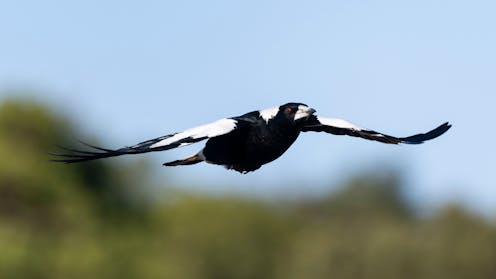
For many New Zealanders, the Australian magpie is a familiar, if sometimes vexing, sight. Introduced from Australia in the 1860s, magpies are known for their territorial dive-bombing during nesting season, which has cemented their reputation as an unwelcome import.
But our new research reveals a fascinating twist in this narrative.
For more than two decades, we have been unearthing fossils from sites near St Bathans in Central Otago. These sites, once at the bottom of a large prehistoric lake, offer the only significant insight into Aotearoa New Zealand’s land vertebrates from about 16 to 19 million years ago.
This unique window into the past has recently revealed fossils belonging to an ancient relative of the Australian magpie. This discovery suggests magpies have a much deeper connection to Aotearoa than previously thought, challenging common perceptions about their “Aussie immigrant” status.
Together with fossils of other songbirds from St Bathans, these discoveries reshape our understanding of what it means for a species to be “native”. They paint a picture of a dynamic, ever-changing land, rather than a static pre-human ecosystem.
An ancient relative
We named the species we describe in our research the St Bathans currawong (Miostrepera canora). It lived in New Zealand about 19 to 16 million years ago during the Early Miocene.
This bird, roughly the same size as today’s Australian magpie, was a cracticine – a group of songbirds that includes modern currawongs, magpies and butcherbirds. Its discovery challenges the very notion of what is “native” or “introduced” on a geological timescale.
We often regard magpies as an undesirable Australian species that lacks a place in the New Zealand ecosystem. However, its close relatives did live here in the past, and likely did so until a cooling climate limited their habitat near the end of the Miocene, about five million years ago.
The presence of this ancient magpie ancestor strongly suggests an over-water dispersal event from Australia to Zealandia early in the evolution of the magpie-currawong group.
We propose this colonisation was likely helped by a diverse subtropical or warm-temperate flora then present in New Zealand. This vegetation created a hospitable environment for species arriving from across the Tasman.
Currawongs eat a wide variety of fruits, insects and small animals. New Zealand’s Miocene flora included many fruit-bearing trees, of which puriri and taraire are two survivors, and offered abundant food.
New Zealand’s ever-shifting ecosystems
Our research at the St Bathans fossil sites reveals a past far from a static, unchanging paradise prior to human arrival.
We know from numerous pollen studies that New Zealand’s forests were changing continuously for millions of years. This continual reworking of the composition and distribution of forests challenges the common conservation aim to return New Zealand to a pre-human ecological state.
Indeed, during the Miocene, New Zealand’s forests would have been unrecognisable to modern eyes. They boasted numerous eucalypts, laurels and casuarinas – plants more typical of Australian forests in Queensland today. This rich floral diversity supported a broader range of fauna, including the newly described currawong, illustrating how different ancient Aotearoa was.
A symphony of ancient songbirds
Further research by our team on other fossil songbirds (of the bird order passeriformes) from St Bathans paints an even richer picture of ancient avian life.
Our analysis of the diversity of tiny leg bones indicates the Early Miocene New Zealand bush had significantly more kinds of songbirds than it did just before human arrival.
Our studies demonstrate the presence of potentially up to 17 different songbirds in the Early Miocene fauna. This ancient choir included species varying in size from a large honeyeater (of the bird family Meliphagidae), which was bigger than today’s tūī, to a tiny New Zealand wren. Several different families are also represented.
These findings suggest Zealandia had a far greater diversity of songbirds during the Early Miocene than in the Holocene (past 11,000 years).
The legacy of Miocene climate cooling
Why did these diverse ancient songbirds, including the St Bathans currawong, disappear?
Research points to a dramatic global climate shift. Starting around 13 million years ago, during the later part of the Middle Miocene, New Zealand experienced a period of rapid cooling. This profound climatic change triggered a drastic loss in floral diversity throughout the Middle and Late Miocene.
Many plants that thrived in warmer climates went extinct. This loss of plant life had devastating cascading effects on birds. The disappearance of numerous fruiting trees meant the decline and eventual local extinction of birds such as currawongs and certain pigeons that relied on these food sources.
Lower habitat complexity and fewer kinds of food led to a significant decrease in the number of songbird species.
The story of the St Bathans currawong and the rich songbird diversity of ancient New Zealand serves as a powerful reminder that ecosystems are not static. They are constantly evolving, shaped by climatic shifts, geological events and dispersal across the ocean.
Understanding this deep history allows us to view concepts such as “native” and “introduced” with more nuance. We then appreciate that the biodiversity we have today is but one snapshot in a long, dynamic and ever-unfolding story.
Change is to be expected and ongoing, as seen in the newest of New Zealand’s native birds – the barn owl and Australian wood duck – which self-introduced in the past decade.
Authors: Vanesa De Pietri, Senior Research Fellow in Palaeontology, University of Canterbury

















