

1 in 3 Tuvaluans is bidding for a new ‘climate visa’ to Australia – here’s why everyone may ultimately end up applying
- Written by Jane McAdam, Scientia Professor and ARC Laureate Fellow, Kaldor Centre for International Refugee Law, UNSW Sydney
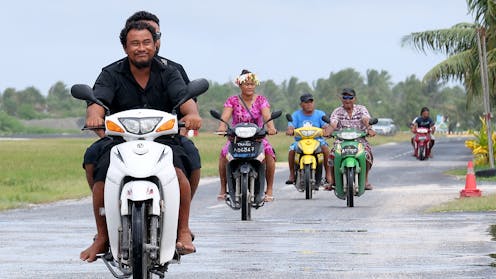
In just four days, one-third of the population of Tuvalu entered a ballot for a new permanent visa to Australia.
This world-first visa will enable up to 280 Tuvaluans to move permanently to Australia each year, from a current population of about 10,000. The visa is open to anyone who wants to work, study or live in Australia. Unlike other visa schemes for Pacific peoples, a job offer in Australia is not required.
While the visa itself doesn’t mention climate change, the treaty that created it is framed in the context of the “existential threat posed by climate change”. That’s why when it was announced, I described it as the world’s first bilateral agreement on climate mobility.
The Australian government, too, has called it “the first agreement of its kind anywhere in the world, providing a pathway for mobility with dignity as climate impacts worsen”.
The high number of ballot applications may come as a surprise to many, especially given there were multiple concerns within Tuvalu when the treaty was first announced. Even so, some analysts predicted all Tuvaluans would apply eventually, to keep their options open.

Grabbing the chance
The visa highlights the importance of creating opportunities for people to move in the context of climate change and disasters. The dangers of rising sea levels are clearly apparent, including coastal flooding, storm damage and water supplies. But there is a lot more at play here.
For many, especially young families, this will be seen as a chance for education and skills training in Australia. Giving people choices about if, when and where they move is empowering and enables them to make informed decisions about their own lives.
For the government of Tuvalu, the new visa is also about shoring up the economy. Migration is now a structural component of many Pacific countries’ economies.
The money migrants send back to their home countries to support their families and communities is known as remittances. In 2023, remittances comprised 28% of GDP in Samoa and nearly 42% of GDP in Tonga – the highest in the world. Currently, Tuvalu sits at 3.2%.

A long time coming
Well before climate change became an issue of concern, Tuvalu had been lobbying Australia for special visa pathways. Demographic pressures, combined with limited livelihood and educational opportunities, made it a live policy issue throughout the 1980s and ‘90s. In 1984, a review of Australia’s foreign aid program suggested improved migration opportunities for Tuvaluans may be the most useful form of assistance.
By the early 2000s, the focus had shifted to the existential threats posed by climate change. In 2006, as then-shadow environment minister, Anthony Albanese released a policy discussion paper called Our Drowning Neighbours. It proposed that Australia create Pacific migration pathways as part of a neighbourly response. In 2009, a spokesperson for Penny Wong, then minister for climate change, stated permanent migration might eventually be the only option for some Pacific peoples.
When combined with other Pacific pathways to Australia and New Zealand, nearly 4% of the population could migrate each year. This is “an extraordinarily high level”, according to one expert. Within a decade, close to 40% of the population could have moved – although some people may return home or go backwards and forwards.
 Australian Prime Minister Anthony Albanese and Prime Minister of Tuvalu Feleti Teo signed the Australia-Tuvalu Falepili Union into force on August 28, 2024.
AAP Image/Lukas Coch
Australian Prime Minister Anthony Albanese and Prime Minister of Tuvalu Feleti Teo signed the Australia-Tuvalu Falepili Union into force on August 28, 2024.
AAP Image/Lukas Coch
How will the new arrivals be received?
The real test of the new visa’s success will be how people are treated when they arrive in Australia.
Will they be helped to adjust to life here, or will they feel isolated and shut out? Will they be able to find work and training, or will they find themselves in insecure and uncertain circumstances? Will they feel a loss of cultural connection, or will they be able to maintain cultural traditions within the growing Tuvaluan diaspora?
Ensuring sound and culturally appropriate settlement services are in place will be crucial. These would ideally be co-developed with members of the Tuvaluan community, to “centralise Tuvaluan culture and values, in order to ensure ongoing dialogue and trust”.
It has been suggested by experts that a “liaison officer with Tuvaluan cultural expertise and language skills could assist in facilitating activities such as post-arrival programs”, for instance.
Learning from experience
There are also many important lessons to be learned from the migration of Tuvaluans to New Zealand, to reduce the risk of newcomers experiencing economic and social hardship.
Ongoing monitoring and refinement of the scheme will also be key. It should involve the Tuvaluan diaspora, communities back in Tuvalu, service providers in Australia, as well as federal, state/territory and local governments.
By freeing up resources and alleviating stress on what is already a fragile atoll environment, migration may enable some people to remain in Tuvalu for longer, supported by remittances and extended family networks abroad.
As some experts have suggested, money sent home from overseas could be used to make families less vulnerable to climate change. It might help them buy rainwater tanks or small boats, or improve internet and other communications. Remittances are also beneficial when they are invested in services that lift the level of education of children or boost social capital.
Australia is offering ‘climate visas’ to 280 residents of Tuvalu (10 News First)Delaying a mass exodus
It is difficult to know when a tipping point might be reached. For instance, some have warned that if too few people remain in Tuvalu, this could constrain development by limiting the availability of labour and skills. A former president of Kiribati, Teburoro Tito, once told me migration was “a double-edged sword”. While it could help people secure employment overseas and remit money, “the local economy, the local setup, also has to have enough skilled people” – otherwise it’s counterproductive.
With visas capped at 280 a year – and scope to adjust the numbers if concerns arise – we are still a long way from that point. Right now, the new visa provides a safety net to ensure people have choices about how they respond to climate change. With the visa ballot open until July 18, many more people may yet apply.
Authors: Jane McAdam, Scientia Professor and ARC Laureate Fellow, Kaldor Centre for International Refugee Law, UNSW Sydney

















